Visa
About All Saints University Lango
Origins and educational purpose
All Saints University Lango is a private university associated with the Church of Uganda in the Lira area of northern Uganda. Its institutional history separates the early idea for a university from its eventual establishment. The proposal was first conceived in 1963, reviewed in 1968, and reconsidered by the Synod of Lango Diocese in 2004. Establishment followed in 2008, with the first student cohort admitted in the 2009–10 academic year. The university explains its origins in relation to the educational and social challenges facing Lango and the wider northern region after prolonged conflict. Its stated purpose includes developing skilled people, supporting community empowerment and widening educational opportunity. The motto, “Enlightenment with Godliness,” reflects its religious foundation, while its published core values emphasise professionalism, transparency, ethics and integrity.
Sources: About ASUL: history and purpose ↗
Academic breadth
ASUL’s Academic Affairs page identifies three faculties: Education, Business Administration and Management, and Social Science. The published programme list spans certificate, diploma, bachelor’s and master’s study. Business provision includes business administration, entrepreneurship and small-business management, together with an MBA. Social-science subjects include social work and social administration, project planning and management, and public administration. Education programmes address primary and secondary teaching and arts with education. The same institutional list includes information technology, medical records and health informatics, agriculture and environmental management, journalism and communication, and theology. These fields give ASUL a broader academic identity than a single professional school. They connect the university’s regional educational purpose with several areas of work and public life, including schools, organisations, communication, administration and agriculture. The Academic Affairs account also identifies an ICT unit serving the campus and a university library supporting its faculties.
Library collections and development
The university library’s account describes materials selected to support teaching, learning and research. It divides its content into reference, reserve and open collections, distinguishing different ways in which readers can use academic resources. The page also outlines a development project associated with a move to a roomier facility at the Canon Lawrence campus. Its proposed digital wing would introduce internet-connected desktop computers and expand their number over successive semesters. That proposal is presented as a development plan rather than a verified inventory of currently installed computers. The account’s underlying emphasis is on extending access to information, including the possibility of students and staff consulting library content through their own phones. Printed collections and planned digital access therefore appear together in the library’s description.
Orientation and the first weeks
New-student orientation is described as a week-long programme arranged by the office of the Dean of Student. It begins with a reception in the assembly hall, presided over by the vice-chancellor and attended by teaching staff and key administrative officers. The Student Guild then helps guide newcomers around the campus. The published itinerary includes the library, ICT unit, games and recreation facilities, and university health service. Each stop includes explanations and opportunities for questions. This introduction connects new students with both academic resources and the services used in daily university life, while giving the student organisation an active role in welcoming the incoming group.
Sources: New-student orientation ↗
Student welfare and digital skills
The Office of the Dean of Student is responsible for welfare matters, including healthcare, accommodation and feeding. The university’s account places guidance and counselling within these responsibilities and identifies the chaplain as an important source of such support. The dean helps direct students to appropriate guidance rather than treating counselling as a single uniform service. The same account explains a university-wide approach to basic digital skills: first-year students take a two-credit course in computer applications. The ICT unit also provides training where teaching or key administrative staff need support with information and communication technologies. These arrangements connect student welfare with the practical skills required to participate in academic work. They also show that the ICT unit’s role extends beyond students specialising in information technology to the wider university community.
Sources: Student Affairs and ICT skills ↗
Journalism beyond the classroom
A student-authored field-trip report published in 2026 provides a concrete example of learning outside ASUL. Journalism students travelled with their department head to Livingstone International University in Mbale, with the stated purposes of meeting fellow media students, interacting with professionals and lecturers, and gaining practical media-production experience. The report describes discussions with university staff and students about journalism, professionalism and new technologies, including artificial intelligence. A session in the host institution’s television studio involved using cameras and participating in television presentations. The writer explicitly distinguished those host facilities from ASUL’s own resources, explaining that comparable facilities were not yet available at home. The report therefore documents an educational visit and exchange of experience. It also shows how students can encounter different teaching environments while considering the resources and future development of their own programme.
Campus setting and community
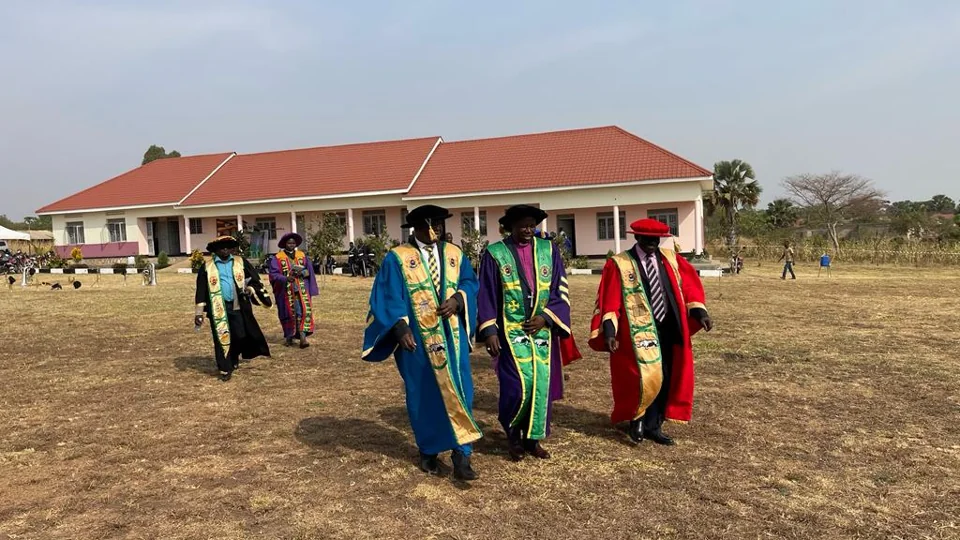
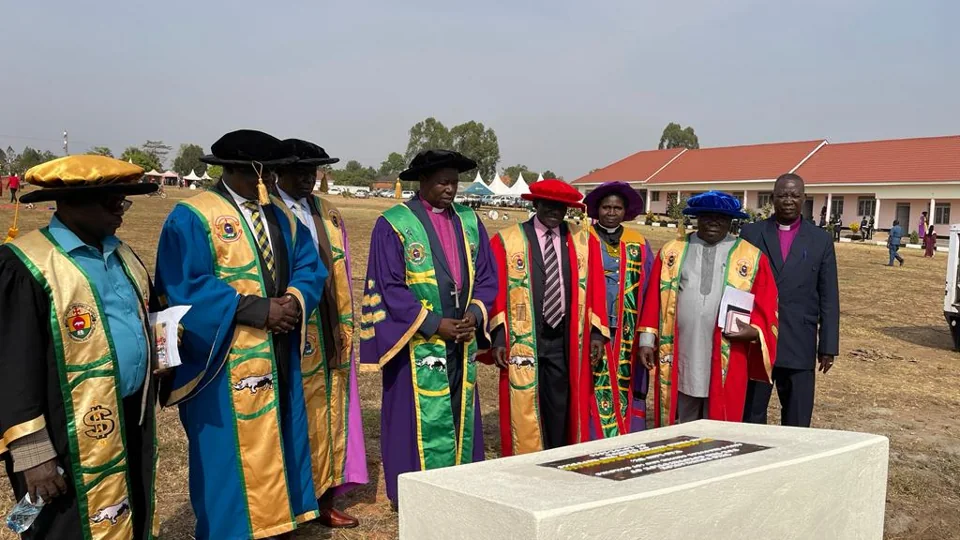
The university’s homepage describes its move to the Canon Lawrence campus near Lira City. An accompanying campus account evokes the Boroboro setting through classroom blocks, trees, hedges and a central games field. This description places the university in a landscape used for both study and recreation. Its official photograph gallery adds another view of institutional life through graduation photographs, including academic processions and participants gathered outdoors. These accounts and images connect the university’s educational mission with the physical setting and ceremonies through which its community comes together.
Sources: ASUL campus account and institutional overview ↗ · Official graduation photograph gallery ↗