Visa
About Akrokerri College of Education
Teacher education in Adansi Akrokerri
Akrokerri College of Education is a teacher-education college in Adansi Akrokerri, in the Adansi North District of Ghana’s Ashanti Region. Its institutional history dates its establishment to 26 October 1962, when it was created to accommodate candidates who could not obtain places in existing teacher-training colleges. The college’s present educational focus includes Bachelor of Education programmes in primary and junior-high-school education.
Its earlier provision changed with the needs of Ghana’s teacher-training system. A four-year Teachers’ Certificate A programme began in 1962; later provision included post-secondary training and specialist courses. An English specialist course introduced in 1964 was transferred to Winneba in 1966. A mathematics and science specialist course operated for three years from 1973. The three-year Diploma in Basic Education subsequently replaced certificate provision, before the college’s development as a tertiary institution.
The college’s stated mission combines academic proficiency and professional competence with teaching, research and community service. Its motto, Non Scholae Sed Vitae, expresses learning for life. The values published with its institutional profile include discipline, respect, industry, cleanliness and inclusivity. The crest combines a sunrise, sea and an open book, representing the college’s beginnings, its early educational environment and the openness of its mission.
Sources: College History and Profile ↗ · GTEC Public Colleges of Education Register ↗
An educational and residential community
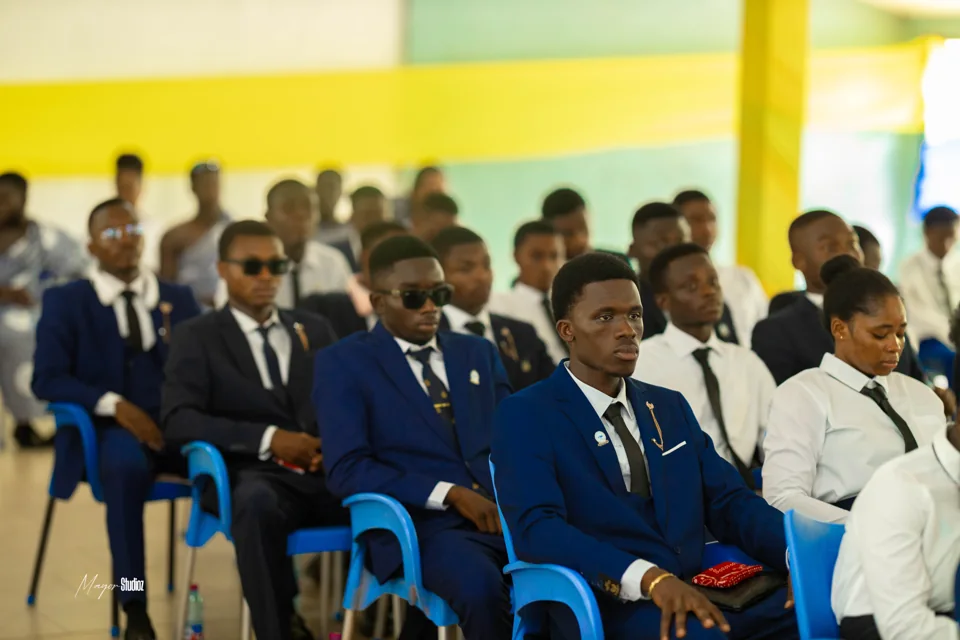
The current college website presents teacher preparation as a combination of academic learning, practical school experience, leadership and service. Its campus-life material includes library reading spaces and learning facilities, while the news section identifies events such as matriculation, a principal’s investiture and the commissioning of accommodation for female students.
The college’s online organisation also provides student and staff portals and identifies student affairs, guidance and counselling, and Supported Teaching in Schools among its services. These elements place academic preparation within a wider college community, with spaces for study, residential life and institutional occasions marking students’ entry into professional teacher education.
Sources: College Community and Campus Life ↗
Governance and representation
The Governing Council provides strategic leadership, policy direction and oversight. The membership published as constituted in 2025 includes presidential nominees, the principal and representation from Ghana’s tertiary-education, education-service and teacher-regulation bodies. Academic and non-teaching staff, the affiliate university, alumni and the Students’ Representative Council also have representation.
Professor Abdulai Salifu Asoro is listed as council chair. This composition brings internal college constituencies together with external educational and public representation. Students and staff therefore appear within the formal governance structure, alongside members concerned with the wider direction of teacher education. The council’s remit concerns institutional policy and oversight, complementing the management team’s responsibility for academic and operational administration.
Sources: Governing Council ↗

Academic and operational management
The college management page lists the principal and vice-principal alongside the registrar, internal auditor, finance officer, college librarian and dean of students’ affairs. Professor Dacosta Aboagye is identified as principal. The team’s stated responsibilities encompass academic standards, the administration of college activities and support for staff and students.
The presence of library, finance, registration, auditing and student-affairs leadership within this structure reflects the different services required by a residential teacher-education institution. Management is described as a collaborative body responsible for the college’s academic and operational work, linking its educational purpose with the organisation of day-to-day institutional activity.
Sources: College Management ↗
Teaching, supervision and professional learning
A 2026 lecturer-recruitment notice provides a concrete account of academic work at the college. It identifies teaching assigned B.Ed courses, preparing course outlines and learning materials, setting assignments and examinations, and supporting the professional preparation of teacher trainees. Supervision includes student projects, action research, Supported Teaching in Schools and field-based learning.
The notice also places research, publication, mentoring, committee work and community service within lecturers’ responsibilities. Its advertised subject areas were physics and agricultural science, with both advanced subject knowledge and a professional teaching qualification specified. These responsibilities show how teacher educators’ work connects subject teaching with supervised practice and scholarly activity, rather than ending at the delivery of lectures.
Scholarship on the work of teacher educators
Published research provides examples of college-affiliated scholarship. A 2017 article by Phyllis Agyeman Nyarko, identified with Akrokerri College of Education, examined management support for tutors in public colleges of education in the Ashanti Region. The study considered orientation, appraisal, in-service development and incentives, using questionnaires to investigate professional support. It reported the existence of orientation and appraisal arrangements and considered in-service programmes useful for improving tutors’ skills, with study leave identified as a preferred incentive.
Its conclusions included the value of induction for newly appointed tutors and ongoing performance appraisal. The article places the working environment of teacher educators within an educational-research discussion, connecting institutional support with the conditions in which teaching staff perform their responsibilities.
Sources: Tutor Management Support Research ↗
Research across culture and the arts
Another article, published online in 2025 in the Journal of African Arts and Culture, lists John Kofi Brewu with an Akrokerri affiliation among its authors. It examines varied musical styles in Methodist Church worship in Ghana, including hymns, canticles, danceable tunes and locally rooted forms of singing.
The researchers used interviews with people involved in church music and worship to investigate how these musical practices relate to congregants’ attitudes. This example extends the college-affiliated publication record beyond education management into music and cultural study, illustrating the variety of scholarly interests represented by its authors.
Sources: Music and Cultural Research ↗