Visa
About Accra College of Education
Teacher education in East Legon
Accra College of Education is a teacher education institution in East Legon, Accra, Ghana. The college’s principal’s report and student handbook record its establishment in November 1962 at Accra New Town as a government teacher training college, with nineteen students in the first intake. It moved to the present East Legon site in January 1985 and acquired full residential status in October 2001.
The college’s educational offer developed through several generations of teacher preparation, including four-year post-middle and two-year post-secondary Certificate A routes, modular provision for pupil teachers, a three-year post-secondary certificate and the Diploma in Basic Education. Its later provision includes four-year Bachelor of Education pathways. The principal’s report records a change of affiliation from the University of Cape Coast to the University of Ghana, Legon, in 2018. These developments place the current college within Ghana’s changing structure of professional teacher education.
Sources: Principal’s report: institutional history ↗ · Student handbook ↗
Mission and professional formation
The college’s mission is to prepare competent professional teachers for pre-tertiary schools through teaching and learning, research and the use of modern technologies. Its published core values are academic excellence, professionalism, innovation and creativity, integrity and teamwork. These priorities connect subject knowledge with the responsibilities of working in schools and with other educators.
The departmental descriptions show how different academic subjects contribute to that purpose. Science teaching builds on knowledge acquired through integrated science at secondary level and develops methods for teaching science in basic education. Mathematics and ICT brings together mathematics, mathematics teaching methods and computer education. Social science subjects include social studies, religious and moral education, music and dance, and HIV/AIDS education.
Education Studies organises on-campus teaching practice and school attachment, during which trainees gain practical teaching experience in schools within surrounding communities. Vocational and home economics-related study includes creative arts, sewing, catering and material-based practices such as textiles, pottery, ceramics, leatherwork, graphic design and picture making. The emphasis is on acquiring both subject understanding and appropriate ways of teaching it.
Sources: Vision, mission and values ↗ · Academic departments ↗
The college library
The Sir John Rodger Library was commissioned on 12 November 2012. It supports teaching, research, individual study and the college’s outreach activities. The library describes a continuing process of improving its services, including work towards automation beginning in 2017.
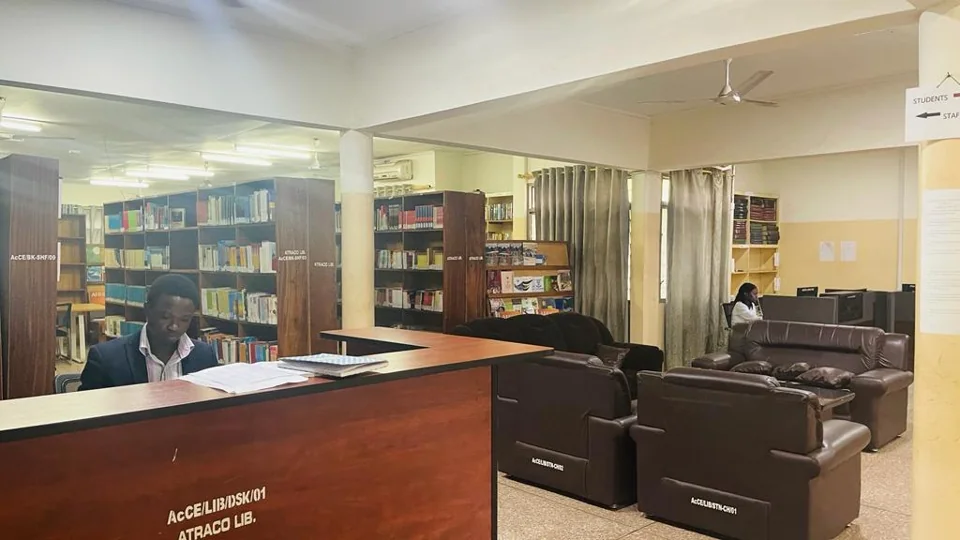
Its collections combine printed and non-print resources. Printed materials include reference books, local and international journals, periodicals, newspapers and student project work or dissertations. Electronic resources, ebooks and audiovisual materials extend this collection. Reading, reference and discussion areas sit alongside an electronic library facility, allowing different forms of study to take place within the service.
Library services include circulation and reference assistance, interlibrary loans, information-literacy instruction, electronic-resource support and reprographic work. Behind those public services, the library identifies cataloguing and classification, collection development and maintenance, and bookbinding as distinct areas of activity. This combination supports the everyday use of learning materials as well as the organisation and preservation of the collection.
The library’s stated mission includes maintaining local and international collections and providing electronic information to support learning, research and outreach across the institution.
Sources: Sir John Rodger Library ↗
Residential life and learning facilities
The college’s campus facilities include lecture halls and classrooms, computer laboratories and science laboratories. Its facilities page also identifies student residences, with study rooms and common areas, and a dining hall. Together these form the setting for a residential teacher education experience, combining formal teaching spaces with places for study and daily life.
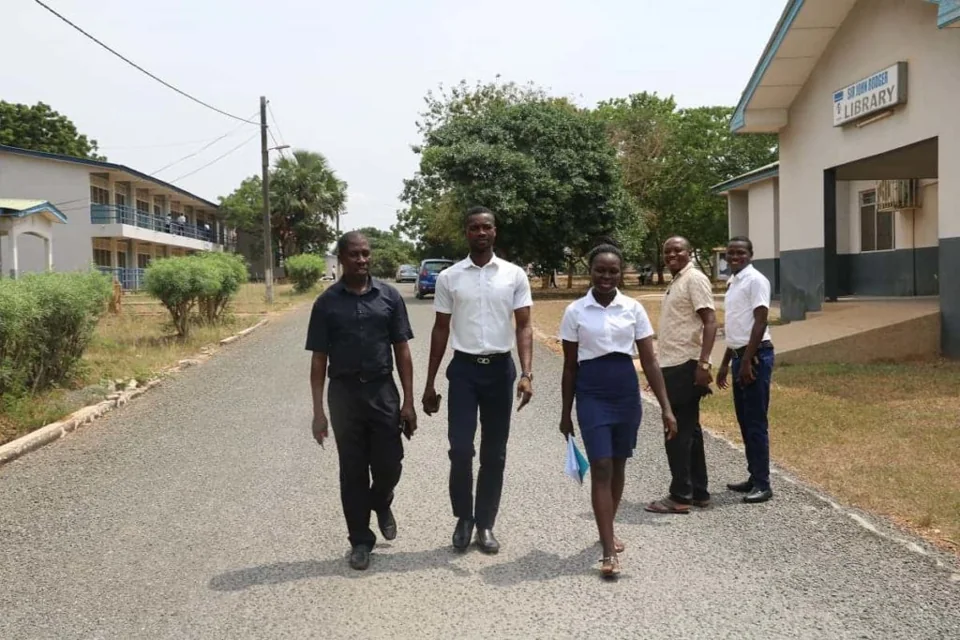
A sick bay and counselling services are included among the campus support facilities. The college also describes campus Wi-Fi access and electronic learning platforms that provide access to course materials and online learning. Student interaction, diversity and inclusion are presented as parts of campus life, alongside the resources needed for academic and personal development. The published campus photograph shows members of the college community beside the library and other teaching buildings.
Sources: Campus life and facilities ↗
Guidance, relationships and student support
The Guidance and Counselling Unit addresses personal, academic and career-related concerns. Its stated work includes helping students develop problem-solving skills, consider choices about courses and careers, and manage difficulties encountered during college life. It also provides guidance to staff.
The unit’s objectives extend to relationships within the college community. It seeks to encourage peaceful coexistence and constructive behaviour, and to bridge communication between students and the administration. Guidance is therefore presented both as individual support and as part of the wider educational environment in which future teachers learn to work with other people.
Sources: Guidance and counselling ↗
An international teacher education partnership
On 27 April 2026, the college hosted a Beijing Normal University delegation to formalise a memorandum of understanding concerning teacher education cooperation. The college’s report identifies the initiative as establishing a West African branch of the China-Africa Teacher Education Center at Accra College of Education.
The reported plans encompass professional exchange, research, capacity development and discussion of teacher education policy. Proposed activities include workshops, academic exchanges, collaborative research and engagement with emerging technologies, including artificial intelligence. The partnership is presented as a way to strengthen teacher preparation in Ghana and the wider West African region, extending the college’s work beyond its own campus through international educational cooperation.
Sources: China-Africa Teacher Education Center partnership, 2026 ↗