Visa
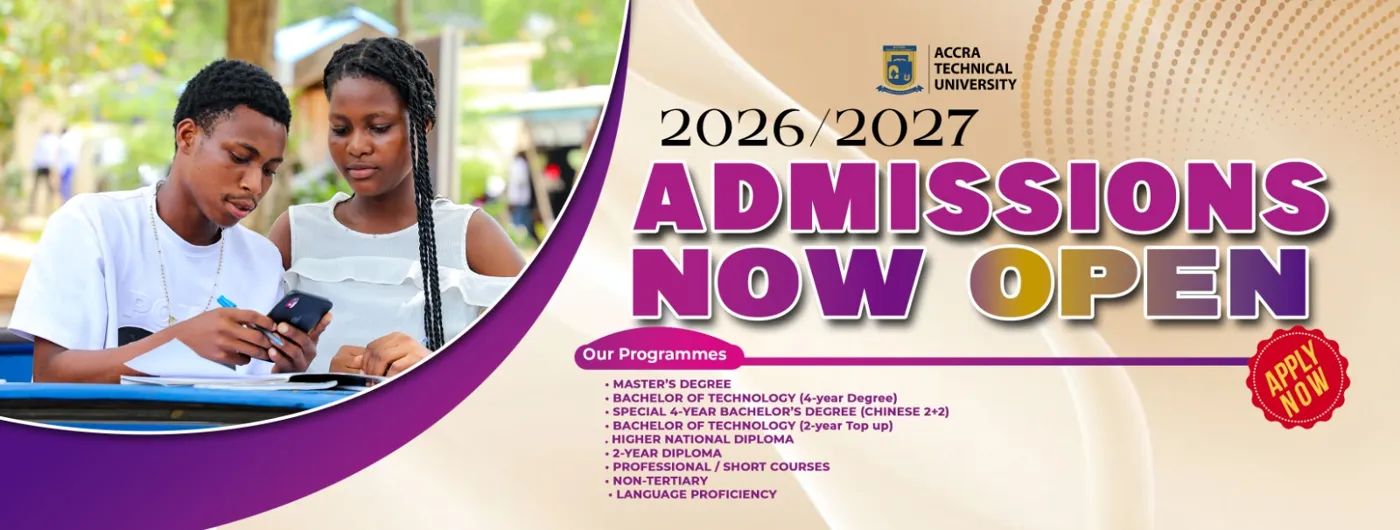
About Accra Technical University
From technical school to technical university
Accra Technical University developed from a technical school established in 1949. It was commissioned as Accra Technical Institute in 1957 and took the name Accra Polytechnic in 1963. The institutional history connects this development with Ghana’s industrialisation and the need for technical education that combines knowledge with practical capability.
The polytechnic gained tertiary recognition during the implementation of the 1992 polytechnic legislation in the 1993–1994 period. Its provision included Higher National Diplomas, while later legislation expanded the framework within which polytechnics could offer qualifications. The university’s timeline records the introduction of Bachelor of Technology programmes in 2007. The Technical University Act of 2016 converted Accra Polytechnic into Accra Technical University, marking another stage in the institution’s educational development.
The university’s current academic structure brings together engineering, the built environment, applied sciences, applied arts and business. This breadth retains the institution’s technical foundation while extending its teaching into scientific, creative and commercial fields.
Sources: University history ↗

An urban setting and an applied educational focus
The university is located in Accra’s central business district. Its official overview situates the campus close to the Trade Union Congress, the University of Ghana’s City Campus, the Ghana Assembly Press and several other public and commercial organisations. This places the institution within a busy urban environment, with educational activity taking place alongside the administrative and economic life of the capital.
The university describes its educational approach as hands-on and competency-based, particularly in engineering and industrial practice. Practical learning is linked with classroom teaching and research, with the stated intention of developing technical responses to problems encountered in industry and communities. Creativity is part of that approach: the university presents technical development as requiring the application of knowledge and the capacity to devise solutions, alongside familiarity with established methods and processes.
Sources: About the university ↗
Engineering and practical training
The Faculty of Engineering identifies mechanical, electrical and electronic, and civil engineering among its departmental areas. Its published offer includes Higher National Diploma programmes, Bachelor of Technology top-up study and other professional provision. Teaching introduces engineering principles while emphasising their practical application.
The faculty describes institutional collaboration as part of its training approach. Named partners include VAMK University of Applied Sciences in Finland, Ghana Ports and Harbours Authority and A-Tech Group Korea Incorporation. The faculty also identifies a practical training hub at Mpehuasem-Samsam for engineering exploration and training.
A drone technology centre established with A-Tech Group Korea is described as supporting drone assembly, programming and flight training. These examples show the faculty connecting conventional engineering disciplines with newer technical applications. Its account places laboratory work, applied research and technology transfer alongside teaching, rather than treating practical experience as a separate concern.
Sources: Faculty of Engineering ↗
Applied sciences and technology
The Faculty of Applied Sciences links scientific knowledge with useful applications and combines substantial practical work with theoretical understanding. Its listed subject areas include applied mathematics and statistics, science laboratory technology, computer science, medical laboratory technology, and information systems and technology.
The published programme portfolio includes four-year Bachelor of Technology routes, two-year top-up routes, Higher National Diplomas and non-tertiary training. Examples include medical laboratory science, medical imaging technology, statistics, computer science and science laboratory technology. Options within science laboratory technology include analytical chemistry, environmental technology and industrial biochemistry.
The medical imaging description illustrates the faculty’s technical emphasis through equipment calibration, troubleshooting, repair and maintenance. It also identifies communication, critical thinking, entrepreneurship, leadership and project management as parts of the educational approach. The faculty frames these subjects as complementary to scientific and technical knowledge, helping students understand the wider organisational setting in which technologies are used.
Sources: Faculty of Applied Sciences ↗
Applied arts and professional communication
The Faculty of Applied Arts covers fashion design and textiles, hotel catering and institutional management, and related communication study. Its overview emphasises practical preparation in hospitality, tourism, clothing and dressmaking. Mentorship involving industry practitioners is described as a means of helping students understand changes in these sectors.
The faculty’s programme information also includes a four-year Bachelor of Technology in Public Relations with Digital Communication. Its description combines academic and practical training in public relations with an emphasis on business creation and management. Students are introduced to communication in organisational settings alongside the broader possibility of applying creative and entrepreneurial knowledge. The range therefore brings design and hospitality into the same faculty context as professional communication, reflecting the university’s interest in applied work across different economic sectors.
Sources: Faculty of Applied Arts ↗
Library and research support
The university library provides several routes into academic information. ATUCat lists books and theses, while the institutional repository preserves and makes visible university research output, including theses, inaugural lectures and links to research articles. The library portal distinguishes access through the university network from off-campus access to subscribed resources.
Other services include a combined search across academic databases, electronic books, an article-request service and an Ask-a-Librarian enquiry route. Students and researchers can request help locating material that is not readily available through the subscribed or free databases. The library also advertises software installation support for reference-management tools such as Mendeley and EndNote. These services support the practical work of finding, organising and using scholarly information for study and research.
Sources: Library resources ↗