Visa
About AKPRIND University
From industrial academy to university
AKPRIND University is the English name used by Universitas AKPRIND Indonesia, a private institution in Yogyakarta. Its history begins on 12 May 1972 with Akademi Perindustrian Yogyakarta. The early academy offered industrial chemistry and industrial management, establishing an orientation towards production and industrial organisation. Industrial maintenance was added in 1978, and that field was divided into mechanical and electrical engineering in 1981. These changes preceded the institution’s later expansion into a science and technology institute.
The departmental history records the conversion of the former sarjana muda provision into Diploma III education in 1986. In 1989, AKPRIND became Institut Sains & Teknologi AKPRIND, with faculties covering industrial technology, mathematics and natural sciences, and mineral technology. The university therefore continues an institution with several earlier organisational forms, rather than representing an entirely new educational enterprise created in 2024.
Sources: Mechanical Technology departmental history ↗ · LLDIKTI: institute becomes Universitas AKPRIND Indonesia ↗
The 2024 institutional transition
The regional higher education service, LLDIKTI Region V, documented the handover of the university conversion decree on 21 March 2024. Ministerial decision 217/E/O/2024 authorised the change from the science and technology institute to Universitas AKPRIND Indonesia in Yogyakarta, operated by Yayasan Pembina Potensi Pembangunan. The ceremony took place at the main campus and included the appointment of the university’s rector for the 2024–2028 term. The report describes the transition as a change in institutional form, supported by the foundation and university leadership. This university identity sits alongside the older institute name that remains visible in historical accounts of programmes and laboratories.
Sources: LLDIKTI: institute becomes Universitas AKPRIND Indonesia ↗
Technical drawing and factory layout
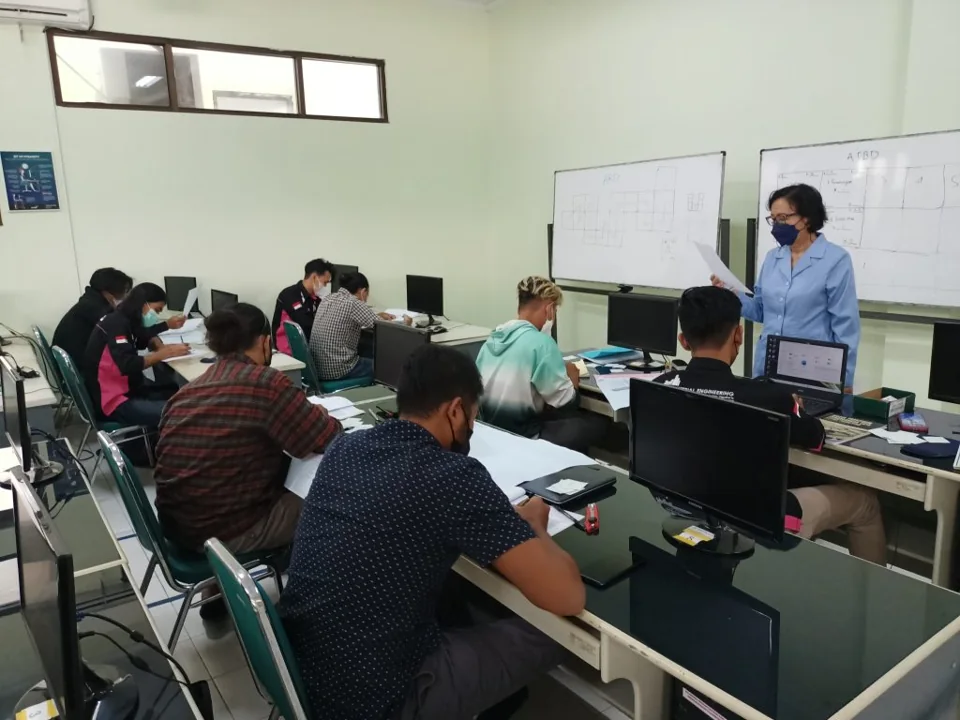
The Industrial Technology Diploma III programme describes a laboratory serving both technical drawing and facility layout design. Drawing practice uses Autodesk Inventor to introduce three-dimensional design. Students work through modelling operations, working drawings, assemblies and a drawing project, followed by presentation and assessment. The room’s listed equipment includes computers, drawing tables, a projector, printer and scanner.
The facility layout component asks students to plan a factory for a specified product. Its sequence includes a factory visit, an operations process chart and analysis of relationships between activities. Students then develop diagrams, calculate departmental space requirements and allocate areas before presenting the proposed layout. This gives the laboratory a role in both representing individual engineered objects and organising the larger space in which production happens. The two practical subjects connect digital drawing work with the spatial planning of industrial facilities.
Sources: Technical drawing and facility layout laboratory ↗
Production systems and manufacturing
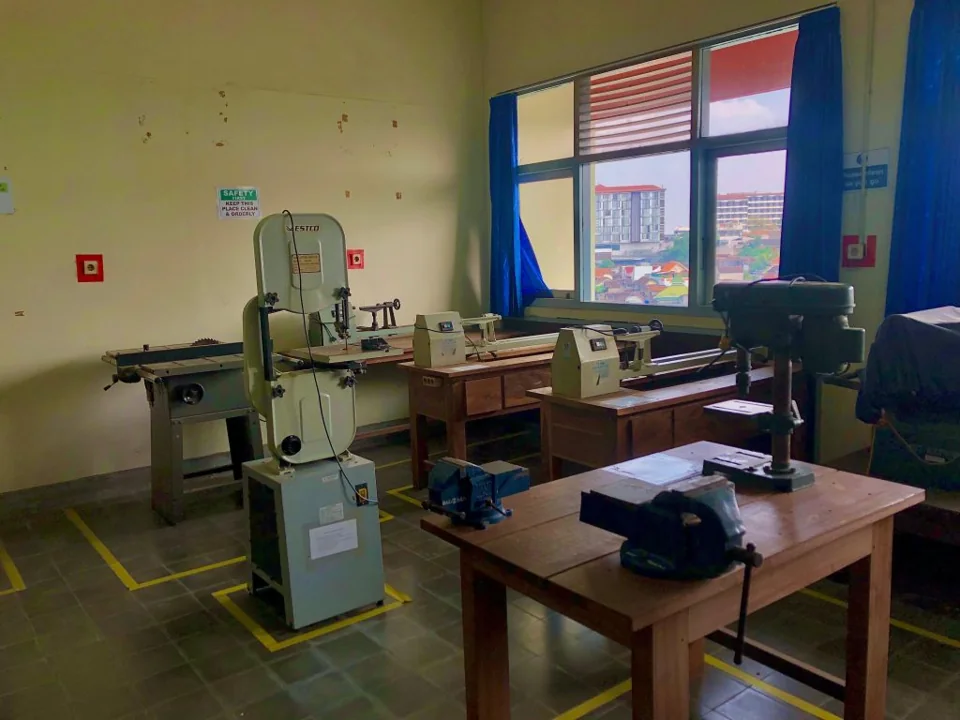
Another Industrial Technology laboratory combines production processes with production systems teaching. Its manufacturing practice covers conventional equipment alongside additive manufacturing. The published equipment list includes woodworking lathes, band saws, drilling equipment, jigsaws and grinders, together with computers and three-dimensional printers. Students study both subtractive production and additive processes, including slicing with CURA software for three-dimensional printing.
The production systems practical uses POM-QM to support calculations involved in production and marketing decisions. Topics include forecasting, aggregate planning, inventory, material requirements planning, order lots and job scheduling. The department presents these exercises around producing an appropriate quantity at the appropriate time while using resources efficiently. Computers, printing and scanning facilities support this analytical part of the laboratory. Manufacturing practice and planning calculations are consequently described as complementary parts of its teaching remit.
Sources: Production systems and manufacturing laboratory ↗
Ergonomics and work analysis
The ergonomics and work design laboratory introduces human-centred approaches to industrial work. Students measure body dimensions, process anthropometric data and use the results in product design and analysis. Other exercises examine how lighting, noise and temperature affect an operator’s work. The listed resources include an anthropometric chair, a controlled-climate room, a light meter, an exercise bicycle, a treadmill and a reaction timer.
A second practical component focuses on analysing and improving working methods. Its topics include productivity, work charts, learning curves, micromotion study, performance rating and work sampling. Assembly materials and a pin board are among the supporting resources. These activities place attention on the person performing a task as well as on the equipment, sequence and time associated with that task.
Language practice
The Industrial Technology programme also identifies a language laboratory for English practice. The practical component supports its English course through introductions, discussion of activities, description, explanation and problem solving. Its stated emphasis is everyday communication using English sentence patterns. Computers, a printer and air conditioning are listed among the room’s facilities. Language practice thus appears alongside the department’s manufacturing, design and analytical laboratory work.
Sources: Language laboratory ↗
Mechanical technology and vocational learning
The university’s vocational provision includes Mechanical Technology and Industrial Technology. Its departmental history records the creation of a vocational education unit in May 2022, followed by the placement of Diploma III programmes under that unit in June. This organisational development preceded the university conversion.
The Mechanical Technology programme page describes a sequence beginning with engineering drawing, mathematics, materials, applied physics and technical English. Later study moves through machining, metrology, welding, computer-aided design, pneumatic and hydraulic systems, numerical control and maintenance. Automation, machine elements, process control and technological entrepreneurship also appear in the published outline. The later stages include industrial field practice and a final project. The teaching description brings together designing, fabricating, maintaining and testing machinery, with workshop and laboratory activity forming a substantial part of the programme’s presentation.
Sources: Mechanical Technology departmental history ↗ · Mechanical Technology programme ↗