Visa
About Akademi Penerbang Indonesia Banyuwangi
An aviation academy in Banyuwangi
Akademi Penerbang Indonesia Banyuwangi, commonly shortened to API Banyuwangi, is a government vocational higher-education institution within Indonesia’s Ministry of Transportation. It is accountable to the head of the ministry’s transportation human-resources development agency. Its campus occupies part of the Banyuwangi Airport complex at Blimbingsari in East Java. Aviation education is therefore central to both its institutional purpose and its physical setting.
The academy’s stated mission connects professional education with research, technological development and community service. It also calls for cooperation with Indonesian and overseas institutions and for curricula that respond to aviation industry needs. Integrity, professional conduct and accountable management appear alongside technical competence in these objectives. Its ambition to compete in the Asia-Pacific region is expressed as a development goal, supported by work on teaching, partnerships and institutional governance.
Sources: History and institutional development ↗ · Mission and objectives ↗
From a training centre to an academy
The institution was inaugurated on 23 December 2013, following the establishment of Loka Pendidikan dan Pelatihan Penerbang Banyuwangi under a September 2013 transportation regulation. Its early development was linked to the aviation technical academy in Surabaya, now Politeknik Penerbangan Surabaya. The Banyuwangi centre subsequently developed its own organisational identity.
In August 2015, it became Balai Pendidikan dan Pelatihan Penerbang Banyuwangi. A September 2016 finance decision authorised public-service-agency financial management. The present academy name followed a transportation regulation issued in April 2019. Its institutional history also records a 2020 statute and a further organisational regulation in 2021. These successive changes explain why older documents may refer to a training centre while current academic pages use the academy name.
Fixed-wing pilot education
One of the academy’s principal academic offerings is Diploma III Penerbang Sayap Tetap, or Fixed-Wing Pilot. The published programme brings together applied scientific knowledge, flight operations and the professional responsibilities associated with operating aircraft. Its learning outcomes encompass applied mathematics and natural science, navigation, aviation procedures and regulations, and the use of technical information.
Communication is an explicit part of this preparation. The programme describes aviation phraseology, teamwork and the ability to coordinate with other personnel, alongside leadership and the management of risk, conflict and stress. Computer applications and operational management also feature in its learning framework. The programme’s wider objectives include research, community engagement and collaboration with other institutions. Together, these elements give the course a broader educational scope than practical aircraft handling alone, linking technical activity with judgement, communication and professional ethics. The published outcomes additionally address environmental protection, workplace health and safety, and the documentation of operational analysis in written technical work.
Sources: Diploma III Fixed-Wing Pilot ↗
Aircraft operations beyond the cockpit
The separate Diploma III Operasi Pesawat Udara programme concentrates on the operational systems supporting civil aviation. Its published curriculum covers air law, navigation, meteorology, aircraft knowledge and air traffic management, followed by flight planning, flight monitoring, communication procedures and aircraft weight and balance. Later subjects include dangerous goods, aviation security, aircraft marshalling and apron movement control.
The programme also incorporates human factors, emergency situations, search and rescue, safety management and airline operational management. Its curriculum provides an on-the-job training stage involving flight operations, aviation security, dangerous goods and apron or marshalling work, followed by a final project. Published learning outcomes emphasise accurate reporting, inter-unit coordination, responsible teamwork and the ability to analyse operational problems. The resulting educational focus is on connecting aircraft, airport and ground-handling activities within a coordinated transport operation.
Sources: Diploma III Aircraft Operations ↗
Training for different stages of aviation work
Alongside diploma study, API Banyuwangi publishes a training framework with five categories. Initial formation training develops foundational knowledge, skills, discipline and professional ethics for people entering aviation education. Technical training addresses specific operational capabilities and is aimed at personnel from public bodies, state-owned enterprises and private organisations, as well as participants with relevant technical foundations.
A further category supports progression and the development of more advanced competence among experienced personnel. Refresher training updates existing knowledge as technology and regulations change, while practical skills training concentrates on particular workplace activities. The academy describes these categories as serving a range of aviation roles, including pilots, technicians, instructors and operational managers. This structure places continuing professional development alongside the education of new entrants.
Sources: Education and training categories ↗
Library and learning resources
The academy library supports education, research and community service, the three interconnected responsibilities of Indonesian higher education. Its stated work includes providing information and coordinating services for teaching and research. The published resource description includes electronic books, journals and manuals, with an electronic-library service linked from the academy website. A dedicated library unit manages this provision. These resources complement the technical and operational subjects taught across the academy’s aviation programmes.
Sources: Academy library ↗
Partnership activity and community engagement
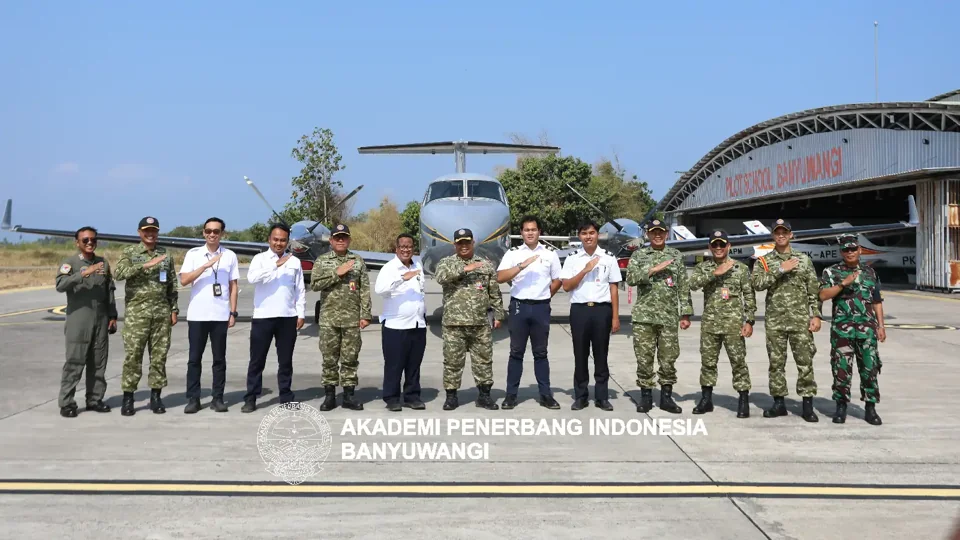
In October 2026, the academy reported a visit by Indonesia’s naval aviation centre, Puspenerbal, to discuss and survey facilities for proposed Single Engine Sea Class Rating training. The discussions covered curriculum, aircraft, instructors, waterbase support and administrative arrangements. The report described exploratory work towards a cooperation agreement, with technical meetings followed by a facility inspection.
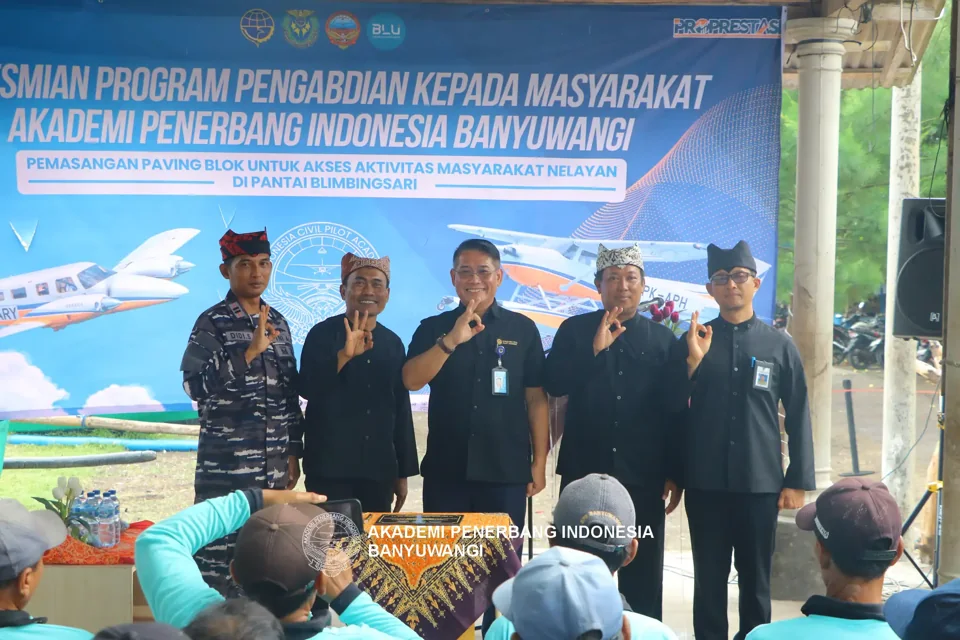
Community service also extends beyond aviation training. An official December 2025 gallery documents the inauguration of an academy paving-block project at Blimbingsari Beach. The activity connected the institution with its neighbouring coastal community and provides a concrete example of the public-service role described in its mission.
Sources: Puspenerbal coordination and facility survey, October 2026 ↗ · Blimbingsari community-service project, December 2025 ↗