Visa
About Akademi Maritim Suaka Bahari
A maritime academy in Cirebon
Akademi Maritim Suaka Bahari, also known as AKMI Suaka Bahari Cirebon, is a maritime vocational institution in West Java, Indonesia. Its campus is in Ciperna, Cirebon Regency, on Jalan Jenderal Sudirman No. 156. The institution traces its establishment to 26 December 1987, when Yayasan Suaka Bahari Cirebon founded Akademi Kemaritiman Indonesia, abbreviated AKIN. The foundation's notarial record carries the same date. In 1988 the academy adopted the name Akademi Teknologi Kemaritiman, or ATEKMAN. Its institutional history records the adoption of the Suaka Bahari maritime academy name on 16 April 1990. Nautical studies, marine engineering and commercial-shipping and port administration have been part of its educational identity since its early development. These three fields continue to organise its present Diploma III provision, linking work aboard ships with the administrative and logistical activities supporting maritime transport.
Sources: Institutional history ↗
Education, character and community
The academy's mission brings applied maritime knowledge together with the development of professional character. It identifies moral values, ethics and the psychological aspects of professional life as elements of cadet education. Research forms another part of the mission, with attention to maritime knowledge, innovation and problems relevant to the industry. Community service is directed towards maritime communities, including coastal knowledge and environmental concerns. The academy also sets out continuing development for lecturers and employees, linking staff capabilities with the quality of academic and administrative services. Its objectives include effective teaching, institutional quality management and cooperation with organisations at regional, national and international levels. These are stated institutional priorities: they describe how the academy intends to connect vocational study, research, community engagement and organisational development.
Sources: Vision, mission and objectives ↗
Nautical studies and navigation
The Diploma III Nautika programme concerns navigation and the operational responsibilities associated with a merchant ship's deck department. Its published competency areas include terrestrial and electronic navigation, ship handling, cargo organisation and maritime communications. Electronic chart systems, radar, automatic identification and compass systems appear in the programme description. Cargo study includes stability and loading arrangements, with different kinds of merchant cargo providing the context. Safety, emergency communication and prevention of marine pollution also form part of the stated educational scope. The programme page describes bridge simulation, radio communication facilities and electronic navigation practice as supporting resources. This combines classroom understanding with simulated situations, allowing the study of navigation, communication and ship operations within an educational setting. The nautical route therefore concentrates on a different part of maritime work from the academy's engineering and port-management diplomas.
Sources: Diploma III Nautical Studies ↗
Marine engineering and ship machinery
The Diploma III Teknika programme focuses on the machinery, propulsion and electrical systems of merchant ships. The academy describes study in the operation, preventive maintenance and repair of shipboard equipment. Main diesel engines are one area, while auxiliary machinery includes generators, boilers, pumps, compressors and fuel-treatment equipment. Electrical distribution, automation and control systems give the programme an electrical as well as a mechanical dimension. Refrigeration and air conditioning are also included in its description, connecting machinery study with accommodation and cargo requirements. Practical resources named on the programme page include an engine-room simulator, diesel equipment, metalworking and welding workshops, and electrical and control laboratories. The stated approach combines simulated engine-room situations with workshop activity. Its subject matter is distinct from navigating the vessel, while remaining concerned with the systems that support maritime operations.
Sources: Diploma III Marine Engineering ↗
Port administration and maritime logistics
The third Diploma III programme is Ketatalaksanaan Pelayaran Niaga dan Kepelabuhan, abbreviated KPNK and presented in English as Port and Shipping Management. It addresses the organisation of shipping business, port terminals and maritime supply chains. The published competencies cover berth and yard operations, cargo handling, freight forwarding, warehousing and the documentation accompanying goods. Export-import administration and customs processes form another strand. Ship agency and crewing administration connect the programme with the services needed when vessels arrive at or depart from a port. Its practical learning description includes simulated port and trade documentation, computerised logistics and shipping-agency administration. These topics bring together the movement of cargo, the information accompanying it and the coordination of services. The programme consequently approaches the maritime sector through commercial and administrative processes alongside the academy's two ship-focused diplomas.
Learning spaces and campus life
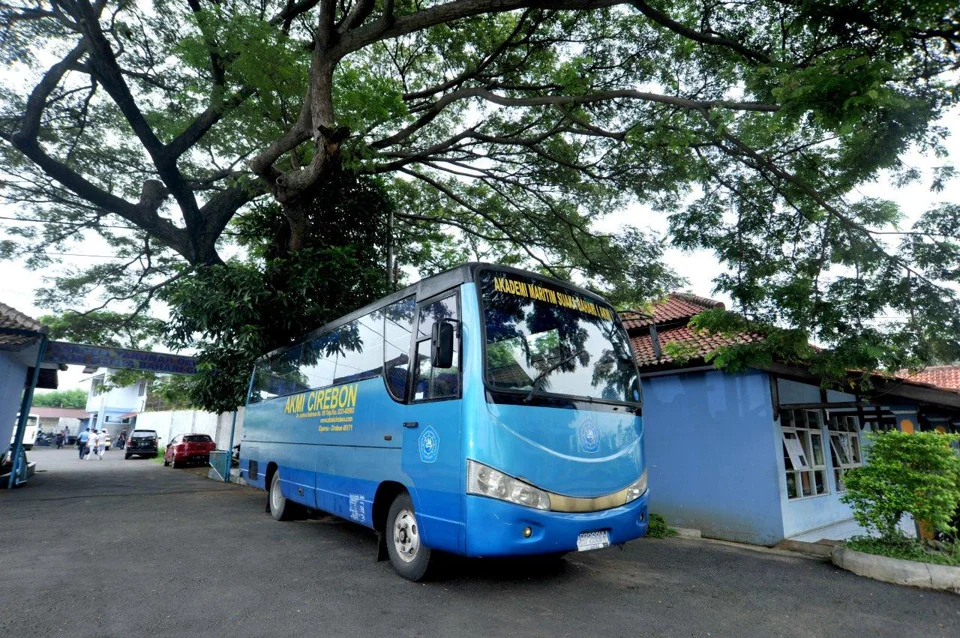
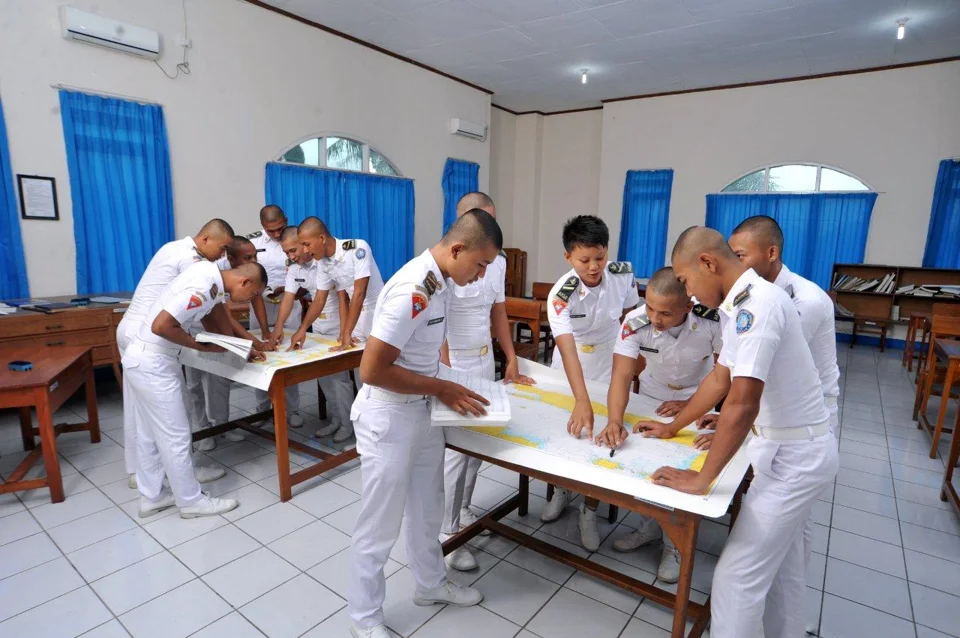
The facilities presentation describes several settings for practical learning. Bridge and engine-room simulation support the two shipboard disciplines, while navigation, radio communication and safety-training resources address other parts of maritime study. The academy also lists metalworking facilities, computer-based learning and language provision. Classrooms support theoretical teaching alongside these specialist settings. Dormitories, a parade ground and an auditorium appear in the wider campus presentation, showing that its facilities extend beyond the specialist laboratories. Photographs in the official collection also show cadets working together over paper charts and an academy-branded bus beside campus buildings. These images illustrate the physical setting and cadet activity without establishing the age or current inventory of every item shown. The range of spaces described reflects the institution's combination of classroom study, practical exercises and a cadet community.
Sources: Campus facilities ↗
Relationships across the maritime sector
AKMI's cooperation page identifies several kinds of external relationship. Its industry presentation names shipping and logistics organisations including Samudera Indonesia, TEMAS, Waruna and Humpuss, together with terminal and freight-forwarding interests. The same page identifies maritime education and training organisations such as STIP Jakarta, BP2TL Jakarta and Polimarin Semarang. It discusses cooperation in curriculum development, instructor capabilities and practical maritime education. Simulator and laboratory providers are included in a separate part of the presentation, illustrating the connection between educational equipment and specialist suppliers. The academy's mission also links cooperation with research, professional networks and the relevance of practical teaching. Taken together, these published relationships place its three diploma fields within a wider network of maritime businesses, training organisations and technical services. They complement the institution's local campus base in Cirebon with connections to the broader shipping sector.
Sources: Cooperation and partnerships ↗