Visa

About Akademi Komunitas Negeri Pacitan
A state vocational academy in Pacitan
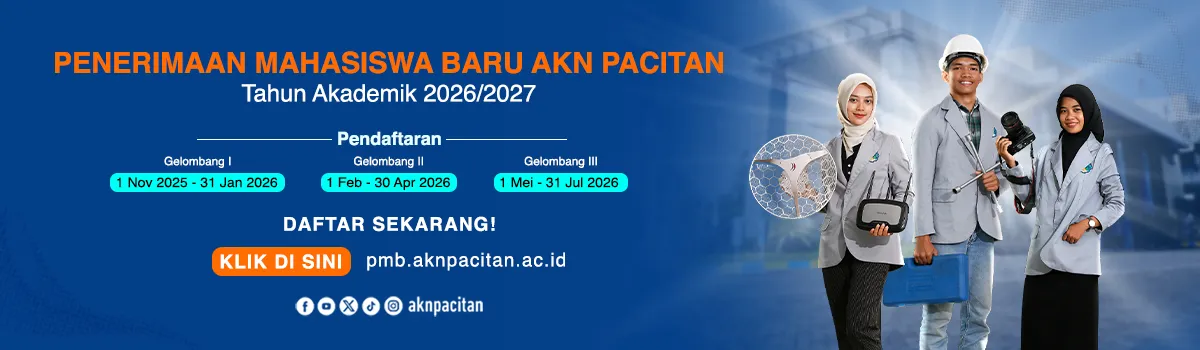
Akademi Komunitas Negeri Pacitan, or AKN Pacitan, is a state vocational higher-education institution in Pacitan, East Java, Indonesia. Its history traces its origins to Community College Pacitan, established in 2002 through the local government with guidance from Politeknik Elektronika Negeri Surabaya, or PENS. The institution became an out-of-domicile study programme in 2012 before its inauguration as a community academy on 16 October 2013. The historical account distinguishes that inauguration from its later administrative independence: in 2017 the academy became a separate working unit, ending the earlier institutional guidance arrangement with PENS. That change also brought programme names reflecting computer and network maintenance, production-studio management and light-vehicle maintenance. The academy's published contact address is Jalan Walanda Maramis 04A in Pacitan. Its current homepage publishes Diploma II admissions information for the 2026/2027 academic year.
Sources: Official institutional history ↗ · Official homepage and 2026/2027 Diploma II admissions notice ↗
Vocational education and regional engagement
The academy's vision places vocational education and applied science and technology at the centre of its work. It describes access for the wider community and the development of graduates with character as part of that direction. Its mission includes preparing technically skilled personnel with entrepreneurial capabilities, developing applied knowledge and carrying out community service. A further priority is using science and technology in ways that draw on regional potential and contribute to wellbeing. Cooperation with other organisations is identified as a means of improving educational quality. These aims connect the academy's technical specialisations with local needs, while giving public engagement and enterprise a place alongside formal teaching.
Sources: Institutional vision and mission ↗
Three practical study fields
The academy's official learning-management system describes three complementary programme areas. Computer and Network Maintenance covers network design and management, computer-hardware maintenance and the development of applications for desktop and mobile environments. Production Studio Management addresses multimedia skills, including audio and video editing, photography, design and animation, together with preparation for enterprise in the creative digital sector. Light Vehicle Maintenance combines practical and theoretical work on engines, chassis, electrical systems, transmissions and workshop operations. Its description also refers to planning, development, production and maintenance as related bodies of knowledge. These descriptions show the range of the academy's applied provision: digital infrastructure, creative media and automotive technology. Each area links technical knowledge with activities that students can practise and develop, rather than presenting the institution as a general academic university.
Digital services and reading resources
The campus-services page describes several systems supporting learning and administration. Daletols, an online-learning service, provides teaching materials, educational video, attendance facilities and video-conference streaming. A separate management-information system supports institutional administration, including staff and student data and attendance information. The page also describes online registration, data collection and examination functions through PMBAK Online. Library resources include general reading and materials relevant to the academy's computer-and-network, studio-production and light-vehicle programmes, together with online references. These services connect practical subject teaching with access to information and the administrative processes needed to organise study. They also give students several distinct digital points of contact with the academy.
Sources: Campus services ↗
The framework for academic study
The academic-regulations page identifies the student guide as a framework for learning at AKN Pacitan. The topics it covers include educational programmes, curriculum, the semester-credit system and evaluation of learning. Academic and non-academic activities, study leave, institutional partners and academic cooperation are also included. The guide further addresses extracurricular student activities and the role of academic advisers. This range brings the organisation of coursework together with responsibilities and support beyond individual classes. It establishes the subjects addressed by the academy's academic guidance without reducing student life to classroom assessment alone.
Sources: Academic regulations ↗
Network skills in an assessment setting
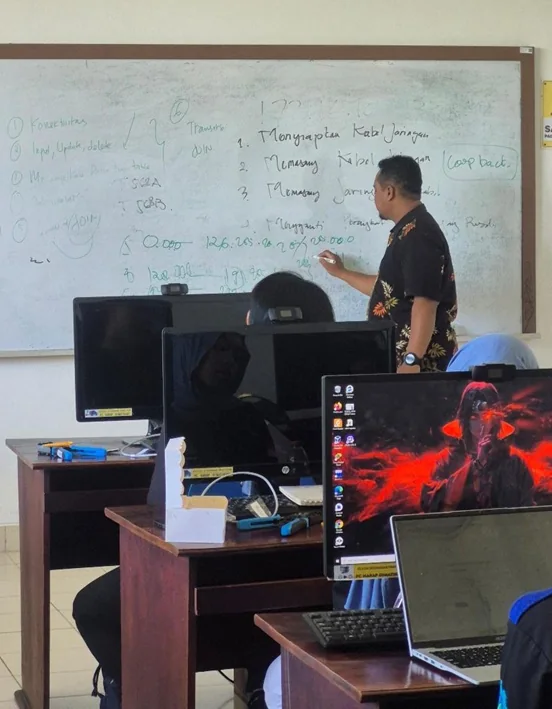
An October 2026 institutional report describes a network-technician competency activity held in September at the academy's Architecture and Fibre-Optic Networking Laboratory. It involved twenty-one Computer and Network Maintenance students and cooperation with LSP TIK Indonesia. The reported sequence included preparation with programme lecturers, an explanation of the assessment standards and pre-assessment stages before practical assessment and interviews. Practical tasks included preparing and installing network cables, setting up wireless networks and replacing faulty networking devices. The report therefore gives a concrete example of the practical abilities assessed within the computer-and-network field, connecting laboratory work with a defined set of technical tasks.
Sources: Network technician assessment 2026 ↗
Automotive practice and evaluation
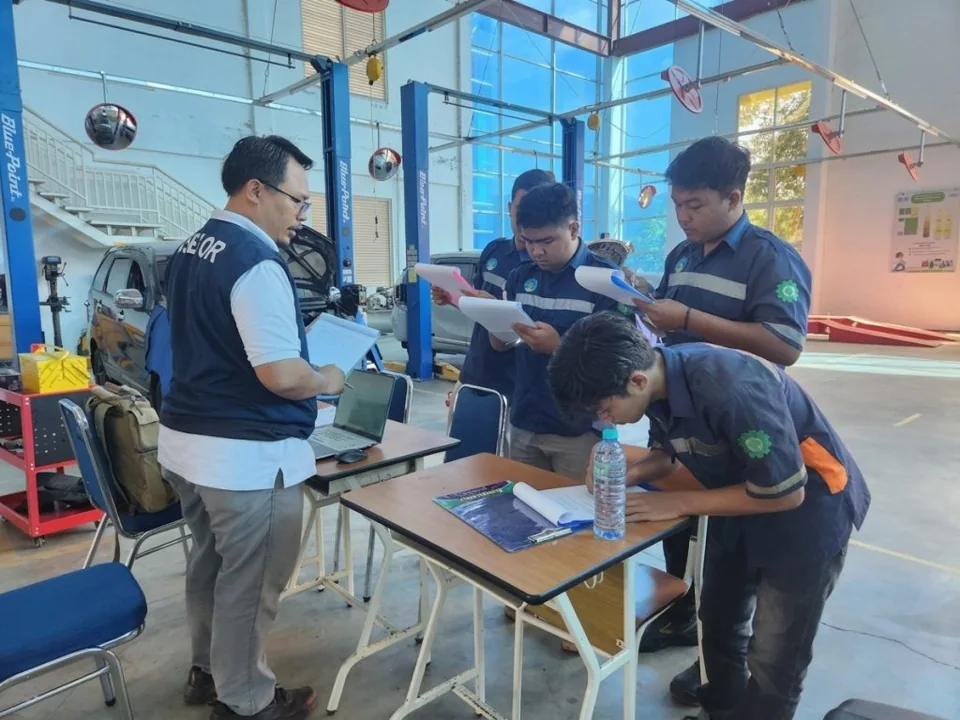
A separate report describes automotive training and assessment held in July 2026 with LSP Global Otomotif. The two assessment schemes concerned fuel-injection engine tune-up and brake-system maintenance. Before assessment, students received preparation in occupational safety, vehicle inspection and maintenance, measuring instruments and simulated competency tasks. The academy reported different outcomes across the two schemes and described the results as material for evaluating practical teaching. This account shows assessment being used both to review individual performance and to inform programme development. It also illustrates the workshop-based nature of light-vehicle education, where safe working procedures and the use of technical equipment accompany knowledge of vehicle systems.
Sources: Automotive assessment 2026 ↗
Lecturer development in industrial automation
The computer-and-network programme also reported training for lecturers in programmable logic controllers, or PLCs, held over three days in July 2026. Activities took place in the Hardware and Operating Systems Laboratory and combined theory with hands-on work. Topics progressed from traffic-light control and DC motors to servo motors, temperature and humidity sensors, variable-speed drives and load-cell weight transmitters. The stated follow-up included integrating relevant PLC material into teaching, developing smart-manufacturing practical modules and evaluating implementation among lecturers. This provides an example of staff development directed towards curriculum improvement, extending the programme's technical teaching towards industrial automation while retaining an emphasis on practical learning.
Sources: PLC training for lecturers 2026 ↗