Visa
About Akademi Komunitas Industri Tekstil dan Produk Tekstil Surakarta
An industrial vocational academy in Surakarta
Akademi Komunitas Industri Tekstil dan Produk Tekstil Surakarta, commonly known as AK-Tekstil Solo, is a vocational higher-education institution in Surakarta, Central Java, Indonesia. Its history links its establishment to cooperation between the Ministry of Industry, the city government, the Central Java textile association and Solo Technopark. Surakarta's role as a textile centre, particularly its association with batik, formed part of the context for locating the academy there.
Educational activity began in 2015, and the institution was inaugurated by President Joko Widodo on 26 January 2016. The academy developed around competency-based industrial education, with laboratories, workshops and a teaching factory. Its historical account describes a dual system connecting learning on campus with education in industry.
Sources: Institutional history ↗
Diploma II education and industry learning
The academy operates under Indonesia's Ministry of Industry and focuses on textile and garment technology. Its campus is on Jalan Ki Hajar Dewantara in Jebres, Surakarta. The official profile identifies three programmes: Teknik Pembuatan Benang, Teknik Pembuatan Kain Tenun and Teknik Pembuatan Garmen, covering yarn, woven-fabric and garment production.
The educational structure is Diploma II, with 80 credits over four semesters. The profile describes a block approach incorporating theory, campus practice and industrial practice. It also identifies a teaching factory, a professional certification institution and competency-testing facilities within its competency-based model. Cooperation with regional government and industry is presented as part of the organisation of education, including the learning and industrial-practice stages.
Sources: Official institutional profile ↗
Yarn production
The yarn-production programme combines textile foundations with the operation and control of production processes. Supporting studies include computer applications, work ethics, workplace safety and English. Textile fibres and textile manufacturing provide a foundation for more specialised practical learning.
The programme description covers blowing, carding, drawing and combing, followed by roving, ring spinning, open-end spinning and winding. Quality control and fibre testing are also included. Its workshop equipment corresponds to these stages, while the testing laboratory includes instruments for examining fibre length, fineness and maturity, tensile strength and elongation. The programme's published direction connects vocational education with applied research, technological innovation and cooperation with industry practitioners.
Sources: Yarn production programme ↗
Woven-fabric production
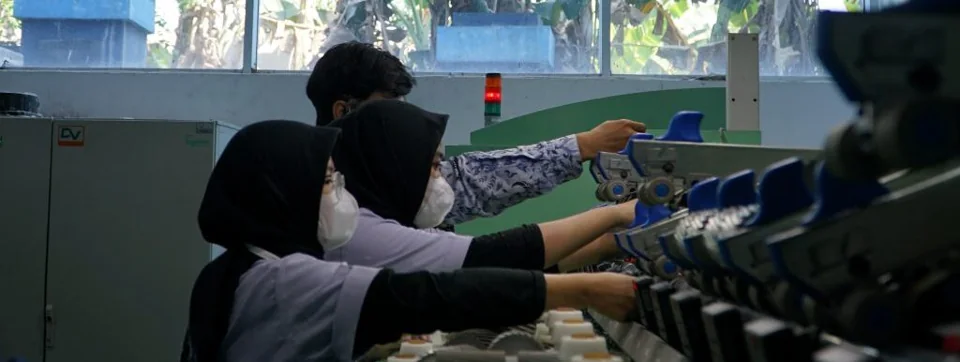
The woven-fabric programme addresses the preparation and production of woven textiles. Its published learning areas include winding, warping, sizing and reaching, alongside setting warp beams and operating shuttle and shuttleless looms. Production quality control and testing form another strand of the programme.
As with the academy's other programmes, supporting knowledge includes computers, workplace safety, professional ethics, English and textile fundamentals. Practical learning has a prominent place in its competency-based approach. The programme also identifies applied research, appropriate technology and community service among its responsibilities. Its educational direction links knowledge of textile production with the ability to understand and respond to production needs, rather than treating weaving solely as a design subject.
Sources: Woven-fabric production programme ↗
Garment production and workshop resources
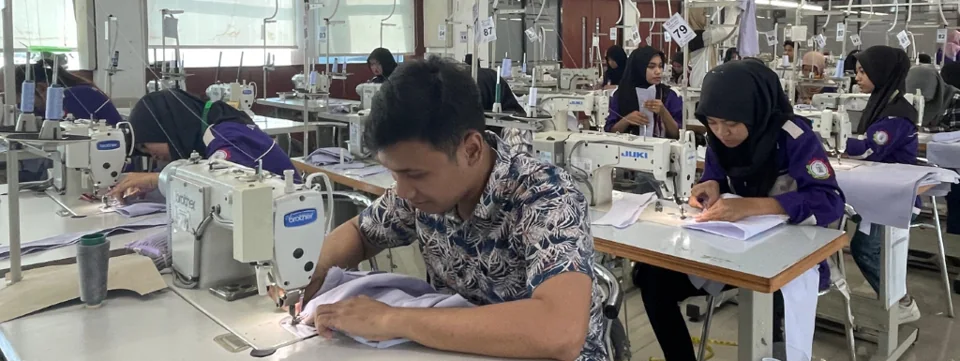
Garment production extends the academy's textile focus into the development and assembly of clothing. The programme includes drawing and pattern design by hand and with computer-aided design. Other subjects cover fabric selection, spreading and folding material, cutting to a pattern, sewing-machine operation, specialised garment machinery and embroidery equipment. Production quality control and garment testing are also part of its published learning areas.
The programme describes separate resources for manual patternmaking, cutting and computer-aided pattern work. Manual facilities include tracing and pattern tables and dress forms. Cutting facilities include round-knife and vertical-knife machinery and cutting tables. The computer-aided design workshop lists software with three-dimensional design features. These resources show the sequence from pattern development through preparation, cutting and garment assembly within its practical teaching environment.
Sources: Garment production programme ↗
Research and Jurnal Tekstil
The academy's research and community-service unit publishes Jurnal Tekstil: Jurnal Keilmuan dan Aplikasi Bidang Tekstil dan Manajemen Industri. The journal began in 2018 and states that it adopted a twice-yearly June and December schedule from volume five in 2022. It is an open-access, peer-reviewed publication accepting research and review articles in Indonesian and English.
Its scope includes textile and apparel manufacturing, materials and products, industrial management and production-process optimisation. Supporting subjects include supply chains, maintenance, quality control and ergonomics. Submitted manuscripts undergo initial editorial review followed by double-blind peer review. This publication gives the academy a research-sharing role across technical and management questions related to textile and garment production, complementing its vocational teaching activities.
Sources: About Jurnal Tekstil ↗
Cooperation with industry
An official July 2026 report describes a cooperation agreement with CV Sevine Indonesia, signed in a meeting room in the academy's Building A. The proposed areas of collaboration included curriculum alignment, industrial internships, student competency development and sharing information about developments in textile and garment technology.
The academy's account connects this partnership with continuing curriculum improvement and students encountering industrial work directly. The company also identified education and technology exchange as reasons for participating. The agreement therefore provides a specific example of the institutional relationships underlying the academy's dual-learning approach, with curriculum and practical experience both included in the intended cooperation.
Practical skills shared with the community
On 28 October 2026, AK-Tekstil Solo held a pouch-making workshop for residents of the Jebres area. The activity took place in the garment workshop in Building A as part of its Youth Pledge Day commemoration. Participants were introduced to making a useful textile product through direct practical activity.
The academy's report describes the workshop as an opportunity for residents to encounter its vocational learning environment and develop creative skills. Pouches were presented as items for everyday use and as products with potential for further craft development. The event illustrates the community-service side of the institution: sharing garment-related skills and workshop resources with people living near the campus.