Visa
About Akademi Kesehatan John Paul II Pekanbaru
From academy to a higher school of health sciences
Akademi Kesehatan John Paul II Pekanbaru is the historical academy name of a health-education institution in Pekanbaru, Riau, Indonesia. Its foundation's official history records a change of institutional form on 27 July 2026 to Sekolah Tinggi Ilmu Kesehatan John Paul II Pekanbaru. The institution therefore has a continuing educational identity alongside a newer higher-school designation.
The operator, Yayasan John Paul II Pekanbaru, was founded in 2011 and received legal recognition in 2012. Its first founder and chair of trustees was the then Bishop of Padang, Martinus Dogma Situmorang. The foundation records the academy's establishment in 2014 and a change in its governing organs in 2022. These milestones separate the foundation's creation, the opening of the academy and the later change in institutional form.
Sources: History of Yayasan John Paul II Pekanbaru and July2026 institutional change ↗
The development of health-laboratory education
The institution grew from a proposal that the Diocese of Padang should establish higher education in health. Planning involved representatives of Yayasan Salus Infirmorum and Santa Maria Hospital in Pekanbaru. Although nursing education was considered initially, discussions concerning restrictions on new nursing and midwifery institutions led the organisers towards health-analyst education. The academy developed with a Diploma III programme in Analis Kesehatan.
Preparation included comparative visits to existing health-education institutions and work on curriculum, staffing and institutional documents. The former DELSOS building was adapted for the campus, with additional teaching and support spaces. The institution received its operating permission in 2014. Its campus inauguration took place on 22 September that year, with the first cohort attending. An introductory campus programme followed on 23–25 September 2014, helping the new students become familiar with their study environment and the transition into higher education.
Sources: Institutional history ↗
Purpose, values and educational relationships
The published mission places teaching, health research and community service alongside relationships with partner institutions and the communities using their expertise. Its vision looks towards an independent and distinguished higher-education institution by 2035. This is a statement of institutional direction rather than a description of a completed development target.
The director's welcome gives additional emphasis to humanity, ethics and spirituality in learning. It presents knowledge and practical skills together with integrity and a spirit of service. Cooperation with health institutions and the development of teaching facilities are also part of this educational approach. The welcome describes the website as a channel connecting the campus with students, parents, alumni and the wider public, reflecting the range of people involved in its institutional community.
Sources: Vision and mission ↗ · Director’s welcome ↗
Practical learning and laboratory subjects
Practical learning is prominent in the institution's published study information. Its programme information describes a balance of 60 per cent practical work and 40 per cent theory. The laboratory fields it lists include haematology, chemistry, parasitology, molecular biology, bacteriology and research. This gives a more specific picture of its health-laboratory orientation than the broad institutional title alone.
The information also identifies teaching by practitioners and supporting laboratory facilities as features of the learning environment. Together, the practical component and the range of laboratory subjects connect the institution's origins in health-analyst education with the learning activities described on its current website.
Teaching spaces and campus resources
The facilities page identifies classrooms, laboratories, a library and a prayer room. Classrooms are equipped with air conditioning, projectors and screens. The laboratories cover haematology, chemistry, parasitology, bacteriology, molecular biology and research, with equipment intended to support practical teaching. Air conditioning and projection facilities are also described for laboratory spaces.
The library provides domestic and international book collections and is presented as a resource for the teaching, research and community-service responsibilities of higher education. A prayer room in the main building is provided for Muslim students and lecturers. The published campus address is Jalan Permata I No.32, Pekanbaru. These facilities bring academic study, laboratory activity, access to books and religious practice into the campus resources described by the institution.
Sources: Facilities ↗
Developing academic writing
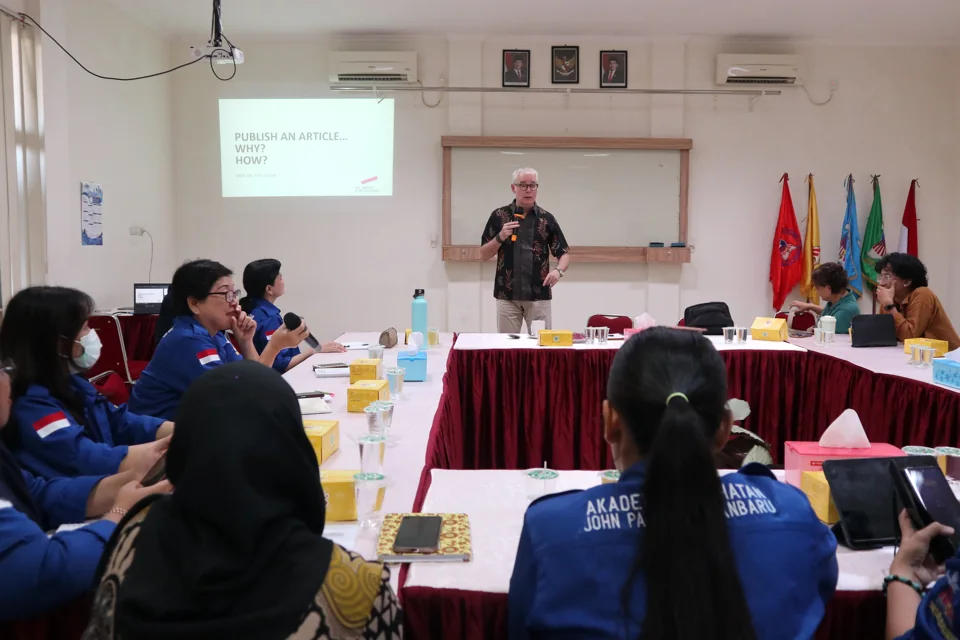
On 30 April 2026, the campus hosted a workshop on writing international journal articles with Antonius J.H. Satink, an invited speaker from the Netherlands. Lecturers and laboratory staff attended. The session addressed the structure of scientific articles, choosing an appropriate journal and preparing manuscripts for publication.
The report describes an interactive format involving discussion, case examples and writing practice. Participants considered publication standards and common challenges in academic publishing as well as the organisation of a manuscript. The activity illustrates professional development for the people who support teaching and laboratory learning. It also gives a concrete example of the institution's interest in research communication: helping staff move from conducting or supporting academic work towards presenting it in a form suitable for a journal audience.
Sources: International article-writing workshop,30April2026 ↗
A lecture on measurement and laboratory quality
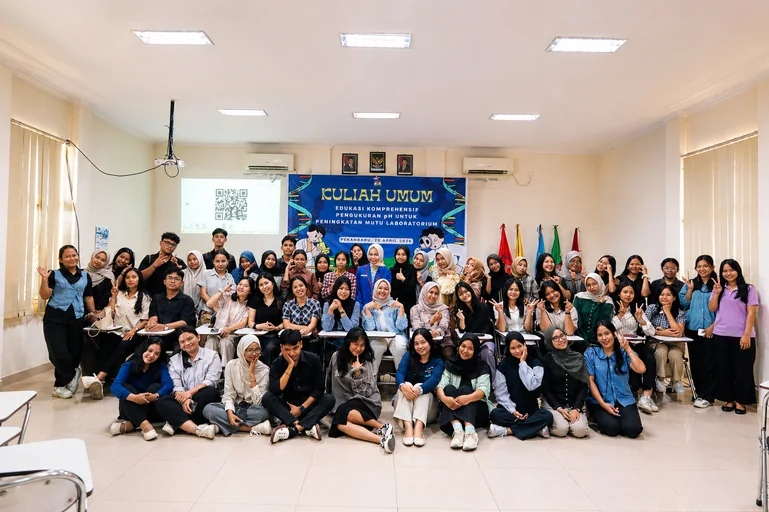
A further campus report documents a public lecture held on 28 April 2026 on measurement and laboratory quality. The invited speaker was Cherie Hafizah Putri, associated with Kisbiokim Medilab. Students and lecturers participated in the activity.
The lecture addressed precision in measurement and laboratory quality standards, including their relevance to health research and service. Its subject closely matches the laboratory fields described in the institution's facilities and programme information. As a dated academic event, it shows students encountering a specialist contribution beyond their regular classes, with attention to the quality of the measurements on which laboratory work depends.
Sources: Laboratory measurement lecture,28April2026 ↗