Visa
About Akademi Keperawatan YKY
From nursing academy to health sciences college
Akademi Keperawatan YKY is the former nursing academy of Yayasan Keperawatan Yogyakarta, now continued as STIKES YKY Yogyakarta. Its campus is on Jalan Patangpuluhan in Sonosewu, Ngestiharjo, Kasihan, Bantul Regency, within the Special Region of Yogyakarta. The academy received temporary operating permission on 11 April 1995. Teaching initially occupied rented premises in the Surokarsan area of Mergangsan before moving in 2002 into a three-storey building belonging to the foundation.
The institution's development included a change from health-sector supervision to national education supervision through Kopertis Region V in 2005. A later strategic plan envisaged development into a health sciences college. That transition was authorised by decree 581/E/O/2024, dated 6 September 2024, and the decision was handed over through LLDIKTI Region V on 30 September. The new STIKES structure retained Diploma III Nursing and added a bachelor's programme in Occupational Safety and Health, known locally as K3.
Sources: History of STIKES YKY ↗
The nursing diploma and its educational focus
The nursing diploma remains an important link between the former academy and the present college. Its published programme profile describes a 2022 curriculum informed by Indonesia's national qualifications framework and the 2022 AIPViKI nursing education curriculum. The educational target is the Ahli Madya Keperawatan qualification at level five of the national framework. The published study pattern begins with six semesters.
The programme describes several connected graduate roles: providing nursing care, educating clients, organising care within a nursing team, and using research in case studies. Its stated specialist emphasis is medical-surgical nursing with modern wound care. Learning objectives address individuals, families and particular community groups across clinical, household and community settings. Biological, psychological, social, cultural and spiritual needs appear together in this account of care. Family participation, professional ethics and the nursing process are also explicit parts of the intended educational approach.
Sources: Diploma III Nursing programme profile ↗
Practical assessment through simulated clinical stations
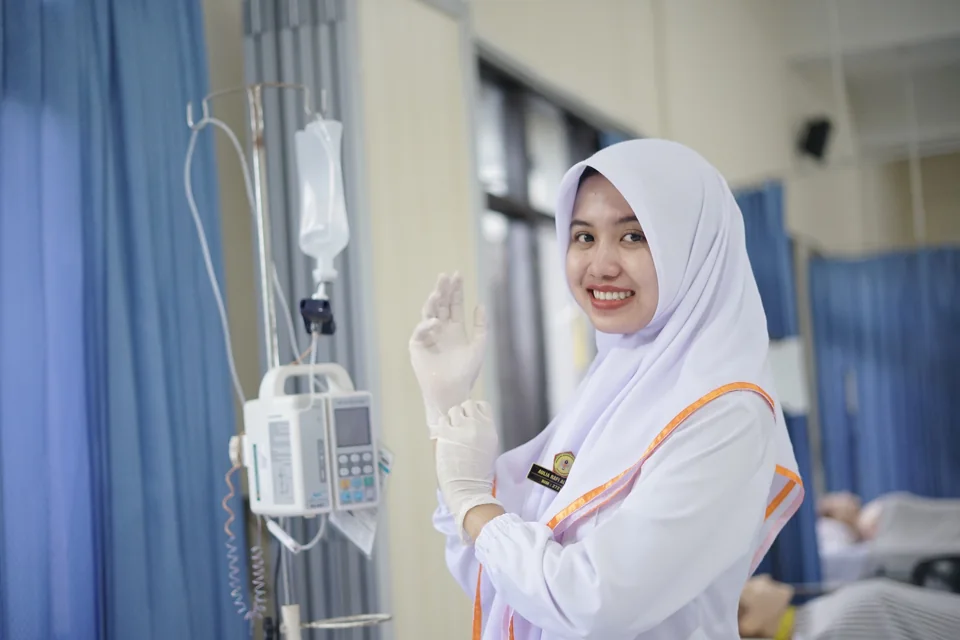
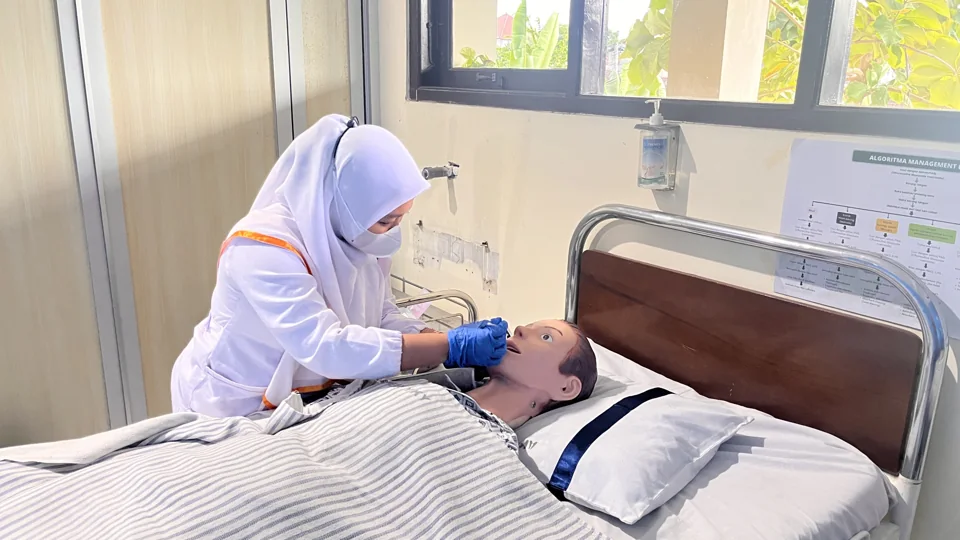
A July 2026 report documents the nursing programme's use of Objective Structured Clinical Examination, or OSCE, assessment. Students move through structured stations designed around situations encountered in nursing practice. The assessment brings together theoretical knowledge, practical procedures, therapeutic communication and professional conduct, rather than examining written knowledge alone.
Lecturers act as examiners with supporting staff, using standardised assessment forms. The reported criteria include following operating procedures, attention to patient safety, communication and nursing documentation. The college also identifies critical thinking and decision making as abilities examined through the stations. Its accompanying photographs show students working with simulation equipment, including a nursing mannequin in a bed. This form of assessment makes the practical component of the diploma visible: learners must demonstrate how they organise and communicate a task in a controlled educational setting.
Sources: Nursing OSCE assessment, July 2026 ↗
Research planning and academic documentation
Research at the current institution follows a documented sequence beginning with a proposal. Researchers set out the question and its significance, objectives, methods, proposed outputs, schedule and budget. Review considers alignment with the institutional research roadmap, relevance and originality, methodological quality, feasibility, and possible scholarly or intellectual property outputs.
Approved projects proceed with records of progress, data collection, analysis and results. The research guidance also addresses the administrative format of proposals and reports, ethical requirements, research permissions and documentation of outputs. Completed work is reported for institutional evaluation, with publication routes including journal articles and conference proceedings. The published research page lists projects concerning diabetes self-management, occupational risk perceptions among adventure tourism workers, and physical activity in cardiac nursing. These examples show the range of questions being investigated across nursing and occupational health.
Developing staff knowledge of intellectual property
A separate September 2026 report describes training for lecturers on preparing patent applications. The invited speaker was Apri Tri Nugroho, an intellectual property analyst from Universitas Gadjah Mada. The session addressed recognising potentially patentable innovations and understanding the stages of an application, connecting lecturers' research work with the preparation of formal intellectual property documents.
Participants discussed how to describe an invention and formulate claims. Practical work used research ideas brought by the lecturers themselves, giving the workshop a direct relationship to their academic projects. The institution presented the activity as part of developing staff research capacity and protecting innovations arising from research. It therefore complements the research proposal and reporting procedures: one activity structures the investigation, while the other introduces the documentation involved when a resulting invention is considered for protection.
Introducing students to campus life
The college organised its 2026–27 new student orientation over four days, from 5 to 8 October 2026. Activities combined introductory sessions, a campus tour and student performances. Early sessions covered citizenship, anticorruption, character development, academic integrity and adapting to higher education in the era of artificial intelligence.
The programme also introduced occupational safety, health and environmental issues, alongside the campus task force for preventing and handling violence. Student organisations included the student executive body, student information and counselling centre, and programme associations. Campus services received their own introductions: library staff explained the library, while other sessions presented the academic information system, e-learning and laboratories. Students met programme teams and associations before the closing talent performances. The orientation thus connected institutional expectations with the people, systems and facilities students would encounter during their studies.
Internal review and institutional management
The present college's quality management activities include internal audit and management review. A July 2026 report records an audit conducted from 30 June to 2 July, followed by a management review meeting on 14 July. Institutional leaders, programme heads, unit heads, internal auditors and the quality assurance unit participated in reviewing the findings.
Programmes and units presented proposed responses and discussed obstacles to implementation. The resulting follow-up plans specified priorities, responsible staff, indicators and completion targets. The quality assurance unit was assigned periodic monitoring and evaluation of these actions. This process sits within the institution's internal quality cycle of setting standards, implementation, evaluation, control and improvement. The review covered teaching, research, community service, governance and services for the academic community, bringing several areas of institutional activity into a common planning process.
Sources: Management review of internal quality audit, July 2026 ↗