Visa
About Akademi Farmasi Yamasi Makassar
From pharmacy school to academy
Akademi Farmasi Yamasi Makassar is a specialist pharmacy education institution in Makassar, South Sulawesi, Indonesia. Its history begins with Yamasi's provision of secondary-level pharmacy education in 1982. The later academy developed through the conversion of that school into Diploma III pharmacy education, under Yayasan Ma'bulo Sibatang. The institutional account identifies conversion authorisation in March 2010 and subsequent steps to transfer supervision to the national higher education authorities.
That process culminated in an education ministry decision dated 30 August 2012. The academy's history therefore distinguishes the earlier school from the development of higher education provision. Its current website identifies the academic programme as Diploma III Farmasi and gives the campus address as Jalan Mapala, Block D5 Number 10, Makassar. The institution continues to present pharmacy education as the central focus of its work.
Sources: Institutional history ↗ · Official homepage and campus contact ↗
Educational aims and programme direction
Yamasi's institutional vision looks towards becoming an independent and quality-focused pharmacy higher education institution by 2037. Its mission combines education, innovative research, community service, development of staff and facilities, institutional governance and cooperation with national and international stakeholders. Research is specifically linked with its potential integration into learning.
The programme mission gives particular emphasis to public safety within vocational pharmacy education. It connects teaching and research with responsible use of pharmaceutical and health products, while community service forms another part of that educational direction. The programme also identifies experience within industry, business and workplaces as a way to broaden learning. These statements place academic work, practical experience and responsibility towards the surrounding community within a shared educational framework.
Sources: Institutional mission ↗ · Programme mission ↗
Curriculum references and learning spaces
The academy's curriculum guidance page explains that programme development draws on applicable education and health guidance. It identifies a collection of 2024 reference documents, including vocational higher education curriculum guidance, APDFI graduate profiles and learning materials, Diploma III pharmacy OSCE guidance, vocational pharmacy competency standards and an examination blueprint. The page presents these as resources used when preparing the programme curriculum.
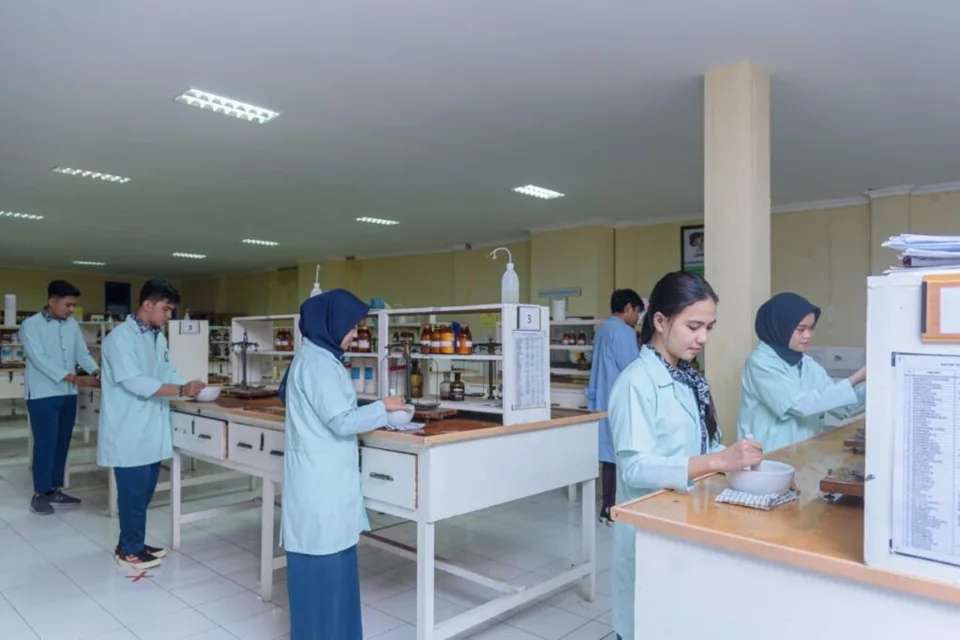
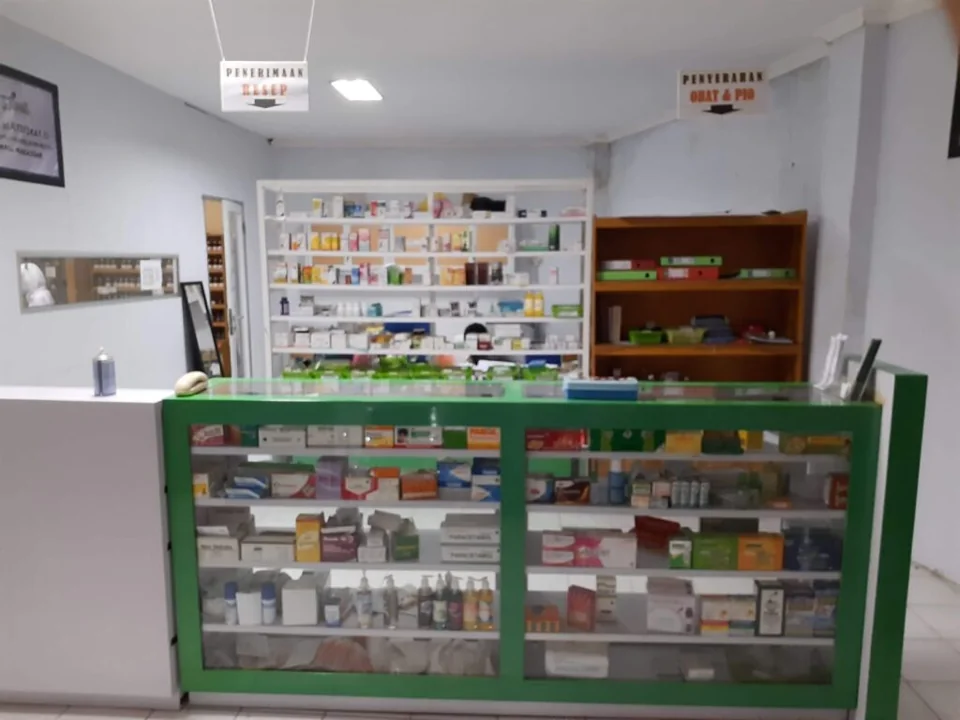
Practical facilities are documented in a separate official gallery published in February 2024. It identifies laboratories for pharmaceutics, natural materials technology, pharmaceutical microbiology, pharmacology, pharmacognosy and phytochemistry, and pharmaceutical chemistry. Computing facilities and a simulated pharmacy are also included. The photographs show students working at laboratory benches and a pharmacy teaching setting with a counter, product displays and designated service areas. These spaces provide a concrete view of the academy's practical learning environment.
Sources: Curriculum development references ↗ · Laboratory gallery,February2024 ↗
A documented field placement cycle
The academy's account of field placements for the 2024/2025 academic year provides a dated example of learning with external partners. Preparatory sessions took place on 6 and 7 February 2025 in the second-floor campus hall, with partner representatives and other stakeholders attending.
A subsequent report records the reception of students at placement settings on 10 February 2025. The participating settings included hospitals, community health centres, pharmaceutical wholesalers and pharmaceutical warehouses. Reception meetings involved supervisors from the academy and supervisors at the placement organisations. The academy reported eighty-eight participating students and a schedule of three weeks at each setting. This sequence links preparation at the institution with supervised experience in several types of pharmaceutical service and supply environment.
Sources: Field placements2024/2025 ↗ · Placement preparation,February2025 ↗
Research publications and subject interests
Yamasi's research and community service unit maintains a record of research publications. The listed work shows interests spanning pharmaceutical materials, formulation, laboratory analysis and aspects of service organisation. Examples recorded for 2021 include the production and characterisation of cellulose powder from banana stems and the examination of biodegradable plastics using different cellulose concentrations.
Later entries include studies of soap and cosmetic formulations, physical stability, fermentation and the characteristics of pharmaceutical preparations. The 2024 list also includes research concerning storage systems and community knowledge about medicines. These are documented topics of scholarly work, illustrating the range of questions examined within the academy's research activity. The list gives a view of laboratory and applied interests alongside the programme's teaching, with publication years allowing readers to distinguish the periods represented.
Sources: Research publication record ↗
Books and other scholarly outputs
The research unit also publishes a record of books and intellectual property outputs, with titles, publication years and identifiers. Its book list includes teaching material on pharmacotherapy and occupational health and safety in 2020, followed by pharmaceutical research methodology and medicine distribution and storage in 2021. Pharmaceutical microbiology, analytical chemistry and vocational pharmacognosy appear among subsequent subjects.
The record extends into 2026 and includes pharmaceutical dosage technology and analysis of water, food and beverages. Other entries address food hygiene, environmental health and health service administration. A separate part of the same page records intellectual property certificates associated with teaching material and research-related work. This documentation shows an additional form of academic output beyond journal articles, including resources connected with teaching and professional subject knowledge.
Community engagement in the publication record
The unit's community service publication list describes activities reaching groups outside the academy. Its 2021 entries include the distribution of protective kits to traders at Tidung Market in Makassar and an education activity in Suangga. A 2022 entry concerns entrepreneurship and agrotourism grounded in local knowledge in North Benteng Alla, Enrekang.
Other recorded subjects include soap-making workshops, hygiene and sanitation within traditional medicine production, and cosmetics education for adolescents. The unit also lists school outreach and community workshops, including a perfume-making activity with a women's community group in Jonjo, Gowa. Presented as a record of educational and service activity, these entries show how the academy's documented work extends from campus-based pharmacy learning into collaboration with schools, neighbourhoods and other local groups.