Visa
About Akademi Farmasi Prayoga Padang
From pharmacy school to academy
Akademi Farmasi Prayoga Padang is a vocational pharmacy institution on Jalan Jenderal Sudirman in Padang, West Sumatra. Its history begins with Sekolah Menengah Farmasi Prayoga, a pharmacy secondary school established in 1971. That earlier school provided the institutional foundation for a later change in educational level.
On 5 February 2001, a Ministry of Health decision converted the school into Akademi Farmasi Prayoga. A further change in July 2008 transferred supervision of the programme to the Directorate of Higher Education. The academy was established by Yayasan Prayoga Padang to provide pharmacy education relevant to the development of healthcare personnel. These dates distinguish the original school, the creation of the academy and the later supervisory transfer, explaining the institution’s development without treating every stage as a separate university.
Sources: PROFIL AKFAR - AKADEMI FARMASI PRAYOGA PADANG ↗
Teaching, research and service
The academy’s published mission connects education in pharmaceutical services with research and community engagement. Teaching is intended to develop pharmacy knowledge and practical competence, while research contributes to the development of the discipline. Community-service activities provide another setting for applying academic expertise outside the institution.
The mission also identifies cooperation at national and international levels as a means of improving the programme. Its stated objectives include developing scholarly work for publication in local and national journals and creating partnerships that benefit lecturers and students. Ethical character and independence appear alongside professional knowledge in its educational aspirations. The result is an account of vocational education that includes how students learn and conduct themselves, how staff develop knowledge, and how the academy relates to other organisations and its surrounding community.
The vocational pharmacy programme
The academy’s competency page describes a Diploma III pharmacy programme organised over six semesters, normally three years. Its published framework identifies community pharmacy, hospital pharmacy and pharmaceutical industry as important professional settings around which learning is organised.
The competencies cover several connected areas of work. They include managing pharmaceutical supplies, keeping records and documents, calculating costs and communicating with patients and other healthcare personnel. Supporting competencies include ethics, legal awareness, organisational skills, interpersonal relationships and communication in English. The account also connects computer use with the preparation of packaging and health-information materials.
These are educational competencies to be developed through the programme. Their breadth shows that the academy’s vocational emphasis includes administration and communication as well as scientific and practical learning. Students encounter the relationships between stock management, information, documentation and service, rather than studying pharmacy only as a collection of laboratory subjects.
Progression through the published curriculum
The published curriculum begins with general education and scientific foundations. First-year subjects include religion, Pancasila, English, pharmaceutical mathematics and biology, anatomy and physiology, basic pharmaceutics and chemistry. Subsequent study introduces microbiology and parasitology, organic chemistry, pharmacology, physics and health legislation.
Later semesters develop biochemistry, pharmaceutical physics, preparation technology, pharmaceutical chemistry, professional ethics, computer applications and entrepreneurship. The curriculum also lists pharmacognosy, occupational health and safety, procurement management and accounting. Communication, statistics, research methods, pharmaceutical marketing and hospital pharmacy appear toward the later part of the programme.
The final semester is organised around practical fieldwork and a scientific paper. This progression links foundational science with technical subjects, management and the preparation of an independent written project. The curriculum’s inclusion of language, communication, computing and business-related study also reflects the range of supporting skills described in the academy’s competency framework. Practical work and academic writing bring several parts of that learning together near the end of study.
Academic organisation and advising
The academy’s academic regulations describe a semester-credit system in which courses have different weights according to the learning effort involved. Lectures, practical classes, fieldwork and other assignments form part of that framework. An academic calendar sets out teaching and administrative activities for each semester.
Students prepare a study plan, known as KRS, in consultation with an academic adviser. The adviser is a lecturer formally assigned to guide students during their studies. Semester results are recorded through the KHS, while the transcript brings together results across the programme. The regulations also explain procedures for temporary leave, returning to study and other changes in academic status. These arrangements give students a structured administrative route through the programme, connecting course selection and progress records with ongoing academic guidance rather than leaving planning entirely to individual decisions.
Sources: PERATURAN AKADEMIK - AKADEMI FARMASI PRAYOGA PADANG ↗
Facilities supporting practical study
The facilities page describes a teaching building with classrooms and spaces for other campus activities. Classroom resources include multimedia computers and projection equipment. The laboratory provision covers pharmaceutics, pharmacognosy, pharmacology, physical chemistry, pharmaceutical chemistry and microbiology, giving different branches of the programme identifiable settings for practical learning.
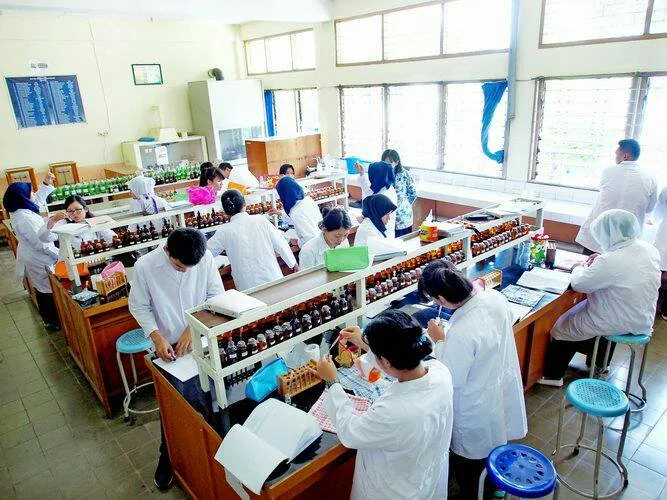
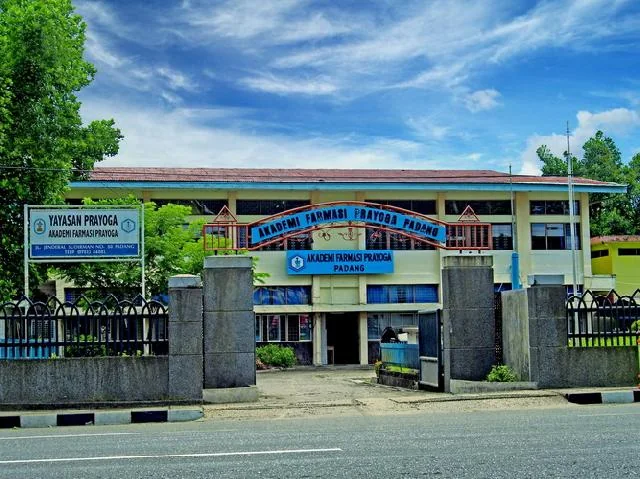
The library supports teaching, research and the development of educational programmes through books, journals and other reference materials. Campus internet access and an online academic information system provide further support for study and administration. The academy also identifies a canteen, prayer space, parking and a sports or assembly area among its general facilities. These resources combine subject-specific spaces with the everyday infrastructure used by students between classes. The official gallery’s archive photographs provide views of the academy building and students working in a laboratory.
Sources: FASILITAS - AKADEMI FARMASI PRAYOGA PADANG ↗