Visa


About Adigrat University
A public university in northern Ethiopia
Adigrat University is a comprehensive public university in Adigrat, Tigray, Ethiopia. Established in 2011, it brings together education, research and community engagement across scientific, professional and humanities subjects. Its president's message, dated August 2026, places the institution within a period of recovery and transformation following the conflict that affected the university and its surrounding communities. The message describes strengthening academic quality, research, digital services and partnerships as connected priorities for the university's development.
The university presents students' subject knowledge, practical abilities, critical thinking and digital competencies as central to its educational mission. It also emphasises the conditions in which academic and professional staff can teach, investigate problems and collaborate. International links are intended to support joint research, academic mobility, training and technology transfer. This account connects recovery with longer-term academic development, while recognising that the institution's future depends on its people, its community relationships and the resources supporting their work.
Sources: About Adigrat University, president’s August 2026 message ↗
Colleges, specialist study and academic breadth
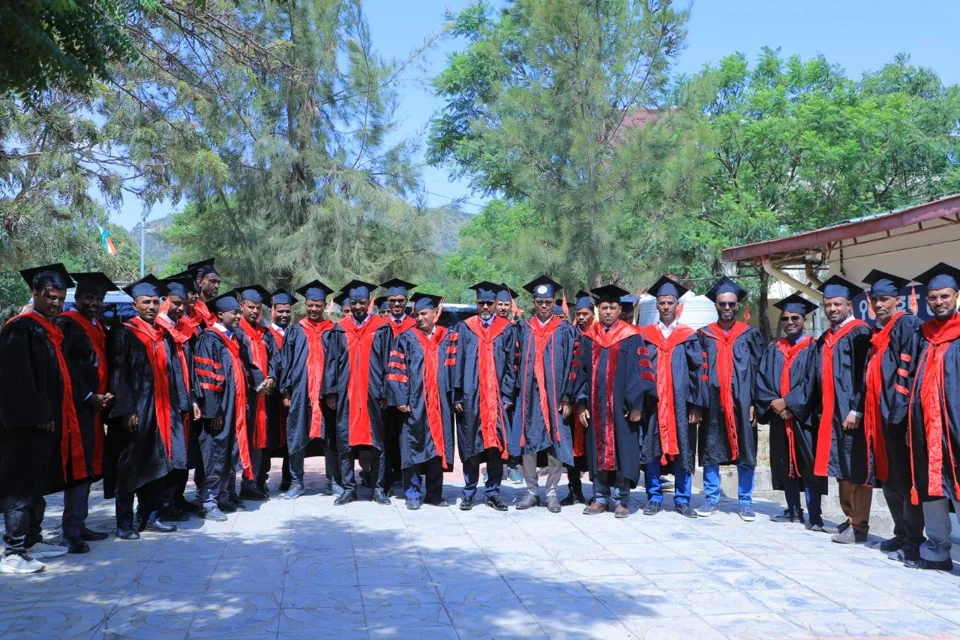
The university's academic organisation comprises six colleges, an institute and a school. The colleges cover Engineering and Technology; Medicine and Health Sciences; Agriculture and Environmental Sciences; Business and Economics; Natural and Computational Sciences; and Social Sciences and Humanities. Together, they provide undergraduate and postgraduate education across a broad range of disciplines. The academic structure therefore places technical and scientific subjects alongside the study of organisations, culture, social development and human behaviour.
The Belese Institute is identified with specialised training, advanced research and community-focused initiatives. The School of Law provides a separate home for legal education. Within the colleges, the university links teaching with research and community services, rather than describing these as wholly separate activities. Engineering and technology emphasise practical and research-based study, while agriculture and environmental science address production and resource management. Business and economics contribute another perspective through the study of management and economic development.
Sources: Academic organisation ↗
Agriculture and environmental work
The College of Agriculture and Environmental Sciences addresses agricultural production, environmental management and sustainable development in northern Ethiopia. Its subject areas include crop and soil sciences, animal production, agricultural economics, natural resource conservation and environmental management. The college's stated mission brings education together with needs-based research and outreach. Its research priorities include food security, soil and water management, crop and livestock systems, agroforestry, rural development and adaptation to climate change.
Community engagement is described through training, consultancy and technology transfer with farmers, cooperatives, public agencies and non-governmental organisations. The college also identifies relationships with agricultural industries and research institutes as part of keeping academic work connected to practical questions. This approach gives agricultural study a regional setting: students and staff examine production and environmental problems that matter to surrounding communities, while considering the longer-term sustainability of land, water and other natural resources.
Natural sciences and laboratory rehabilitation
The College of Natural and Computational Sciences encompasses biology, chemistry, physics, mathematics, statistics and computer science. Its academic interests combine fundamental science with applied and computational work. The college identifies mathematical modelling, software development, artificial intelligence, data science and environmental studies among its research areas. Science outreach, consultancy and collaboration with research organisations are also included in its community work. These activities connect scientific investigation with education, technological development and the analysis of practical problems.
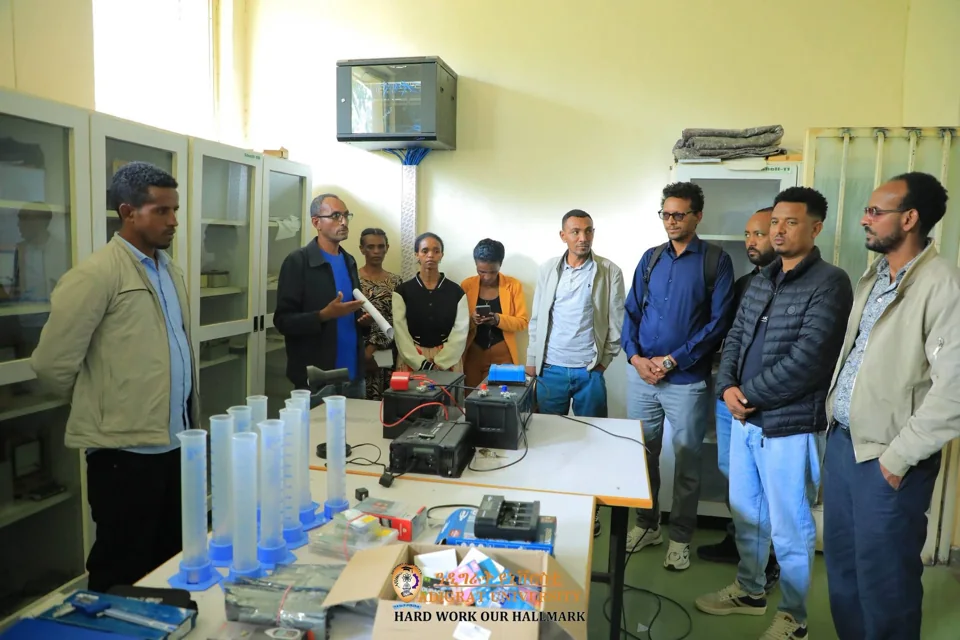
An official university report describes the receipt of equipment for the Department of Physics to strengthen laboratories affected by the conflict. The support followed continuing links between a former member of the department, Professor Baker Farangis, and university lecturer and researcher Gebregiorgis Haileslassie. Financial support was provided by Dr. Meenaxi Barkataki Ruscheweyh in memory of Professor Dr. Stephan Ruscheweyh. The equipment covered solar energy, mechanics and heat, waves and optics, electricity and magnetism, and workshop-related practical training.
At the handover, departmental representatives connected the materials with experimental learning and the improvement of laboratory services. The report presents the donation as one contribution to strengthening practical physics education and academic collaboration. It gives a specific example of how professional relationships can help rebuild teaching resources: support is directed towards equipment that students and staff can use in experiments, rather than remaining an expression of partnership alone.
Sources: Natural and Computational Sciences ↗ · Support for physics laboratories ↗
Digital resources for learning and administration
The ICT Executive Directorate supports academic, research and administrative activity through a university data centre and campus network. Its published account describes a modular infrastructure that combines computing, power and cooling, supported by grid electricity, diesel backup and solar energy. Central network monitoring accompanies wired and wireless connectivity. The purpose is to provide an integrated foundation for the university's digital services, including communication, teaching platforms and the systems used to manage institutional information.
Student-facing services include the eShe learning platform, online examination systems, digital library resources and institutional email. Virtual desktop infrastructure is also described as a way to access university applications and learning resources. Research data repositories and journal repositories are also included in the directorate’s account of the digital resources supporting scholarly work. Video conferencing supports remote lectures and meetings, while a student information management system serves academic administration. These services complement classroom and laboratory learning by providing routes to materials, communication and assessment across the university's different academic units.
Sources: ICT Executive Directorate ↗