Visa
About Académie Royale des Beaux-Arts de Liège
Part-time artistic education in Liège
The Académie Royale des Beaux-Arts de Liège presented on this institution’s website is an ESAHR academy: an establishment of part-time artistic education. It welcomes learners at different stages of life, including teenagers, adult beginners and people with previous artistic experience. Its central purpose is the development of personal creativity, artistic culture and independent expression. Study can support an existing practice, prepare a learner for further artistic education or provide a sustained setting for creative exploration.
The academy’s workshops cover painting, sculpture, drawing, printmaking, lithography, illustration, comics, photography, textile creation and videography. Multidisciplinary preparation and experimental practices broaden the choice further, while art history and aesthetic analysis contribute theoretical perspectives. Teaching is organised around the workshop as a place for experimentation, discussion and individual and collective development.
Sources: Presentation and educational purpose ↗ · Course organisation ↗
History and the academy building
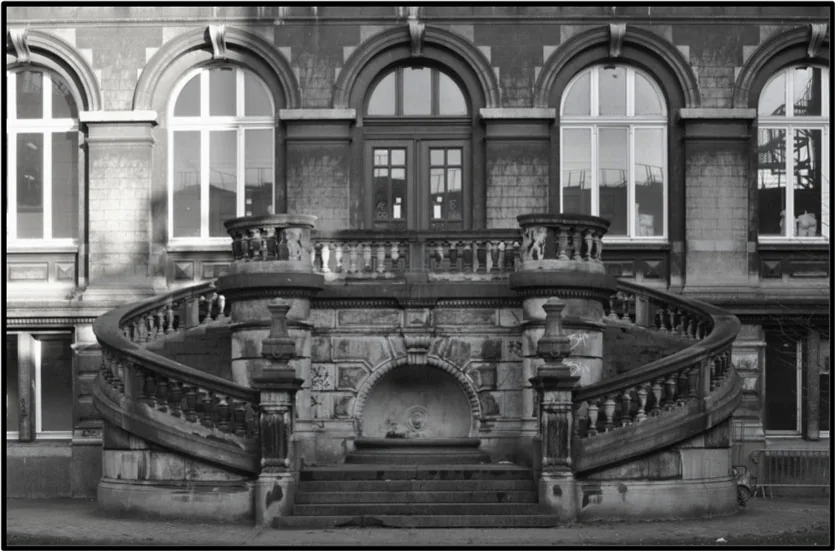
The academy connects its history with artistic teaching established in Liège by Prince-Bishop François-Charles de Velbruck in 1775. It identifies 1836 as its formal foundation as the Royal Academy of Fine Arts. Its later purpose-built premises were inaugurated in July 1895, following a design by city architect Joseph Lousberg. The building replaced earlier accommodation that had become too small for the numbers attending the academy.
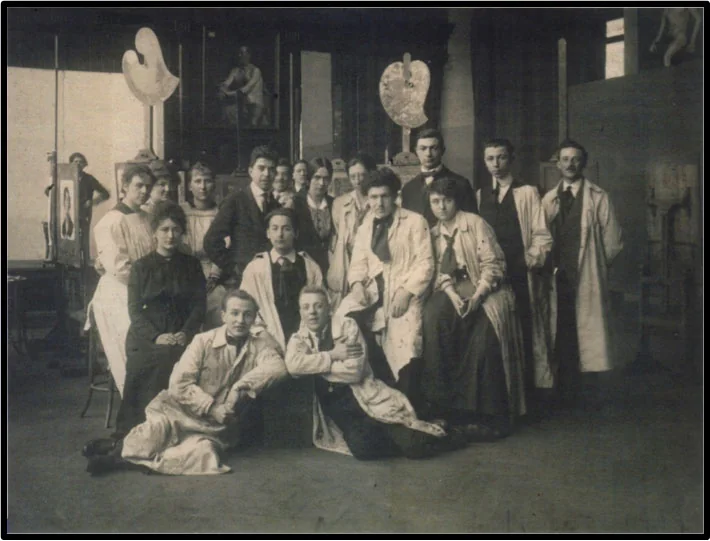
The institution’s historical account also places the building within the wider life of the city. After the First World War, its rooms temporarily housed a Red Cross medical facility for sick and wounded prisoners. Another part of its cultural history concerns the Concerts de Midi, held between 1949 and 1959 in a room associated with the academy’s collections. Historical photographs and accounts displayed for the 2018 open days preserve these connections between artistic education, the city and the changing uses of the academy’s spaces.
Sources: Institutional history ↗
Routes from introduction to advanced practice
Course organisation distinguishes introductory preparation, qualification and transition routes. The preparatory workshop for younger teenagers meets weekly, while multidisciplinary formation provides an entry point for older teenagers and adults without previous artistic learning. Learners with appropriate experience can enter qualification-level studio study. This progression allows the academy to accommodate both first encounters with art and the further development of established skills.
The published structure describes a short transition route with two studio sessions each week and accompanying art history. A certificate follows its three-year sequence. A longer transition route continues advanced study and concludes with a diploma. The academy’s use of these routes reflects the structure of part-time artistic education. The teaching aims to move students gradually from guided discovery towards increasingly independent choices and a coherent personal practice.
Sources: Course organisation ↗
Painting and three-dimensional work
The painting workshop develops observation, analysis, criticism and synthesis alongside practical techniques. Learners work with form, colour, rhythm and the organisation of a surface as they develop projects. Technical learning is connected with expression: the workshop encourages students to find ways of communicating their relationship with the world around them through visual decisions.
Sculpture teaching explores the relationship between meaning, form and emotion through figurative work, abstraction and installation. Students encounter different materials and both classical and contemporary techniques. The workshop includes specific directions in soft sculpture and sculptural ceramics, extending the possibilities beyond conventional rigid forms. Experience, research and successive projects contribute to the development of a personal approach and greater artistic autonomy.
Sources: Painting workshop ↗ · Sculpture workshop ↗
Photography and textile experimentation
Photography teaching encompasses analogue and digital approaches, colour and black-and-white images, technical learning and artistic judgement. Students study camera use, composition and image processing, including work with Photoshop and analogue laboratory methods. The workshop also introduces historical photographic processes. Its facilities include an analogue laboratory, computers and studio flash equipment. Meetings and discussions with established photographers add further perspectives on the medium.
Textile creation approaches fabric and related materials as possibilities for contemporary expression. Learners explore techniques, particular materials and themes, adapting proposals to their interests. Work can begin with existing materials or with elements produced in the workshop, such as threads, motifs and paper. The course encourages participants to expand their understanding of textile supports and develop an individual language through colour, form and material experimentation. It welcomes people without prior textile knowledge, placing importance on a willingness to experiment with materials and explore possibilities through thread and needle.
Sources: Photography workshop ↗ · Textile creation ↗
Young learners and interdisciplinary creation
The preparatory workshop for ages 12 to 15 introduces artistic work across different periods, places and styles. Its practical exploration centres on line, colour and volume. Young learners experiment with materials, tools and techniques so that they can gradually understand their possibilities and discover approaches that suit their own expression. The emphasis is on exploration and the development of familiarity through making.
Experimental practices opens another route across disciplines, connecting areas such as videography, textile work, painting, printmaking and sculpture. Its published description includes space, time, light, sound, narrative, moving images, objects, writing and the public realm among possible materials for thought and creation. This approach encourages connections between established and emerging forms of practice. Together with the academy’s more specialised workshops, it provides a setting in which learners can test ideas across media and consider their relationship with contemporary life.
Sources: Preparatory workshop for ages 12–15 ↗ · Experimental practices ↗