Visa

About Académie Royale des Beaux-Arts
A higher arts school in central Brussels
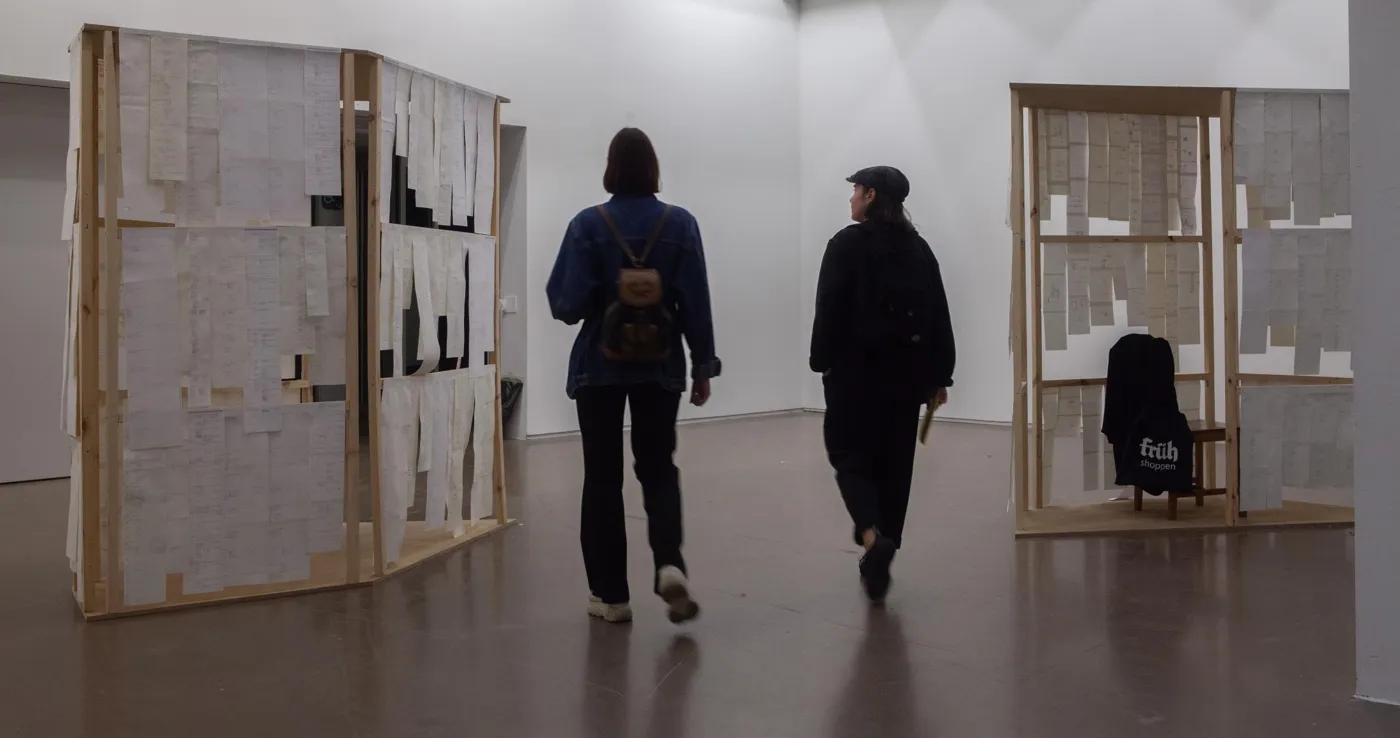
The Académie Royale des Beaux-Arts in Brussels, known as ArBA-EsA, is a higher arts school at 144 Rue du Midi. The City of Brussels is its organising authority, and the institution receives support from the Fédération Wallonie-Bruxelles. Its teaching concerns the plastic, visual and spatial arts, bringing artistic production together with research and critical reflection.
Its courses encompass practices such as interior architecture, communication design, drawing, painting, photography, sculpture, printmaking and textile arts. The school also develops specialised master studies in exhibition practice, editorial practice and urban design. Alongside degree studies, its continuing education includes food design, knitting design and interior design. Exhibitions, workshops, study days and visiting speakers contribute to the academic programme.
Sources: Presentation ↗
Origins and changing artistic traditions
The academy traces its beginnings to 1711, when the municipal authorities allowed painters, sculptors, tapestry makers and other interested participants to practise drawing in a room at Brussels Town Hall. Its origins were therefore closely connected with local artistic corporations and municipal support. Drawing formed the central activity of the early school.
Institutional development continued through changes in patronage, regulations and teaching. Charles of Lorraine granted his protection in 1763, and a subscription organised in 1768 helped establish stronger resources for painting, sculpture and architecture. Following interruptions during the revolutionary period, the academy reopened in 1800. François-Joseph Navez subsequently directed nineteenth-century reforms, and the royal title was granted in 1835. The academy’s history records both longstanding artistic traditions and the experimentation of successive generations.
The historical account also records the expansion of teaching into decorative arts in 1886 and the admission of women to courses following an academic council decision in January 1889. These developments enlarged both the range of artistic work taught and the community able to participate in it.
Sources: History ↗
Studios as the centre of learning
Each course has a studio where students work with their teaching team and encounter the practices of their peers. These spaces support experimentation, production and the gradual development of an individual artistic approach. Students learn to manage their own working methods while participating in a shared environment.
Equipment follows the needs of each medium: printmaking presses, tapestry looms and kilns are among the examples described by the school. Presentations and assessments frequently take place within the studio. The teaching approach emphasises discussion and learning from other people’s practice, with each studio retaining its own organisation and relationship to materials.
Sources: Studio teaching ↗
Building a practice across the bachelor cycle
Bachelor studies extend over three years and combine artistic, technical and theoretical learning. General courses include art history, philosophy, semiotics, literature, human and social sciences, cinema and music history. More specialised theoretical teaching connects this broader foundation with the student’s chosen discipline.
The first year establishes shared foundations alongside the principal studio course. Later study gives increasing space to personal investigation and contemporary questions. In the graduating year, students take greater responsibility for defining their direction, including an additional artistic course that broadens their contact with other media. The cycle culminates in the presentation of a personal project to the diploma jury.
Sources: Bachelor cycle ↗
Crossing disciplines and developing research
Interdisciplinary learning gives students opportunities to encounter practices beyond their main studio. Second-year modules connect practical and theoretical teaching around questions developed with active student participation. In the third bachelor year and first master year, another artistic practice can function as a minor alongside the principal course.
Master seminars bring students from different disciplines together for sustained discussion, reading and theoretical investigation. The school’s master framework also combines artistic work with a written dissertation and an oral defence. Professional internships place students in cultural, industrial or other relevant settings, with a proposed project, an agreed framework and assessment involving the host and teaching staff. A research-oriented master pathway links artistic practice with theoretical enquiry in collaboration with universities.
Sources: Interdisciplinary learning ↗ · Master cycles ↗
Spaces for making and presenting
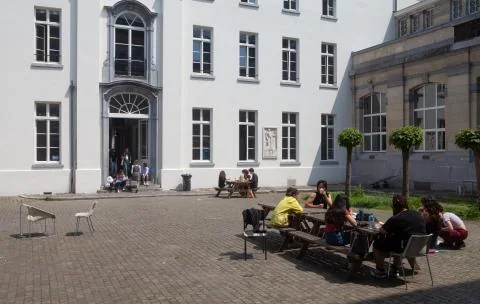
The academy occupies approximately 14,000 square metres across three wings dating from the seventeenth century, nineteenth century and 1970s. Its cloister provides spaces for displaying student work, while the courtyard serves as a meeting place during school events. Dedicated studios sit alongside shared technical, printing and digital platforms.
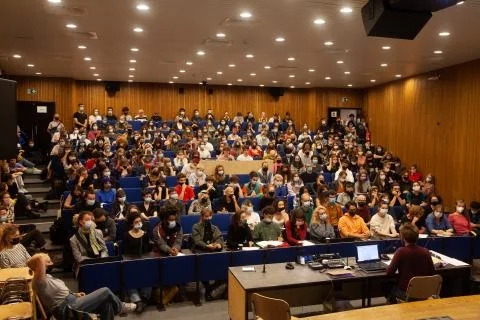
The Horta lecture hall accommodates talks, round tables, theoretical classes and performances. Screenings can also take place there, and students may use its stage space for their work. A materials lending service supplements the workshops, connecting access to equipment with the practical demands of artistic projects.
Sources: Facilities and location ↗
Books, archives and reused materials
The artistic library serves students, teachers and the public. Its holdings include more than 18,000 books and specialised periodicals covering fields such as architecture, ceramics, photography, graphic arts and design. Historic nineteenth-century art and industrial arts publications form part of its heritage collection, accessible through the Brussels regional library catalogue.
La Brolerie offers another kind of resource: a collaborative exchange for reused materials. Participants can give, exchange or obtain supplies ranging from paper and fabric to wood, paint and small art tools. Its internal currency, the Foirien, is earned through materials or services rather than exchanged for money. Student participation in organising the space connects practical resource sharing with cooperation and reuse.
The library belongs to the network of French-language public libraries of the City of Brussels. It provides information, loans and consultation services, connecting the school’s specialist artistic collection with a wider public readership.
Sources: Art library ↗ · La Brolerie materials exchange ↗