Visa

About Aschaffenburg University of Applied Sciences
A university of applied sciences in Bavaria
Aschaffenburg University of Applied Sciences, known in German as Technische Hochschule Aschaffenburg or TH AB, is based in Bavaria’s Lower Main region. Its subject range connects engineering and computer science with business, law, real estate, health and social fields. The university organises its teaching through three faculties: Engineering and Computer Science, Business and Law, and Health and Social Affairs. Its institutional profile emphasises practical education, interdisciplinary work and exchange with companies and other academic institutions. Aschaffenburg is the main campus, complemented by a teaching location in Miltenberg. Applied research and knowledge transfer extend the university’s regional activity through centres in Obernburg and Alzenau. Together, these locations connect academic teaching with work on technical, economic and social questions in the surrounding region.
Sources: About TH Aschaffenburg ↗
Development since 1995
Teaching began on 9 October 1995, initially as part of the University of Applied Sciences Würzburg-Schweinfurt. The first graduates completed their studies in May 1999, and Aschaffenburg became an independent institution in 2000. A further institutional milestone came on 15 March 2019, when it adopted the Technische Hochschule designation. The university’s history also records the establishment of a third faculty in 2022, initially focused on health sciences. Following further development, it was renamed the Faculty of Health and Social Affairs on 1 June 2025. The university celebrated its thirtieth anniversary in 2025. Its historical account documents the development of the campus through photographs of construction, earlier buildings and the people involved in establishing the institution.
Sources: Institutional history ↗
Campus spaces and teaching locations
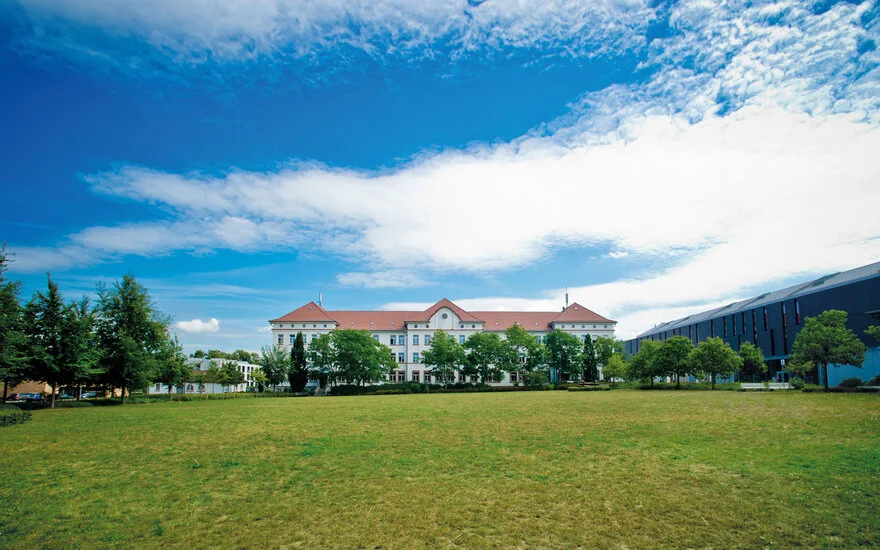
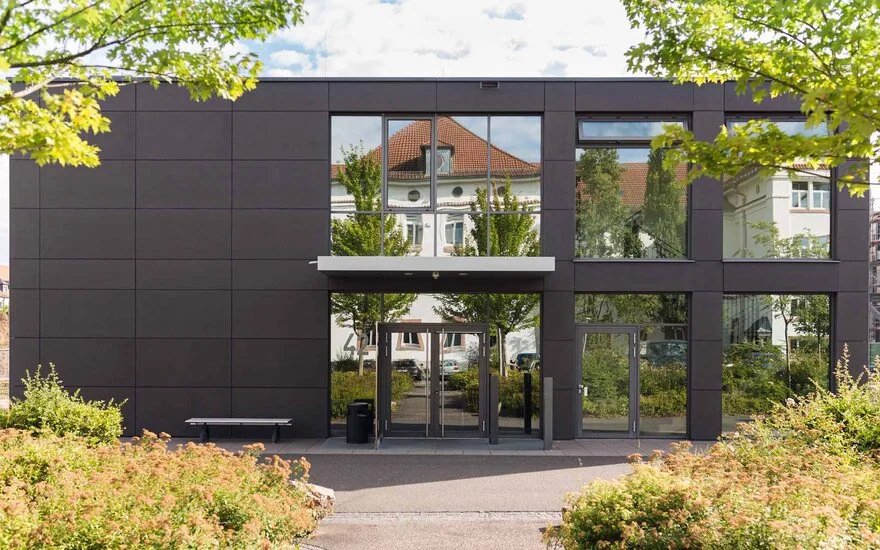
Campus 1 occupies a green site on Würzburger Straße, combining historic and modern university buildings around a central lawn. The library, dining facilities and other teaching spaces form part of this campus environment. The university also identifies Campus 2 further along the same road. Miltenberg provides a separate teaching location for the bachelor’s programme in small and medium-sized enterprise management. Other locations serve specialist research and transfer work: ZeWiS is based in Obernburg, while the Sustainable Energies Technology Transfer Centre, NETZ, is in Alzenau. The university’s campus information distinguishes these different sites and their functions, showing how its activities extend from the central Aschaffenburg campus into the wider Lower Main region.
Sources: Campus and locations ↗
Library resources and academic information
The university library serves students, lecturers, researchers and interested guest users. Its catalogue provides access to books and electronic books, while the Electronic Journals Library supports discovery of electronic journals and newspapers. The Database Information System helps users identify specialist databases. Subject-based search guides organise resources around different areas of study, giving students an entry point into relevant literature. The OPUS publication server makes research and other university publications discoverable, and some student theses are available in printed form within the library. Interlibrary loans extend access to material outside the local collection. Alongside these information services, the library provides courses and advice. Its role combines the provision of academic resources with support for finding and using scholarly information.
Sources: University library ↗
Research as part of study
Students can participate in applied research through several routes. Course-related projects provide an early introduction to laboratory and institute work, while research assistant positions offer another way to join interdisciplinary teams. Bachelor’s and master’s theses may be undertaken in university laboratories, institutes or the NETZ and ZeWiS transfer centres. The university also describes project-oriented master’s study, including industrial engineering, electrical and information engineering, and applied research in engineering and computer science. These programmes place sustained investigation within the study experience. Research advisers and academic supervisors help connect students with appropriate teams and topics. The published guidance presents participation as depending on subject, stage of study and available time, with different forms of involvement linking taught knowledge to practical scientific work.
Sources: Research during studies ↗
Doctoral research and support
Doctoral activity is supported by the interdisciplinary iDok doctoral college. Its provision includes advice, qualification opportunities and networking, accompanying researchers from the development of a project towards publication of their dissertation. Two institutional routes are described: cooperative doctorates with partner universities and research through the Sustainable and Intelligent Systems doctoral centre, NISys. The latter is organised with TH Würzburg-Schweinfurt and Coburg University of Applied Sciences. Its thematic areas include energy and infrastructure systems, mobility, production and materials. The university’s guidance distinguishes supervision at Aschaffenburg from the formal award: degrees are conferred through the relevant partner university or TH Würzburg-Schweinfurt as the managing institution of NISys. This framework connects locally based applied research with the arrangements of the wider doctoral partnership.
Sources: Doctoral research ↗
Intelligent systems and applied technology
Intelligent Systems is one of the university’s identified research focuses. Work in this area concerns the development and use of intelligent software solutions for practical applications. The published themes include artificial intelligence and data science, electronics and electric drives, intelligent mobility, sensors and signals, and robotics and automation. The overview also connects this work with renewable energy, sustainability and applied health sciences. An artificial intelligence competence centre brings together expertise from different disciplines, linking research with teaching and knowledge transfer in collaboration with industry. This focus illustrates the university’s approach to applied investigation: specialist technical capabilities are organised around problems encountered in economic and social settings, with collaboration forming part of the research environment.
Sources: Intelligent Systems research focus ↗