Visa
About Academy of Fine Arts Munich
A Munich academy with historic roots
The Academy of Fine Arts Munich, known in German as Akademie der Bildenden Künste München, is an art higher education institution in Munich, Germany. Its history includes a drawing school established in 1770 and the Royal Academy founded in 1808. The academy developed as a place for painting, graphic art, sculpture and architecture, bringing teaching into contact with the artistic and intellectual life of the city.
The institutional chronicle follows changes in artistic education, buildings and the academy’s relationship with Munich over more than two centuries. Its move towards the northern Maxvorstadt and Schwabing districts helped connect the school with the city’s artists’ quarter. Today the academy maintains a distinct institutional setting in which individual artistic approaches, technical learning and theoretical discussion remain connected parts of higher education.
Sources: Institutional chronicle ↗
Degrees, classes and interdisciplinary study
The academy lists a Fine Arts diploma programme and an Art Education programme leading to the state examination. Interior Architecture is offered at bachelor’s and master’s levels, while Architecture and Art and Fine Arts and Therapy are listed as master’s programmes. These routes connect different forms of artistic, spatial and educational practice within the same institution.
Study is organised around professor-led classes, each representing an individual approach to visual art. Workshops provide craft and technical learning, while seminars and lectures address art studies, philosophy and didactics. The cx centre for interdisciplinary studies contributes courses organised around a theme that changes each year. Guest lectures, workshops and excursions bring additional perspectives into this class-based structure. The academy describes its teaching through three connected elements: artistic criticism, practical and technical learning, and historical and theoretical orientation.
Sources: Academic study ↗
Historic architecture and a modern extension
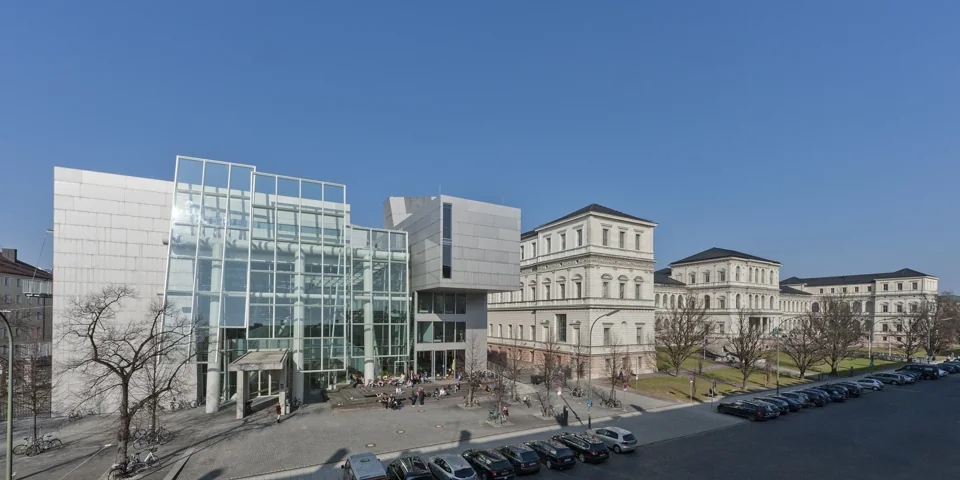
The older academy building was designed by Gottfried von Neureuther near the Siegestor. Construction faced interruptions and funding difficulties before the completed building was formally transferred to the academy in July 1886. Its neo-Renaissance composition combines a long facade, central pavilion and corner pavilions, with a courtyard, staircase and curved approaches contributing to its public presence.
War damage and postwar reconstruction altered parts of the original design. The academy’s architectural account describes changes to roofs and internal arrangements, while noting the survival of generous daylight-filled corridors. A further development came from the competition won by Coop Himmelb(l)au in 1992. The extension’s foundation stone was laid in 2003, and the building came into use in 2005. The old and new buildings now provide contrasting architectural settings for the academy’s work.
Sources: Buildings and architectural history ↗
A reference library for art study
The academy library is an academic reference library with a particular focus on art after 1945 and contemporary artistic practice. Exhibition catalogues form a significant part of its collecting interests. Its published information identifies printed volumes, audiovisual material and current periodicals as resources for students and teaching staff, bringing different forms of documentation into one study environment.
The student identification card also functions as a library card and is presented on entry. The library provides information about internet research access through the university’s computing arrangements. Its website separates resources such as the Primo library portal, databases, journals, media collections and historical library information. These services support looking closely at artistic production, following exhibitions and placing studio activity within a wider body of writing and documentation.
Sources: Academy library ↗
Student-led discussion through Jour Fixe
Jour Fixe is a lecture series organised by academy students. Established in 2007 by Verena Frensch and Asta Unger, it invites international artists to speak publicly about their work. The visit continues with a workshop for interested students on the following day. This format connects an open presentation with a smaller setting for exchange and practical investigation.
The academy’s account records successive student organisers rather than presenting the series solely as a staff-led teaching activity. It is supported through cross-study funding. The combination of public lectures and workshops creates a route for students from different classes to encounter artistic positions beyond their immediate studio environment. It also gives the student organisers experience in shaping a programme, inviting participants and maintaining an ongoing forum for discussion.
Sources: Jour Fixe lecture series ↗
The AkademieGalerie as a public window
The AkademieGalerie has presented projects by academy students since 1989. Its description emphasises works developed specifically for the exhibition room and the opportunity to encounter the variety of artistic positions represented within the institution. The gallery therefore provides both a public presentation space and a context in which students think about how work relates to a particular site.
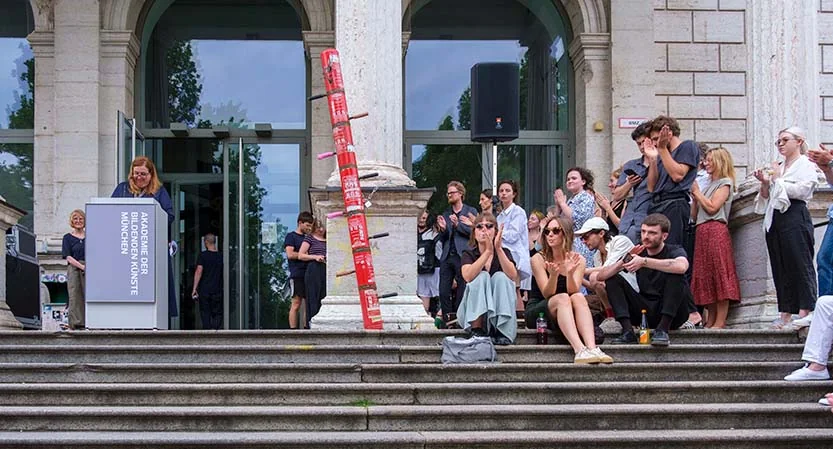
The published programme documents individual and collaborative exhibitions, including projects by classes and partnerships with students from other art institutions. Openings, performances and other associated activities extend some exhibitions beyond a static display. Alongside annual and final exhibitions listed by the academy, this continuing gallery programme helps make student activity visible outside the everyday teaching environment.
Sources: AkademieGalerie ↗
International exchanges and practical coordination
The International Office maintains cooperation with partner universities and acts as a contact point for exchanges and scholarships connected with periods abroad. Its information addresses both students and staff arriving in Munich and members of the academy preparing to travel elsewhere. This gives international cooperation an identifiable administrative base alongside artistic and academic contacts.
The office publishes information about exchange opportunities, application periods and deadlines, as well as the academy’s European Policy Statement for 2021–2027. It also directs outgoing students towards internship arrangements, subject to eligibility and available funding. These functions help connect individual study plans with the practical organisation of international mobility.
Sources: International office and mobility ↗