Visa
About Academy of Arts Education
Professional development in cultural education
The Academy of Arts Education in Remscheid, Germany, operates under the German name Akademie der Kulturellen Bildung des Bundes und des Landes NRW. Its work centres on continuing education for people involved in arts, culture, education and youth work. Located at Küppelstein 34, the academy provides a meeting place for practitioners who want to develop artistic methods, educational approaches and professional relationships across different disciplines.
The institution is organised as an independent, registered nonprofit association. Its membership represents cultural education and the promotion of children and young people. The academy describes its role as connecting people and resources across the cultural education field. Alongside specialist knowledge, it emphasises identifying participants’ abilities and developing their strengths. Its institutional information also explains its approach to learning quality and its safeguarding framework, including a code of conduct and procedures intended to support respectful interaction among staff, guests and younger participants.
Sources: About the academy ↗
Courses across artistic and educational fields
The academy’s programme includes short courses, online learning and professional qualifications organised over several phases. This range allows it to serve people seeking a focused introduction as well as those developing a sustained specialism alongside their work. The multi-phase course catalogue spans literature, music, movement, visual art, media, cultural management and counselling, with many courses connecting more than one subject area.
Examples listed in the current catalogue include storytelling, inclusive literature education, elementary music pedagogy and instrumental teaching with people with disabilities. Other qualifications concern cultural education management, performance art in cultural education, contemporary dance teaching and systemic counselling. The list also includes architectural culture education and arts education for youth art schools and all-day schools. These examples illustrate professional development aimed at applying artistic and educational methods in practical settings, rather than a single general arts course.
Sources: Multi-phase certificate courses ↗
Visual arts and experimental practice
The Visual Arts department combines contemporary artistic approaches with established techniques. Its description places artistic work in relation to current events, personal biography, places and the people who use them. It treats art both as an experimental process and as an intervention that can initiate discussion. The same approach informs its continuing education activities for cultural educators.
The published programme illustrates this breadth through painting, ceramics, experimental printing and open studio work. It also includes courses exploring artificial intelligence in art, creative self-presentation online and artistic responses to social questions. A multi-phase qualification focuses on arts education in youth art schools and all-day schools. Across these offerings, making art and considering how to communicate it to others form connected parts of the department’s work.
Sources: Visual arts department ↗
Media education and digital culture
The Media department addresses photography, video, games, apps, artificial intelligence and social networks. It connects these subjects with the growing importance of media literacy in family life, schools, youth work and cultural institutions. Its professional development courses use interdisciplinary approaches and are aimed at staff working in institutions, associations and project settings.
The department offers short, medium-length and longer training formats. It states that its courses align with the North Rhine-Westphalia media competence framework, with relevant competence areas identified in individual course descriptions. Programme examples include virtual reality in educational projects, poetry clips, storytelling for games and digital privacy. Longer qualifications include Cultural Education and Media Competence, practical media education and a professional media education course with opportunities for individual specialisation. This connects creative production with educational planning and responsible use of digital tools.
Sources: Media department ↗
A residential campus for learning and meetings
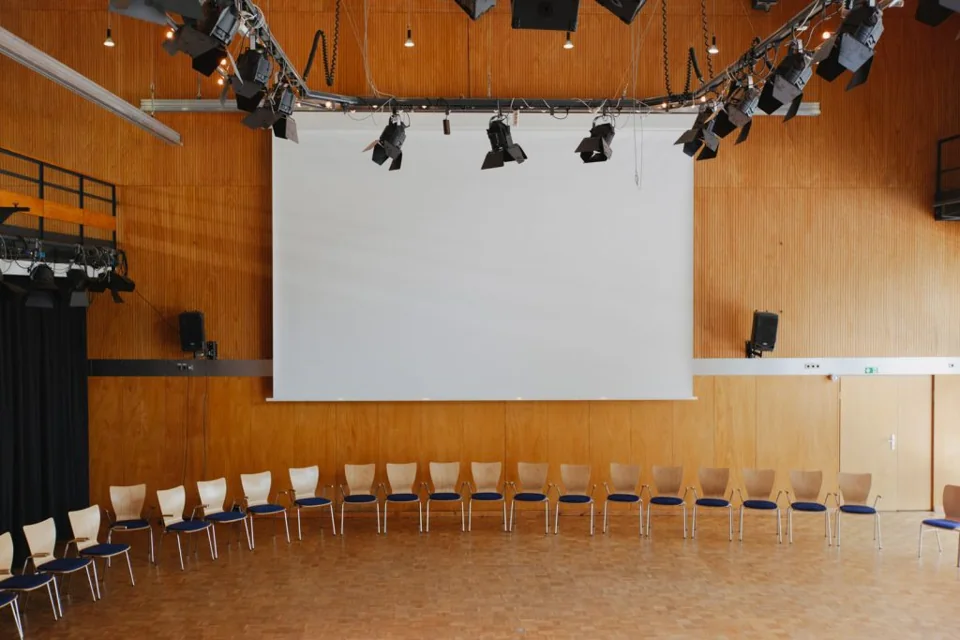
The academy’s campus lies in a green setting between Cologne, Düsseldorf and Wuppertal. It combines teaching facilities with accommodation and meals, supporting courses that bring participants together for several days. Its venue information lists twenty meeting and movement rooms, laboratories and workshops. It also hosts external groups and organisations working in cultural education at regional, national and international levels.
Accommodation comprises 110 beds in single and double rooms, with family-friendly options. The cafeteria provides meals throughout the day and includes a daily vegetarian option. A specialist library brings together literature on cultural education theories, concepts, projects and methods, together with professional journals and information services. The venue’s published examples of visiting groups include orchestras, choirs, theatre education organisations and professional associations. These facilities support a combination of practical activity, discussion and residential study.
Sources: Campus and meeting venue ↗
Professional networks and shared knowledge
The academy is the legal host of the North Rhine-Westphalia cultural education support office, which advises municipalities, schools and youth organisations on developing and connecting cultural opportunities for young people. It also provides the legal framework for the German Centre for Youth and Children’s Films, known as KJF. That centre works in cultural media education and film culture, including national youth photography and film competitions.
Publishing provides another route for sharing professional knowledge. In 2026, the academy launched a book series with kopaed addressing current cultural education topics, including architectural culture education and artificial intelligence. Its earlier Perspectives on Cultural Education series examined subjects such as diversity and changing values. The academy also participates in the partnership behind Kulturelle Bildung Online, an openly accessible knowledge platform bringing together research, theory and practical reflection for practitioners, students and researchers.
Sources: Institutional partners ↗ · Publications ↗