Visa
About Academy of Fine Arts Münster
An art university on Leonardo Campus
The Academy of Fine Arts Münster is known in German as Kunstakademie Münster and presents itself in English as the University of Fine Arts Münster. Located in Münster, Germany, it brings individual artistic practice together with art-related scholarship and the preparation of art teachers. Its campus setting combines purpose-built studios with historic buildings, placing daily creative work close to workshops, exhibition spaces and a specialist library.
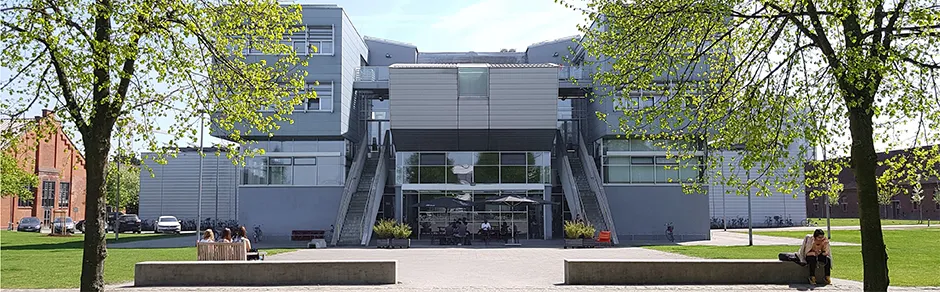
Since 2001 the academy has occupied the Leonardo Campus near Münster's old town. The site began as a cavalry barracks in 1898, later passed into British military use, and was taken over by North Rhine-Westphalia in 1994. Architect Günther Domenig designed the academy's main building on the former riding-arena site. Converted historic buildings surrounding it accommodate studios and workshops. Architecture and design departments of FH Münster and facilities of the University of Münster also use the wider campus.
Sources: University profile and campus ↗
Fine arts and the education of art teachers
The Fine Arts course has a standard duration of ten semesters and culminates in the Akademiebrief. The academy describes this qualification as equivalent to a German Diplom at master's qualification level. The course comprises two semesters of orientation followed by eight semesters of studio study. Students retain freedom in their choice of artistic medium throughout their studies, allowing a practice to evolve across materials and forms rather than being fixed to one medium at entry.
Art teacher education is organized with the University of Münster. Students undertake their artistic studies at the academy while educational sciences and other required subjects are studied at the partner university. The programmes comprise six-semester bachelor's courses followed by four-semester Master of Education study, with routes for different school types. Studio work remains part of this education alongside art history, media and art theory, didactics and practical teaching experience. The academy also has doctoral provision in its academic fields of art didactics, art history and art science.
Sources: Degree programmes ↗
Beginning together, developing an individual practice
Students entering the academy begin with an orientation year that brings newcomers together during their first two semesters. This initial phase establishes foundations for artistic study and helps students find their way into an individual working process. Successful completion is required before progression into an advanced artistic class. It gives the beginning of study a shared structure before students develop their work within a particular studio community.
The subsequent artistic classes bring together students across semesters and degree programmes under the guidance of artists. The academy's programme description identifies fields including painting, sculpture and installation, art in public space, performance, expanded photography, film and video, and cooperative strategies. This arrangement places exchange between students at different stages alongside individual artistic development. Workshops and scholarly teaching complement the sustained process of making, discussing and refining work in the studio.
Sources: Orientation year ↗ · Artistic classes ↗
Art history and critical inquiry
Art-related sciences provide historical and analytical perspectives alongside studio work. Art history teaching ranges from late antiquity to the present and includes the global connections of Western art as well as global modern art. Introductory study considers historical periods and how they have been constructed, with close analysis of artworks and their contexts. Learning in front of original works includes local excursions and seminars at the LWL Museum. More advanced seminars examine the methods used to write art history. This scholarly element encourages students to develop an informed, reflective position toward both historical and contemporary art.
Sources: Art-related sciences ↗
Materials, processes and moving images
The workshops teach material knowledge and technical processes through courses and support for individual projects. Woodworking includes hand tools, machinery and CNC milling, while ceramic and mould-making facilities support work with stoneware, porcelain and plaster. Metalworking provides opportunities to learn welding, forging and other processes. Painting technique includes preparing supports and understanding paints, grounds and solvents. Print facilities cover etching, screen printing, digital printing, risograph production and bookbinding processes.
Photography provision combines digital facilities with an analogue laboratory and a studio. Film, video and new media work can involve digital recording, analogue 8 mm and 16 mm film, virtual reality and 360-degree video. Production equipment is complemented by editing rooms, sound facilities and a film studio; a professional colour-grading area was added in 2025. After the relevant instruction, students can use facilities and borrow equipment for their own artistic projects.
Sources: Artistic and technical workshops ↗
A library and a public conversation about art
The specialist Library for Architecture, Design and Fine Arts opened in 2001 as a shared facility with FH Münster's architecture school. Design later joined the campus, and the library gained an extension planned with a student working group. Contemporary art is a principal collecting area, alongside an expanded art education and didactics collection. Its online material library records materials with information about their origins, appearance, properties and possible applications, complementing books and other research resources.
The public Münster Lectures began in the summer semester of 2009. During teaching semesters, speakers from the international art world discuss their work with students and a wider audience interested in art. The series connects theoretical questions with artistic practice and offers a forum for discussion of current issues. Together with studio exchange, exhibitions and the academy's international partnerships, it makes encounter and dialogue part of the setting in which students develop their work.
Sources: Library and university institutions ↗ · Münster Lectures ↗