Visa


About Arthur Jarvis University
A university in Akpabuyo
Arthur Jarvis University is a private university in Akpabuyo, Cross River State, in the Calabar area of southern Nigeria. Founded by Sir Arthur Jarvis Archibong, it received its federal operating licence in November 2016 and began academic activities on 6 March 2017. Its initial provision consisted of fifteen degree programmes within the Faculty of Natural and Applied Sciences and the Faculty of Humanities, Management and Social Sciences.
The university’s mission connects academic knowledge with life skills and entrepreneurship. Its philosophy presents education of the whole individual as a foundation for social and economic development. Commitment, excellence and integrity are its stated core values. The institution’s account of its development also emphasises community engagement, extracurricular participation and the cultivation of critical thinking, alongside disciplinary study.
Sources: History, mission and values ↗ · Institutional location ↗
A multidisciplinary academic portfolio
The university’s course directory brings together natural sciences, humanities, social sciences, business and health-related disciplines. Its science offerings include biology, microbiology, plant science and biotechnology, chemistry, biochemistry, mathematics, computer science, geology and applied geophysics. These subjects provide several routes through laboratory, quantitative and environmental study.
The humanities and social-science listings include English, economics, sociology, political science, public administration, journalism and mass communication, criminology and security studies, and hospitality and tourism management. Accounting, banking and finance, and business administration also appear in the directory. Health-related provision is organised separately, alongside law. The breadth of this published portfolio reflects the university’s development beyond its original two-faculty arrangement. Individual departments provide further descriptions of their teaching methods, practical components and subject-specific objectives.
Sources: Programme directory ↗
Biological sciences and experimental learning
Biological Sciences combines teaching about microorganisms, plants, animals and other living systems with practical laboratory work. The department describes its subject through structure, genetics, ecology, function and interactions between organisms. Laboratory sessions and research activities form part of its approach to microbiology, biology and biotechnology.
Industrial attachment is included in the department’s programme framework, connecting study with applications in areas such as agriculture, food production, pharmaceuticals and cosmetics. The department’s educational objectives include evaluating scientific literature, assessing research findings and applying problem-solving methods. Students are also expected to communicate scientific ideas through presentations, reports and publications. Designing experiments, collecting and analysing data, and drawing conclusions are identified as further components of scientific training. This combination links understanding living systems with the methods used to investigate them.
Sources: Biological Sciences ↗
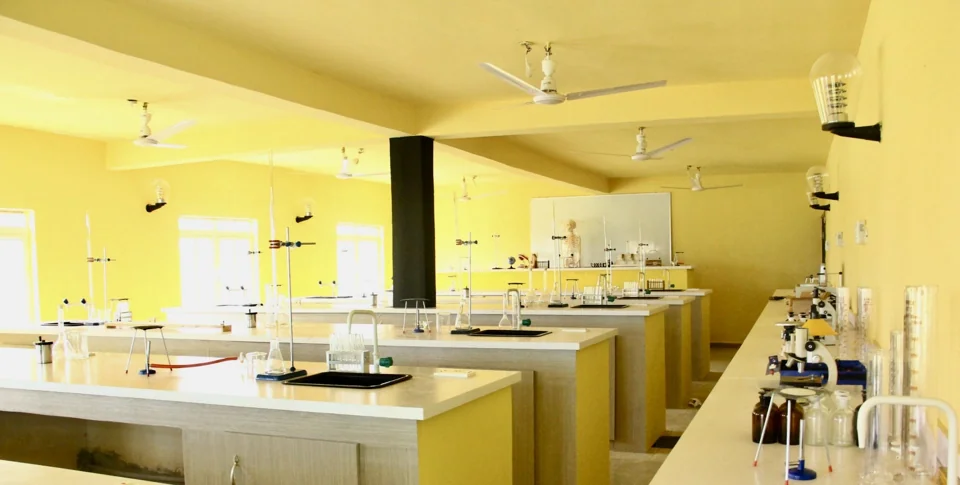
Chemistry, biochemistry and practical skills
The Department of Chemical Sciences offers undergraduate study in chemistry and biochemistry. Its account of biochemistry focuses on chemical processes within living organisms and their applications in areas including agriculture and food science. Practical exposure includes routine laboratory analysis, quality control, product analysis and research involving medicinal plants.
Industrial work experience is a mandatory component described by the department. Entrepreneurial learning is another stated focus, with attention to transferring classroom knowledge into the development of products and services. The department’s published framework therefore combines disciplinary knowledge, laboratory methods and experience outside the classroom. It also encourages the development of professional skills alongside academic study. These activities are presented as parts of the educational programme, linking the study of chemical and biological processes with practical investigation and product-oriented work.
Sources: Chemical Sciences ↗
Earth sciences in the field and laboratory
Earth Sciences offers geology and applied geophysics, with teaching concerned with the Earth’s history, processes and resources. The department describes a practical approach that includes geoscientific software, field mapping and groundwater investigation or modelling. Geological, seismic and geotechnical log interpretation also feature in its account of student training.
The subject is connected with questions involving natural resources, infrastructure, water and environmental protection. Conferences are included among the experiences through which students encounter the wider field. The department’s emphasis on mapping, interpretation and investigation gives its programmes a combination of outdoor observation and analytical work. These methods allow students to approach geological questions through several kinds of evidence, while relating their studies to the physical environments and resource issues discussed within the discipline.
Sources: Earth Sciences ↗
Mathematics and computing
The Department of Mathematics and Computer Science offers bachelor’s programmes in both subjects. Its published educational aims include developing analytical ability, innovation and creativity, while encouraging students to undertake product-oriented research. Entrepreneurship and contributions to community life are also included in the department’s objectives.
The department identifies artificial intelligence, machine learning, software engineering and programming among its areas of computing interest. These are presented within the department’s broader educational ambitions rather than as a separate degree title for each topic. Its account places emphasis on combining intellectual development with the practical use of computing knowledge. Research and innovative community service are described alongside teaching, giving the department a framework that connects technical study with the application of ideas beyond individual coursework.
Sources: Mathematics and Computer Science ↗
Health sciences and legal education
The Faculty of Basic Medical Sciences brings together anatomy, physiology, public health, medical laboratory science, nursing science and optometry. Its teaching framework combines intellectual study with practical training, and the faculty identifies undergraduate education, research and community involvement among its activities. The published programmes include science degrees in anatomy, physiology and public health, alongside the professional degree programmes in laboratory science, nursing and optometry.
Sources: Basic Medical Sciences ↗
Advocacy and educational partnerships
The Faculty of Law describes an educational experience that extends beyond classroom study. Its welcome statement identifies inter-university competitions as opportunities for law students to practise advocacy. Extracurricular activities, entrepreneurship, character and learning are also included in its account of student development. These activities complement the academic component of the law programme and connect legal study with communication and public participation.
Sources: Faculty of Law ↗
An optometry education initiative
The university has also published an account of an Optometry Education Project with Optometry Giving Sight and Charis Vision and Health Mission. The reported project period ran from October 2025 to September 2026. Its stated purpose was to strengthen training through ophthalmic equipment and capacity building. The project description included a university optometric clinic and practical experience, with longer-term educational milestones. These were the initiative’s published aims, rather than evidence that every planned outcome had already been achieved.
Sources: Optometry Education Project ↗