Visa
About Abiola Ajimobi Technical University Ibadan
A technical university in Ibadan
Abiola Ajimobi Technical University is an Oyo State university in Ibadan, Nigeria, also known as Tech-U. Formerly called First Technical University, it carries the name of the former state governor Abiola Ajimobi. An Oyo State government announcement records the decision to rename the institution during its second convocation ceremony in March 2023. The university’s present official website uses the Abiola Ajimobi Technical University name.
The university describes its purpose as addressing the gap between academic knowledge and the practical capabilities required in industry. Its educational philosophy combines theory, hands-on experience, entrepreneurship, innovation and sustainability. Rather than treating technical competence as separate from university study, it aims to develop these together. Its published About page identifies subjects such as mechatronics, biomedical engineering, food science and technology, computer science, cyber security and software engineering among its areas of study.
Sources: About Tech-U ↗ · Oyo State government: university renaming announcement ↗
Engineering study and curriculum resources
Tech-U’s academic handbook directory gives a detailed view of its technical orientation. It publishes curriculum guides for agricultural, biomedical, chemical, civil, computer, electrical, industrial and production, mechanical, mechatronics and petroleum engineering. Food science and technology has a separate guide as well. The collection gives students a route into the organisation and content of individual programmes, including subject requirements and the progression of study.
The About page describes classrooms, laboratories, an electronic library and hostel accommodation as part of the university’s learning environment. Its broader aim is to combine academic competence with practical and entrepreneurial capabilities. That emphasis is reflected in the handbooks’ attention to engineering applications, student responsibilities and professional judgement. The documents provide more specific evidence of the university’s teaching model than general claims about graduate success or employment prospects.
Sources: About Tech-U ↗ · Official curriculum handbook directory ↗

Mechanical engineering in practice
The 2025 Mechanical Engineering handbook places the programme within the Department of Mechanical and Mechatronics Engineering. It explains that the department was formed in the 2020/2021 academic session, while its two engineering programmes were among the faculty’s pioneer offerings in 2017. The departmental philosophy combines general engineering knowledge with manufacturing practice, management and entrepreneurial education. It also identifies connections with industry as part of its educational objectives.
The handbook describes capabilities such as designing components and systems, developing production techniques, installing and maintaining equipment, and adapting technology to local engineering problems. Students are expected to develop professional judgement alongside technical understanding. Its curriculum guide includes course descriptions, industrial attachment and mentoring, assessment arrangements and programme learning outcomes. This combination presents engineering as both an analytical discipline and a practice involving people, resources, decisions and responsibility for functioning systems.
Sources: Mechanical Engineering undergraduate handbook, 2025 ↗
Biomedical engineering and health technology
The Biomedical Engineering handbook describes an interdisciplinary programme bringing engineering principles together with biomedical and biological science. Its aim is to prepare students to investigate health technology needs and contribute to equipment design, development and application. It discusses medical devices, instrumentation, biomaterials and healthcare technologies as areas where engineering knowledge can support the work of health professionals. This is an engineering educational pathway rather than a description of medical practitioner training.
The programme’s published objectives include designing systems within economic, environmental, social and safety constraints. Ethical awareness, communication, teamwork, project management and continued learning are part of the stated outcomes. Students are also expected to understand how technologies can be installed, maintained and adapted to local conditions. The guide links technical knowledge with needs assessment and responsible decision making, making the broader context of healthcare technology part of the engineering learning process.
Library support and digital information
The university’s library development is connected with its wider emphasis on academic resources and technology. The official librarian profile records work on digital transformation, resource management and support for accreditation and resource verification exercises. It describes library leadership as concerned with strengthening access to information as well as managing academic collections. This places the library within the university’s teaching and research infrastructure.
The website directs users to electronic resource providers including ProQuest, EBSCOhost, JSTOR, ScienceDirect and Research4Life, alongside catalogue links. It also provides access points for student and staff portals, academic calendars and programme handbooks. These links show the different information routes brought together by the university, although access to particular subscribed resources depends on the relevant platform and university arrangements. The combination supports students seeking course information, scholarly literature and administrative services.
Sources: University librarian and library development ↗ · University homepage and electronic resource links ↗
A documented international student project
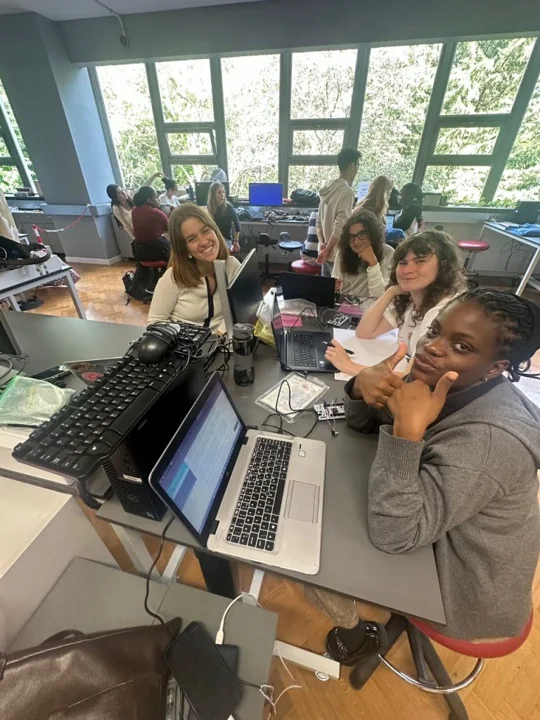
A September 2025 university report describes software engineering student Daniella Abimbola Kolade taking part in an Internet of Things and artificial intelligence bootcamp at Jesus College, Cambridge. Held from 25 August to 12 September, the event brought together participants from different countries to work in teams. The report connects her participation with the Afya Moja health technology capacity building project, in which Tech-U is an institutional partner.
Kolade’s team developed EmMediLux, a project focused on hospital power interruptions, and was named the winning team. The university describes the experience as involving technical work, business model development, resilience, design thinking and presentations. This dated example illustrates a student applying computing knowledge to a practical problem through international collaboration. It is a specific documented achievement, adding a concrete student experience to the university’s stated emphasis on technical skills, creativity and problem solving.
Sources: Daniella Kolade and the 2025 Cambridge bootcamp ↗