Visa
About Army Medical College
A medical college in Rawalpindi
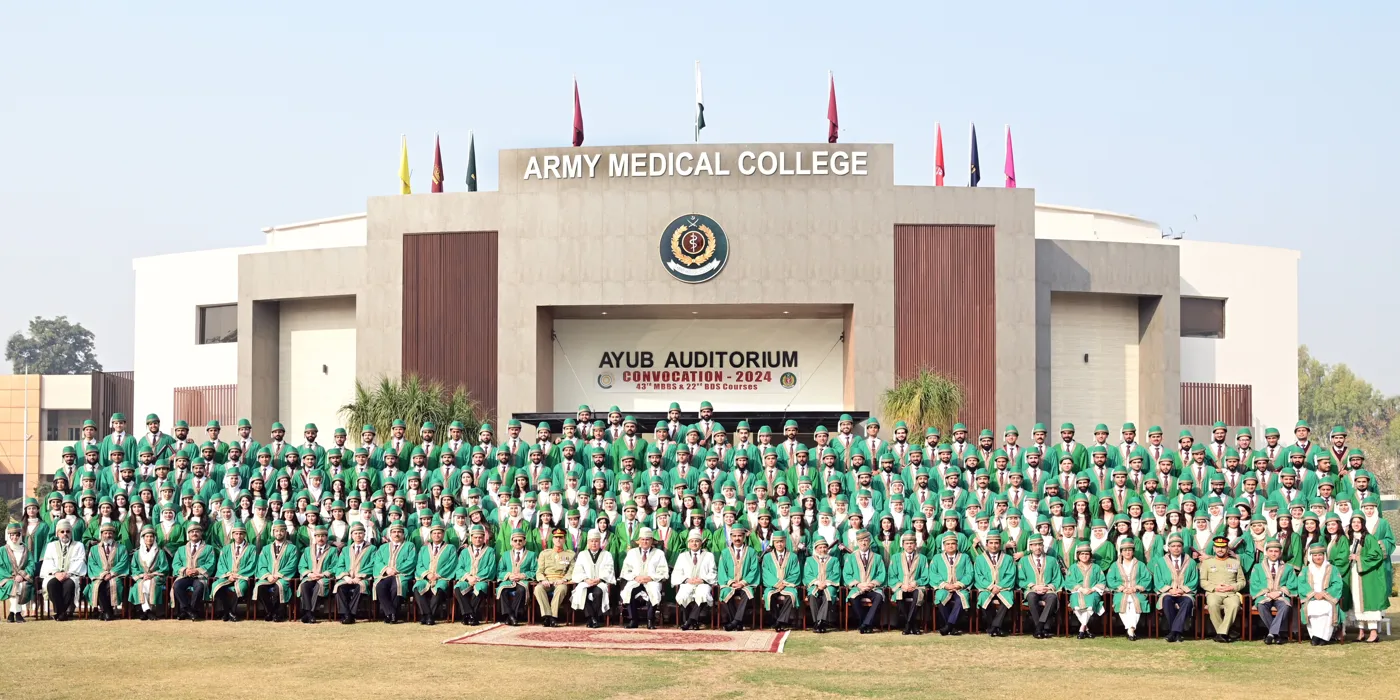
Army Medical College was established in Rawalpindi in 1977 as a residential institution. It initially offered its MBBS degree through affiliation with Quaid-i-Azam University in Islamabad. The college’s published history records its subsequent incorporation within the National University of Sciences and Technology in 1998 and its transition to a constituent college of the National University of Medical Sciences in 2016.
Postgraduate training in basic medical sciences began in 2001, adding further academic and research provision to undergraduate medical education. These institutional changes connect the college’s development with successive university frameworks while retaining its identity as Army Medical College in Rawalpindi.
Sources: College history ↗
Educational purpose and professional values
The college’s mission addresses both undergraduate and postgraduate medical students. It emphasises scholarship, service and lifelong learning, alongside ethical and evidence-based healthcare. The intended scope of service includes Pakistan’s armed forces and the wider community.
Integrity and leadership also appear in its vision for medical education and research. These are stated educational aims that shape the institution’s account of professional development: scientific understanding is presented together with responsibility towards other people. The mission places continuing learning within the medical student’s future professional life, extending the purpose of education beyond completion of a particular examination or degree.
Sources: Mission and vision ↗
Postgraduate study in medical and dental sciences
The postgraduate programme directory identifies MPhil study across a range of basic and related medical sciences. Listed subjects include anatomy, physiology, biochemistry, pharmacology and community medicine. Haematology, chemical pathology and microbiology provide further laboratory-oriented fields, while molecular medicine and the science of dental materials extend the range into additional specialist areas.
The PhD directory includes physiology, biochemistry, molecular medicine and the science of dental materials. These offerings place postgraduate study alongside the college’s undergraduate role and provide academic pathways concerned with particular scientific disciplines. The distinction between the MPhil and doctoral lists is useful in understanding the college’s structure: its postgraduate provision involves several subject areas rather than a single general medical research programme.
Sources: Postgraduate programmes ↗
The library and learning-resource environment
The Army Medical College Library supports students, researchers and faculty with resources for academic work. Its published description places medical knowledge alongside allied information and technology subjects and identifies faculty participation in developing the library’s provision. Both physical collections and electronic resources contribute to this learning environment.
The listed services include an Online Public Access Catalogue, a digital library with electronic books and lectures, journals prescribed through the Higher Education Commission, and access to the Hinari database. Textbooks, circulation books and reference materials provide different forms of printed support, complemented by journals, magazines and newspapers. The Learning Resource Center forms part of this provision. Together, these resources accommodate course preparation, reference work and the wider information needs of students and academic staff.
Sources: Learning Resource Center and library ↗
Simulation-based skills education
The Skills Lab originated within the Community Medicine Department in 2012. Its account describes the inauguration of a dedicated facility in December 2022 and an expansion with another hall in November 2024. The laboratory uses manikins, anatomical models and other trainers to provide structured practice outside immediate patient-care situations.
Its educational outline combines communication, history taking and physical examination with clinical reasoning, professionalism and ethics. Confidentiality, informed consent and reflection are included alongside practical learning. Simulation sessions and case-based work allow students to connect scientific knowledge with professional situations. Assessment approaches listed by the laboratory include direct observation using checklists, Objective Structured Clinical Examinations, peer and instructor feedback, and return demonstrations. These are descriptions of the teaching framework, showing how practice and feedback are organised within the college’s educational environment.
Sources: Skills Lab ↗
Developing teaching and assessment
The Department of Medical Education was established in 2019. It describes its role in terms of evidence-based academic development and the growth of both students and faculty. Its published introduction links educational change with the college’s own vision and its wider university setting.
The departmental structure distinguishes curriculum and faculty-development work from assessment. Its activities include faculty-development programmes and work involving NUMS Master of Health Professions Education interns. The department’s public message also discusses changing approaches to teaching, learner engagement and the use of technology, including the experience of remote learning during the pandemic. This educational focus complements the subject departments by addressing how medicine is taught and how students’ learning is assessed.
Sources: Department of Medical Education ↗
Mentoring through the Student Support Cell
The Student Support Cell provides a structured mentoring system for undergraduate students. Designated faculty mentors offer guidance and encouragement through regular interactions with their mentees. Its remit covers academic challenges alongside adaptation to the demands of health-professions education.
The cell’s description includes support for managing stress and maintaining emotional wellbeing, with early identification of students who may need additional assistance. Appropriate referral forms part of the stated approach when further help is required. Academic, personal and professional development are therefore considered together. The emphasis is on maintaining a supportive and inclusive learning environment in which students have an identifiable route to faculty guidance during their undergraduate studies.
Sources: Student Support Cell ↗
Residential and recreational facilities
Army Medical College describes itself as residential, with accommodation organised into cadet companies for male and female students. Rooms are shared and furnished with beds, study tables, chairs, book racks and cupboards. Mess facilities provide dining within the residential organisation, while study rooms include computers and internet access.
Recreational provision extends beyond accommodation. The hostel page lists outdoor sports grounds, facilities for racket and court sports, a gymnasium and a cadets’ cafeteria. Common television rooms and a visitors’ room provide further shared spaces, and a mosque serves the residential community. These facilities bring study, meals, recreation and everyday residential life into the same college environment. The published account presents accommodation as part of the students’ overall college experience, alongside formal teaching and academic support.
Sources: Residential facilities ↗