Visa
About Aga Khan University
A university rooted in Pakistan
Aga Khan University, generally known as AKU, is a not-for-profit university founded in Pakistan in 1983 and an agency of the Aga Khan Development Network. It began with a focus on health sciences and subsequently developed a wider academic portfolio. Its mission connects teaching, research and service with improving quality of life, while giving importance to leadership, pluralism and opportunities for disadvantaged communities.
Karachi is central to the university’s work in Pakistan. The Stadium Road campus houses the Medical College and School of Nursing and Midwifery, together with the university hospital and specialist teaching and research centres. The Faculty of Arts and Sciences is also identified within its Karachi academic provision. At the Karimabad campus, the Institute for Educational Development operates alongside a professional development centre and the Examination Board. Other Pakistani teaching sites include professional development centres in Gilgit and Chitral. These locations form part of an international university whose academic units in other countries have their own programmes and facilities.
Sources: About Aga Khan University ↗ · Campuses and sites: Pakistan ↗
Medical education and research
The Medical College in Pakistan was established in 1983 within AKU’s Faculty of Health Sciences. Its approach gives attention to students’ professional, personal and intellectual development, with teaching connected to both community settings and hospitals. The five-year Bachelor of Medicine, Bachelor of Surgery programme provides its undergraduate medical route. The college also describes a two-year dental hygiene programme, graduate study and postgraduate education through internship, residency and fellowship programmes.
Research and further study are integral to the college’s academic role. Its graduate programmes address interests in the causes of disease and the management of healthcare, involving professionals and basic scientists. Elective and visiting-student opportunities, a Human Development Programme and online certificate courses provide additional educational activities. The college’s stated aim is to develop responsible professionals who contribute to society as well as advancing their chosen academic or professional fields.
Sources: Medical College, Pakistan ↗
Nursing, midwifery and practical learning
The School of Nursing and Midwifery in Pakistan predates the university’s formal foundation: it was established in 1980 and is identified as AKU’s first academic unit in the country. It offers undergraduate education in nursing and midwifery, alongside master’s and doctoral study in nursing. Its teaching incorporates blended learning and simulation-based training through the Centre for Innovation in Medical Education, or CIME.
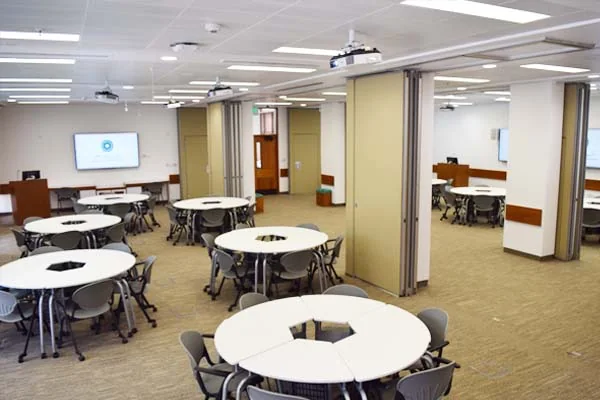
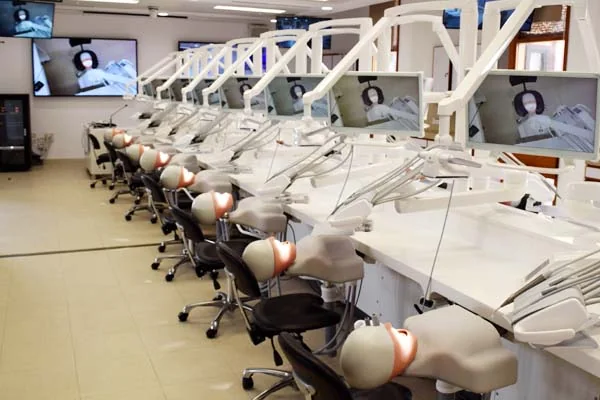
CIME’s Pakistan facilities recreate clinical environments for learning, using simulation spaces for medicine, nursing, dentistry and allied health education. Its published facilities include small-group classrooms, conference rooms, a multipurpose educational hall and simulation laboratories. The simulated environments include wards, operating-room settings, paediatric spaces and a dental laboratory. These are educational settings where learners can practise and apply knowledge before working with real patients. Other spaces include an open learning area, a courtyard and facilities supporting teaching events.
Sources: School of Nursing and Midwifery, Pakistan ↗ · CIME facilities, Pakistan ↗
Educational development in Pakistan
The Institute for Educational Development, Pakistan, was established in 1993. It prepares teachers, teacher educators, researchers and educational leaders, while working on the quality of education in Pakistan and other developing contexts. Its programmes and projects promote student-centred teaching, inquiry-based learning and improvements in school management. Professional development centres in Karachi, Gilgit and Chitral extend this work through shorter non-degree programmes for educators and administrators.
Research is another part of the institute’s role. Its Research and Policy Studies Unit supports research, policy analysis and discussion of educational questions. Faculty and students investigate access to education, curriculum relevance, pedagogy, changing learner needs and educational governance. School-improvement projects also work in underserved areas of Sindh, Balochistan, Gilgit-Baltistan and Chitral, connecting the institute’s academic work with schools and teachers who have limited opportunities for professional development.
Sources: Institute for Educational Development, Pakistan: overview ↗
Arts and sciences education
AKU broadened its undergraduate provision through the launch of the Faculty of Arts and Sciences in September 2023. Its Bachelor of Studies in Arts and Sciences follows a four-year structure, beginning with intellectual foundations and progressing towards focused study and practical application. A twelve-course core brings together humanities and social sciences, natural sciences, quantitative reasoning, digital literacy and civic learning.
Students then pursue an interdisciplinary major. The published programme lists Asian and Middle Eastern Studies, Environmental Studies, Philosophy, Politics and Economics, and Social Development Studies. These routes combine subject knowledge with analytical and methodological training. Experiential learning includes internships, field schools, research experiences and D-Lab projects. In the final year, students complete a supervised research thesis or applied capstone project, drawing together the interests and skills developed during their degree.
Sources: About Aga Khan University ↗ · Bachelor of Studies in Arts and Sciences ↗
Libraries and independent study
The Faculty of Health Sciences Library serves the Stadium Road campus in Karachi. Its two sections are the Jivraj Health Sciences Library and the Kurji Periodicals Library. Together they provide health-sciences materials and general reading across areas such as history, literature, religion, humanities and social sciences. The library also holds World Health Organization publications and supports access to electronic journals, books and research databases.
The Jivraj section includes circulation and reference desks, displays of newly received materials and collections organised around basic, nursing and clinical sciences. A learning commons supports information-literacy sessions. The Kurji section provides periodicals and research space. Individual study carrels, on-site computers and laptops, network access and remote electronic-resource services support different ways of studying. Group work is also supported through spaces associated with the Digital Scholarship Centre and University Centre.