Visa


About Arden University
A university built around different ways of studying
Arden University offers distance-learning and blended-learning degree courses, combining online education with teaching at physical campuses. It operates as Arden University Limited, registered in England and Wales. Its registered office is at Arden House, Middlemarch Park, Coventry. The university’s About page records that it received degree-awarding powers in 2015 and describes provision for students in the United Kingdom and internationally, including its Berlin location.
Arden presents technology-supported study and access to education as central to its approach. Its account emphasises courses developed with input from employers and business organisations, alongside support for learners balancing education with other responsibilities. It also describes an emphasis on practical assessment, connecting academic work with ways students may apply their knowledge. This educational model brings undergraduate and postgraduate study together with different delivery arrangements, allowing the university’s provision to reach learners through both digital platforms and campus-based teaching.
Sources: About Arden University ↗ · University identity and registered office in student terms ↗
Online provision across subjects
Arden’s online-learning route allows students to organise study around personal and professional commitments without attending a campus for regular teaching. The university describes dedicated lecturers and support as part of this learning environment. Its online catalogue spans undergraduate degrees, postgraduate study, top-up routes and other levels of qualification. Certificates, diplomas and apprenticeship programmes also appear alongside its degree listings.
The subjects listed include business management, psychology, law, criminology, graphic design, accounting and finance, computing, engineering, and project management. Examples of postgraduate provision include Data Science, Cyber Security, Design Management, Strategic Digital Marketing and Supply Chain Management and Logistics. Undergraduate examples include Graphic Design, Accounting and Finance, and Business Management routes with different subject combinations. This range illustrates that online learning is a delivery route across several academic fields. The catalogue identifies the mode and location of individual offerings, rather than presenting every course as having the same study arrangement.
Sources: Online learning ↗
Blending campus classes with independent study
Arden’s blended-learning model combines scheduled face-to-face classes with independent work through its iLearn platform. Campus sessions include opportunities to discuss ideas, ask questions and work with a subject lecturer. The online component provides coursework, tutorials, discussion forums and study-support resources, while assignments are submitted through the university’s digital system.
The published model also describes access to an online book collection and academic-skills workshops. These workshops address activities such as finding and evaluating library resources, academic writing, referencing and avoiding plagiarism. Its current guidance sets out different attendance patterns for foundation-year students, alongside the regular campus timetable. Berlin is described separately as a full-time route with a stronger on-campus component. These distinctions show how the balance of classroom teaching and independent study varies within Arden’s provision, while digital learning resources connect the different elements of the student experience.
Sources: Blended learning ↗

Computing, data and artificial intelligence
The computing and data-science catalogue includes undergraduate Computing, Cyber Security, and Data Science and AI degrees. It also lists foundation-year and top-up routes, together with Business Management and Computing. At postgraduate level, the published provision includes Data Science, Cyber Security, Machine Learning and AI, and Digital Leadership and AI Innovation.
The catalogue distinguishes online, United Kingdom campus and Berlin offerings, with location information attached to individual courses. Its subject introduction emphasises practical learning connected with computing and data-related work. The provision also includes an Executive MBA focused on Artificial Intelligence, placing a management-oriented option alongside technical computing courses. These different titles and levels illustrate the breadth of the subject area, from entry routes into undergraduate study to postgraduate specialisation. Course availability is organised by programme and study location within the university’s wider delivery model.
Examples from the London campus network
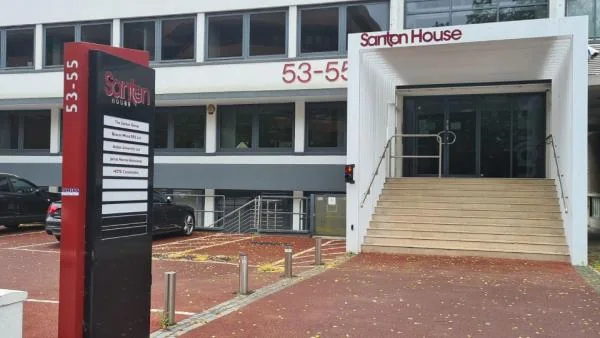
Arden’s London campus page describes locations in Ealing, Holborn and Stratford. Its Stratford account identifies the Turing Building at Stratford Cross, near Westfield Stratford City and the Olympic Park. Ealing is described in relation to Ealing Broadway station and local bus connections, while Holborn is presented as a central London study location served by public transport.
The same page illustrates the Ealing provision with a photograph of Santon House and includes a study-centre scene showing people in a seating area. These examples connect the university’s blended-learning model with identifiable physical settings. The campus descriptions emphasise access to teaching facilities and transport connections, giving students information about the environment in which their scheduled face-to-face study takes place.
Sources: London campuses ↗
A dated expansion into Nottingham
In a report published in December 2025, Arden announced the opening of its Nottingham campus on Castle Meadow Road. The account described a launch event held on 11 December, including a guest address by basketball player Conner Washington. It presented the new campus as an investment in educational access and local skills development.
The opening report connected Nottingham with a wider period of expansion that included Stratford and additional space in Birmingham and Manchester. It also set out the university’s intended contribution to regional development, describing ambitions to support local learners and engage with changing workplace needs. These were the institution’s stated aims for the investment. The Nottingham example adds a dated record of campus development to a university whose teaching also reaches students through online provision, showing how its physical and digital modes sit within the same organisation.