Visa
About Aberystwyth University
A university on the west coast of Wales
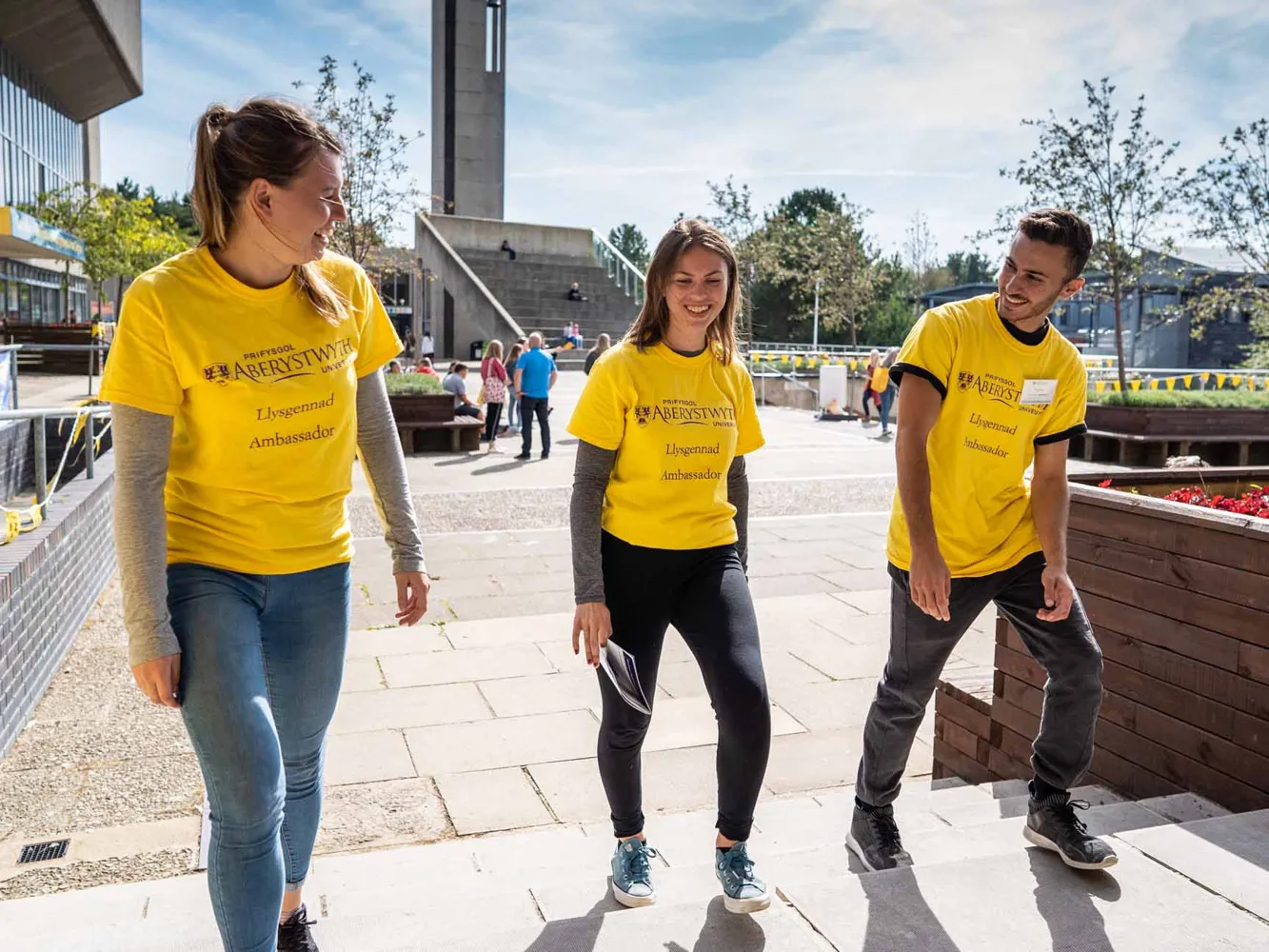
Aberystwyth University is based in the coastal town of Aberystwyth in Ceredigion, Wales. Its setting brings the sea, hills, rivers and surrounding countryside into the experience of university life. The institution describes itself as a research-led university, linking the creation and exchange of knowledge with teaching. Its stated mission places education and research within a supportive bilingual community and connects academic work with challenges facing Wales and the wider world.
The university identifies research interests extending from climate change and food production to human and animal health, artificial intelligence and space exploration. These examples show the reach of its academic activity without reducing the institution to a single specialist field. Campus life also includes the Arts Centre, Sports Centre and student clubs and societies. Together with subject-specific facilities, libraries and digital learning resources, these form a setting in which academic work sits alongside cultural, social and recreational activity.
Sources: About Aberystwyth University ↗
Origins and the move to Penglais
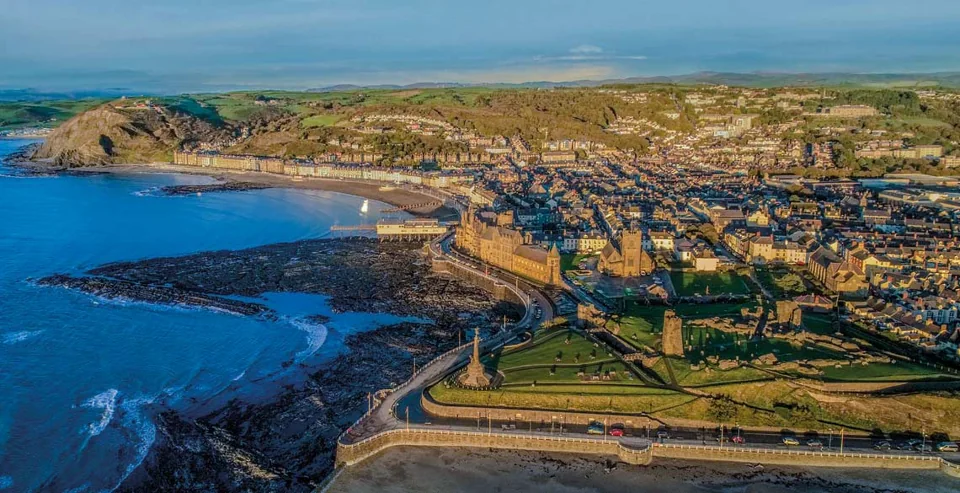
Aberystwyth opened in 1872 as the first University College in Wales. Its establishment followed fundraising efforts led by Hugh Owen and other supporters from the 1850s onwards. Public and private contributions helped turn the ambition of a university institution in Wales into a college housed in a partially completed hotel on the seafront, now known as Old College. The early years brought financial difficulties, with benefactors and organised appeals helping the institution survive.
The university's history emphasises the importance of ordinary Welsh donors as well as prominent supporters. This pattern of support helped connect the college with the wider population of Wales. As the institution expanded, its principal campus moved uphill to Penglais, overlooking the town and Cardigan Bay. Arts and science buildings, residences, the Arts Centre and sports facilities developed there. Old College remains part of the university's heritage, linking the modern campus institution with the seafront building in which its teaching began.
Sources: Our History ↗
Academic breadth across sciences and humanities
The official departmental directory groups academic work within the Faculty of Humanities and Faculty of Sciences. Its listed subjects include art, business, education, English and creative writing, history and Welsh history, information studies, international politics, law and criminology, modern languages, and Welsh and Celtic studies. Theatre, film and television studies add another dimension to the humanities and creative subjects. This range places language, culture, public life and professional study within the same university community.
Scientific provision includes computer science, geography and earth sciences, life sciences, mathematics, physics and psychology. The directory also identifies the Institute of Biological, Environmental and Rural Sciences, the School of Veterinary Sciences and the Healthcare Education Centre. Lifelong learning and the International English Centre appear alongside these departments and schools. The directory describes the university's organisational breadth; individual course pages remain the appropriate place to check qualifications, entry requirements and the availability of particular programmes. It also lists professional services supporting academic operations, research, libraries and students.
Sources: Departments and Faculties ↗
Libraries, study spaces and student support
Penglais has two university library buildings: the main Hugh Owen Library and the smaller Physical Sciences Library. The library service provides information about borrowing, study-room booking, subject guides, electronic resources and help for readers. Hugh Owen sits near the centre of campus, while the Physical Sciences Library is located in the Physical Sciences Building. The National Library of Wales is also nearby, although it is a separate institution rather than a university branch library.
Study facilities extend beyond these buildings. The university describes lounges in residential areas and the Think Tank study space in the Llandinam building, with provision for individual and group work. Student support includes careers advice and disability and learning support. The latter addresses long-standing health conditions and specific learning differences, including advice about enabling technology and examination arrangements. These are named institutional services, rather than assurances of a particular personal outcome. The Students' Union contributes clubs, societies and opportunities for students to meet around shared academic, sporting and cultural interests.
Sources: Student Services and Learning Facilities ↗ · University libraries ↗

Welsh-medium academic and social life
Welsh is part of Aberystwyth's educational provision as well as its local setting. The university offers opportunities to study modules through Welsh, including for students whose courses are mainly taught in English. The amount available varies between subjects and programmes. Its guidance addresses fluent speakers, less confident speakers and learners, and describes support through Welsh-speaking personal tutors. It also discusses working between languages, for example using material in one language while developing notes or assessments in another.
This provision connects subject knowledge with the development of specialist vocabulary and bilingual communication. Welsh-language life also has a residential and social dimension. Pantycelyn is associated with the university's Welsh-speaking community and with UMCA, the union of Aberystwyth's Welsh students. UMCA's activities include societies, events and representation on educational, social and linguistic matters. These academic and social opportunities help explain why Welsh-medium study is a distinctive part of Aberystwyth's identity, rather than simply a translation of university information.
Art collections and a museum tradition
The university's museum tradition dates to 1876, shortly after the college's foundation. As collections grew, material moved into individual departments, including art, geography, physics and zoology. An Art and Crafts Museum established in 1918 was administered by the Department of Art until the disruption of the Second World War, when collections were dispersed around college buildings or placed in storage. Later committees and galleries provided new arrangements for their care and display.
The School of Art's history records the opening of the Catherine Lewis Gallery in Hugh Owen Library in 1984 and a ceramics gallery at the Arts Centre in 1986. In 1993 the School of Art moved to the Edward Davies Building and formed its Gallery and Museum. The graphic art collection subsequently transferred there. This history shows how collecting, teaching and exhibition spaces have developed together. It also places the university's cultural resources within a longer institutional story that reaches beyond its contemporary classrooms and laboratories.