Visa

About Arab Academy for Science, Technology, and Maritime Transport
A regional academy with maritime origins
The Arab Academy for Science, Technology and Maritime Transport is an educational institution with its origins in Alexandria in 1972. Its development has connected maritime education with broader study in engineering, management and other disciplines. The academy’s institutional account describes its work under the umbrella of the League of Arab States and an educational purpose extending across the Arab region.
Its early specialisations included marine navigation, marine engineering, radio officers and marine technicians. The subsequent development of basic sciences and bachelor’s study widened that original maritime focus. Practical application remains an important theme in its account of teaching. Its published history also describes expansion from Alexandria to other locations, alongside community education and professional training. This combination of academic study, technical preparation and regional service helps explain the institution’s broad present-day title.
Sources: About the academy ↗ · History and landmarks ↗
Colleges and fields of study
The academy’s college directory shows how far its academic interests extend beyond its original maritime subjects. Maritime Transport and Technology sits alongside engineering and technology, computing and information technology, and international transport and logistics. Management and business study also have a substantial place within the institution.
Other listed fields include language and communication, art and design, law, fisheries and aquaculture technology, archaeology and cultural heritage, and artificial intelligence. The directory additionally identifies health-related colleges, including pharmacy, medicine, dentistry and physical therapy. Provision varies by location: individual college entries name the campuses where they are represented. This structure allows the academy to bring several professional and academic areas together while maintaining distinct campus-based offerings, rather than presenting every subject as available at every site.
Sources: College directory ↗
Library and information services
The academy’s libraries support teaching, research and independent study through both physical collections and digital resources. Their institutional introduction links the development of a specialised library to the academy’s establishment in 1972. The service has grown around the information needs of students and faculty and the different forms in which academic work is published.
Published reader services include quiet spaces for reading and study, borrowing for registered students and faculty, and assistance in locating requested information. Photocopying and scanning are also listed. Current awareness services help readers follow new information, while document delivery provides another route to papers unavailable locally. The library website brings together access points for books, periodicals, electronic resources and Egyptian Knowledge Bank databases, connecting onsite study with wider information access.
Sources: AASTMT library ↗
Exchange and international learning
The Agreements and International Cooperation Center describes study-abroad opportunities for undergraduate and postgraduate students. Its published exchange introduction allows for different study periods, including one or two semesters and longer arrangements extending to two academic years. These programmes are presented as opportunities to study at an international university while experiencing life in a different cultural setting.
Language and communication are important elements of that experience. The centre emphasises contact with people from different backgrounds and learning that extends beyond the classroom. The exchange provision therefore adds an international dimension to the academy’s educational environment. Its public introduction provides an overview of the purpose and possible duration of exchange, while programme arrangements remain connected with the participating institutions and the particular study opportunity.
Sources: Student exchanges and study abroad ↗
Student participation at Heliopolis
At the Heliopolis location, the student affairs deanery describes its purpose in terms of participation, creativity, leadership and community engagement. Its mission includes personal, social and professional development through activities and services. Its published vision also emphasises an inclusive student experience and opportunities for students to contribute to both university and community life.
The activity areas include sport, cultural and social participation, trips, clubs and organisations. These create different settings for students to meet and explore interests alongside their academic courses. The student affairs website also provides routes to regulations, student email and complaints. Its service information covers transport, accommodation, libraries and medical support. Together, these elements show a student affairs role encompassing both practical support and participation in the wider campus community.
Sources: Heliopolis student affairs ↗
Applied research and knowledge exchange
The academy’s research and innovation website connects academic expertise with technological development and applied inquiry. It provides routes to research projects, workshops, conferences and researcher support. Digital materials include theses, dissertations, graduation projects and information about books, while grant opportunities offer another element of the research environment.
The published project directory includes work on renewable energy, energy efficiency, agricultural monitoring, electric vehicles, water treatment and climate adaptation. Other topics connect ports, logistics, fisheries and the sustainable blue economy with regional development. These project subjects illustrate the relationship between the academy’s technical disciplines and its wider environmental and economic interests. The directory also includes collaboration concerned with teaching methods and engineering education, linking research activity with the development of educational practice.
Sources: Scientific research and innovation ↗
The Heliopolis educational setting
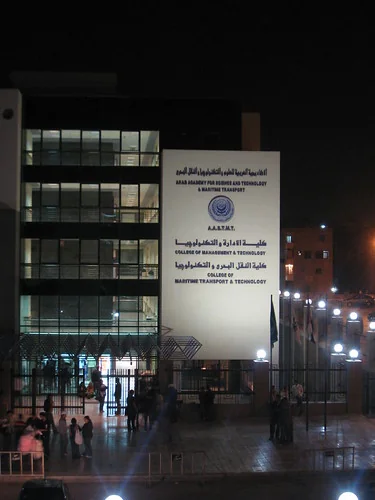
The official Heliopolis campus introduction places this part of the academy in Cairo. It identifies colleges concerned with engineering, management, computing, international transport and logistics, and language and communication, together with graduate business study. The campus website brings admissions, academic information and student services into a single local entry point.
Professional and continuing education also feature in its directory. Listed units include the Productivity and Quality Institute, the International Transport and Logistics Institute, and Community Service and Continuing Education. Students can reach the academy’s registration systems, student portal and email from the campus website, while faculty links connect with academic profiles and education affairs. These services place Heliopolis within the academy’s wider network while giving learners a location-specific set of academic and administrative resources.
Sources: Heliopolis campus ↗