Visa


About Ahram Canadian University
Establishment and academic development
Ahram Canadian University, also known as ACU, is an Egyptian university whose campus is on Banks Complex Street in the Fourth Industrial Zone of 6th of October City. Its official institutional history dates its establishment to 2004 under Presidential Decree No. 393. Academic teaching began in 2005 with faculties of pharmacy, business administration, mass communication, and computer science and information technology.
The university subsequently expanded into additional professional and creative fields. Its account records the establishment of oral and dental medicine in 2013 and the start of engineering teaching in the second semester of the 2014–2015 academic year. Physical therapy, design and creative arts, and languages and translation followed in 2019. This development created a range of subjects spanning health-related education, technology, business, communication, design and languages. The university presents education and scientific research as complementary purposes, with the preparation of specialists in disciplines relevant to society among its stated objectives. Its academic identity is Egyptian, while its international activities include discussions with Canadian institutions.
Sources: University establishment and faculties ↗ · Official campus contact and address ↗
An entrepreneurial student project
A university report from July 2026 describes the Enactus team's QUSHOOR project, which uses orange peels as a source of pectin. The project is presented as an exploration of circular-economy principles, taking an agricultural by-product and considering its use as a material for other applications. The report associates the work with possible uses in agriculture, food and health-related industries.
The university reported that the team advanced to the semi-final stage of the Enactus Egypt 2026 national competition. Its account links the project with student innovation, resource efficiency and the development of practical responses to social and environmental questions. The example offers a concrete view of entrepreneurship activity beyond ordinary classes: students worked on a defined material and process, brought it into a competitive project setting, and connected their work with the idea of reducing waste through new uses for existing resources.
Sources: Enactus QUSHOOR project, July 2026 ↗
Academic discussions with Fanshawe College
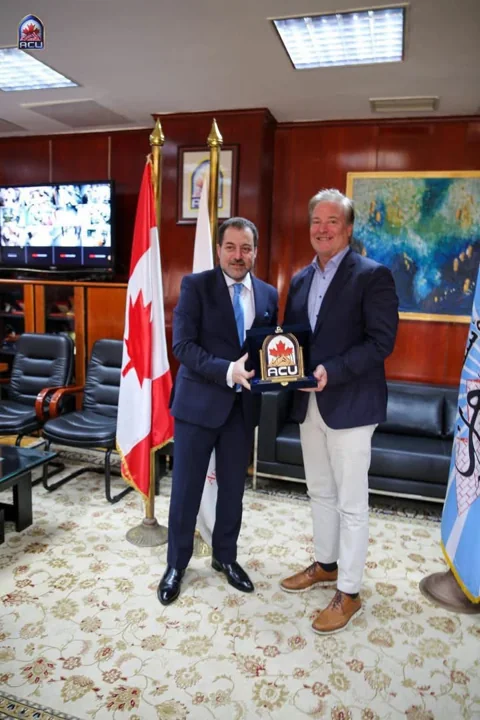
On 1 July 2026, ACU welcomed Jeff Wright, a vice-president of Fanshawe College in Canada, for academic discussions. The university's report describes a meeting involving its president, deans and faculty representatives. The session introduced Fanshawe and explored areas in which future cooperation might be developed between the institutions.
Topics included student and staff exchange, joint academic initiatives, research cooperation and international education. The visit was organised through ACU's Office of Global Engagement and Partnerships. These were discussions about potential collaboration, rather than an announcement that all the activities discussed had already begun. The event illustrates one way the university's international office brings academic representatives together to consider shared interests. It also provides a specific example of Canadian engagement within ACU's wider institutional activity, without implying that its programmes automatically award Canadian qualifications.
Sources: Fanshawe College academic discussions, 1 July 2026 ↗
Entrepreneurship Club participation
The university also reports activity through its Entrepreneurship Club. At a meeting in June 2026, students and faculty who had participated in the club during the 2025–2026 academic year received recognition for their contributions. The university's account highlights their role in organising and supporting the club's programmes and events.
The meeting linked student participation with innovation, leadership and personal development, which the university identifies as purposes of its extracurricular activities. The recognition involved both students and academic staff rather than a single class or degree programme. Together with the Enactus project, this provides another example of opportunities for students to engage with entrepreneurial ideas outside the formal subject curriculum and of institutional support for the people who organise such activities.
Student theatre and creative teamwork
Cultural activity is represented by ACU's theatre team. In July 2026, the university published a report on its production of Crowded World, also given the Arabic title Zahma Ya Donia Zahma, at the Nihad Selaiha Theatre within the Academy of Arts. The cast and performance team included university students in acting and dance roles.
The production was directed by student Fady Essam. The official account describes a preparation process involving auditions, rehearsals and sustained collaboration among the participants. It places the performance within the university's support for student talent and artistic activity, alongside the work of its student-activities and youth-welfare staff. This example shows a different form of participation from academic research or business projects: students contributed to a collective stage production, taking on creative responsibilities and developing a performance for an audience beyond their usual classrooms.
Sources: Student theatre production Crowded World, July 2026 ↗

Routes into study and registration
ACU publishes registration information for several educational backgrounds, including the Egyptian General Secondary Certificate, equivalent Arab certificates, the American Diploma and British secondary qualifications. The requirements are organised by qualification type, reflecting the different records used to document previous schooling. The page identifies original school certificates or authenticated academic records, identity documents and other supporting paperwork among the materials involved.
Separate sections address students transferring from equivalent or non-equivalent faculties within Egypt and those transferring from abroad. For transfers between equivalent faculties, the university lists an official transcript and approved course content among the documents, alongside proof of enrolment. Overseas transfers have a separate documentation route that includes a passport and academic records. This structure distinguishes first-entry applicants from students with previous university study and shows how earlier qualifications and course histories enter the university's registration process. Requirements belong to the applicable route rather than one uniform document list.