Visa

About Al Salam University
A private university in Egypt’s Delta
Al Salam University is a private Egyptian university established through Presidential Decree No. 557 of 2018. Its first students entered the Faculty of Oral and Dental Medicine in September 2020, marking the beginning of teaching after the institution’s legal establishment. The university serves the Delta region of northern Egypt. Its official contact address uses Tanta, while the engineering faculty locates the campus on the Cairo–Alexandria Agricultural Road in Kafr El-Zayat, Gharbia. This setting places the institution along the transport corridor connecting Cairo and Alexandria. The university’s stated mission combines higher education, scientific research and environmental service, with an emphasis on communication, cooperation, planning and the ability to respond to changing social needs.
Sources: University history and mission ↗ · Faculty of Engineering ↗
Engineering and applied problem solving
Engineering teaching follows a credit-hour structure leading to a Bachelor of Science in Engineering. The faculty identifies English as its teaching language and specifies 144 credit hours alongside the other graduation requirements. Its academic portfolio encompasses civil and environmental engineering, architecture, mechanical engineering, mechatronics and robotics, computer engineering, intelligent systems, biomedical engineering, electrical and control engineering, and communications. These subjects connect physical infrastructure with computing, automation and technological systems. The faculty places design, analysis and practical problem solving alongside theoretical knowledge. Professional ethics, teamwork and continued learning also form part of its educational objectives. Its research mission includes applied engineering, cooperation with industry and the development of solutions to environmental and social challenges.
Sources: Faculty of Engineering ↗
Design education through applied arts
The Faculty of Applied Arts began academic activities following Ministerial Decree No. 1847 of 7 September 2025. Its subject groupings include interior design and furniture, advertising arts and animation, and fashion and jewellery. Rather than treating these as purely classroom subjects, the faculty describes workshops, laboratories and field projects as settings in which students develop their ideas. Interior design is presented as the creation of functional human environments, while advertising and animation involve visual communication. Fashion and jewellery bring together cultural expression, materials and technology. The faculty’s educational approach encourages students to connect aesthetic judgement with technical understanding, research and the practical requirements of a design project. Interdisciplinary work is an explicit element of this approach.
Sources: Faculty of Applied Arts ↗
Oral and dental medicine
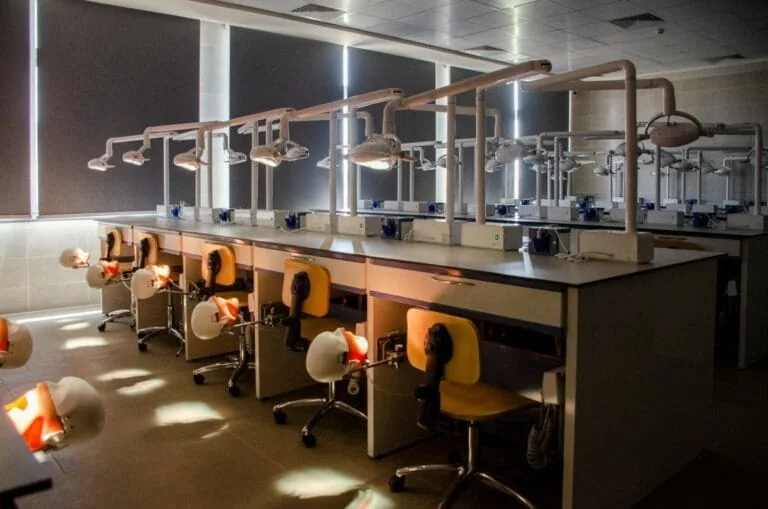
The Faculty of Oral and Dental Medicine combines academic study with interactive clinical training. Its mission gives professional ethics a central place in dental education and connects research with service to society. The faculty’s development objectives cover teaching methods, assessment, educational programmes and the improvement of research facilities. It also sets out plans to strengthen relationships with community institutions and to support the continuing development of dental practice. These objectives place student education within a wider institutional framework that includes research planning and community engagement. The faculty’s introductory message recognises the transition from secondary school to university as a period of greater personal responsibility, encouraging students to take an active role in their learning.
Sources: Faculty of Oral and Dental Medicine ↗
Pharmacy and institutional development
The Faculty of Pharmacy traces its establishment to Ministerial Decree No. 1920 of 2023. Its educational mission combines pharmaceutical knowledge with scientific research and community service. The faculty describes an academic environment intended to encourage creative thinking, innovation and the use of modern technologies. Its published development priorities include practical and professional training, improvements to teaching and assessment, and stronger research capabilities. Digital transformation is another theme, covering information systems, electronic examinations and blended teaching approaches. The faculty also identifies staff development, research publication and cooperation with civil society among its objectives. These are presented as directions for institutional development and for connecting pharmacy education with the needs of patients and the surrounding community.
Sources: Faculty of Pharmacy ↗
Physiotherapy and research-minded learning
The bachelor’s programme in physical therapy describes an educational model built around academic knowledge, clinical skills and evidence-based care. Its mission links professional preparation with public health, scientific research and sustainable development. Professional ethics and integrity are stated principles of the programme. Its objectives include encouraging creativity in physical therapy education and helping students develop the knowledge needed to address changing healthcare needs. Cooperation with healthcare organisations and academic institutions is identified as a means of supporting research and exchanging knowledge. The programme also aims to contribute therapeutic research addressing community needs. This combination of education, collaboration and inquiry gives its stated purpose a broader scope than the acquisition of practical techniques alone.
Sources: Physical therapy programme mission and objectives ↗
Library resources and independent study
The university library serves students, academic staff and researchers through educational and research materials. Its published description includes sections for academic journals, research resources and multimedia, together with quiet study areas and spaces for group work. Holdings are organised using the Dewey Decimal Classification, helping readers locate material by subject. Library guidance asks students to show their university identification, maintain quiet and handle books carefully. Readers leave consulted books on tables so that staff can return them to the correct shelves. The rules also prohibit food and drinks, require mobile phones to be switched off, and ask readers to keep the study space clean. These arrangements support both access and the orderly use of shared resources. The library’s mission also emphasises knowledge exchange and independent access to information, complementing the classroom and practical teaching undertaken across the university’s faculties.
Sources: University Library ↗