Visa
About andscapes, Heritage and Territory Laboratory
A University of Minho research laboratory
The Landscape, Heritage and Territory Laboratory, known as Lab2PT, is a research and development unit of the University of Minho in Portugal. It brings together researchers from the university’s School of Architecture, Art and Design and its Institute of Social Sciences. Established at the end of 2013, the laboratory began its first funding period supported by Portugal’s Foundation for Science and Technology in 2015.
Its research spans architecture, urbanism, history, archaeology, design, visual arts, geography and geology. The laboratory’s central approach is to connect these fields around landscapes, heritage and territory, alongside questions of society, technology and representation. Its institutional presentation combines fundamental and applied research, artistic creation, design and heritage preservation, with attention to communities and relationships with municipalities and international partners.
Sources: Lab2PT: Presentation ↗
Three complementary research groups
Lab2PT organizes its research through three groups. Landscapes and Societies, abbreviated LandS, examines productive and inhabited landscapes across different physical, human and historical scales. Its subjects include resources and land use, settlements, communities, material practices and the effects of extractive and productive activities.
Design and Technology, or DeTech, places laboratory work at the centre of its activity. Its listed themes connect conservation and circularity with materials, construction, computational design, artificial intelligence and design for human experience. Space and Representation, known as SpaceR, addresses visual culture, imagined and built spaces, and projects developed in context. It also examines creative tourism and ways of interpreting heritage through collaboration with communities. Together, the groups connect technical investigation with historical and cultural inquiry.
Sources: Lab2PT: Research Groups ↗
Facilities across Braga and Guimarães
The laboratory works across University of Minho sites in Braga and Guimarães. Its infrastructure includes the archaeology unit in Braga and design, construction and fabrication facilities in Guimarães. Research and teaching share these spaces, which also support collaboration with outside institutions.
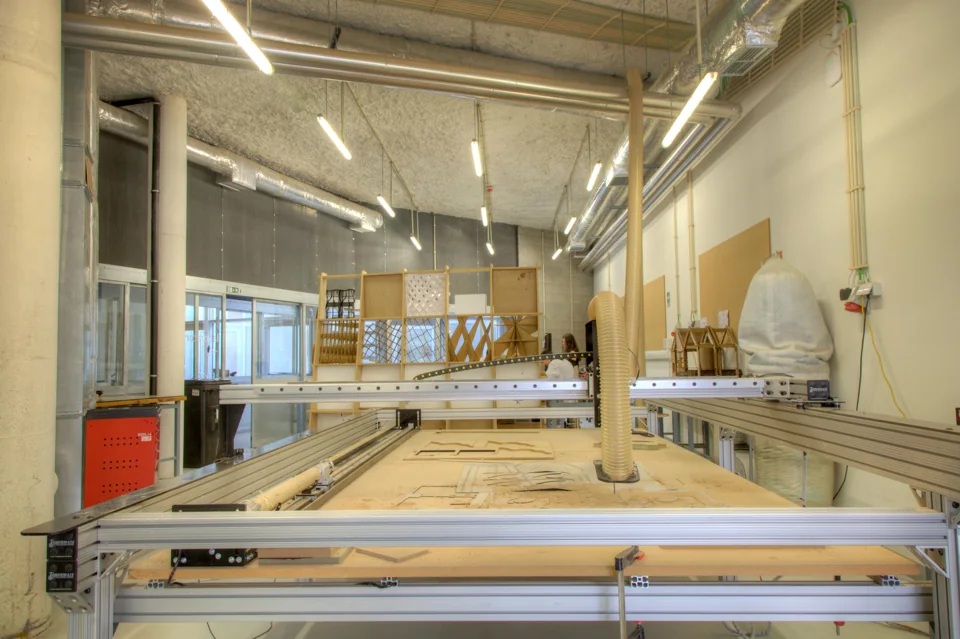
The Institute of Design of Guimarães has woodworking tools and digital equipment, including CNC machinery, laser engraving, three-dimensional printing and scanning. Archaeological infrastructure includes specialized library resources, multimedia and visualization facilities, and information systems for databases and geographic information. Other listed facilities support ceramics, architectural design and construction testing. These resources allow different disciplines to work with physical materials, digital models and documentary evidence.
Sources: Lab2PT: Infrastructure ↗
Connections between research and education
Lab2PT describes its educational contribution through the relationship between research and University of Minho study programmes. These connections extend across first, second and third cycles and include the preparation of master’s dissertations and doctoral theses. The laboratory’s courses page places this work within the university’s schools, institutes and departments.
The listed subject areas include archaeology, visual arts, product design, geography and planning, geology, history and architecture. At postgraduate level, the page includes cultural heritage, geosciences and building information modelling alongside the laboratory’s other disciplinary fields. It also identifies nondegree training in areas such as accessibility and inclusive design, scenography, modern tropical heritage and building façades. This links laboratory activity with several forms of university education.
Sources: Lab2PT: Courses ↗
Services connected with research expertise
The laboratory also offers specialist services to the community through its researchers and facilities. Its published areas of work include archaeological and geomatics studies, archaeological and architectural surveys, urban and architectural projects, heritage intervention and urban rehabilitation. Prototyping and additive manufacturing connect this external work with its design and fabrication resources.
Other service areas include paleographic studies, heritage diagnosis, strategic planning for tourism, support for mining geology, exhibition curation and the preparation of exhibition content. The laboratory also lists the editing and publication of monographs and catalogues, short courses, and artistic, technical and scientific consulting. It presents these activities as closely connected with the research objectives of the unit, drawing on expertise across its different fields.
Sources: Lab2PT: Services ↗
Participation in IN2PAST
Lab2PT participates in IN2PAST, the associated laboratory for research and innovation in heritage, arts, sustainability and territory. Its official description emphasizes collaboration between academic and laboratory investigation, public policy, and cultural institutions such as museums, archives, monuments, archaeological sites and natural parks.
The thematic lines bring together science and technology for cultural heritage; landscapes, territories and heritage; museums, monuments and collections; archives and digitization; and cultural circulation, public memory and inclusive citizenship. Lab2PT’s participation places its work within a wider network that includes research units in art history, anthropology, contemporary history, heritage science and music studies. The network provides a framework for linking specialist research with the preservation, study and public interpretation of cultural heritage.
Scientific organization and participation
The laboratory’s organizational statement identifies scientific plurality, cooperation, the development of ideas and the application of knowledge as guiding values. Its scientific council includes the unit’s doctoral researchers. A coordinating commission and a management commission support its scientific direction and everyday administration.
The management structure includes a director, deputy director and the coordinators of the three research groups. Group representation in the coordinating commission connects the different disciplinary areas with decisions about research, postgraduate projects and engagement with society. A general assembly brings together the laboratory’s members, while an external scientific advisory commission provides input from researchers outside Portugal. This structure combines the work of the research groups with unit-wide planning and consultation.
Sources: Lab2PT: Organization ↗
Mountain landscapes as a research setting
The Cultur-Monts project illustrates the laboratory’s approach to landscape and heritage. A November 2026 report describes the project’s 2024–2026 programme, supported through Interreg Sudoe, and its work on mountain cultural landscapes in Portugal, Spain and France. The Portuguese research focuses on Peneda-Gerês, including Arcos de Valdevez and Terras de Bouro.
The Lab2PT team brings together archaeological, historical and computing expertise. Its stated work concerns historic roads, transhumance routes and the bread-making cycle, alongside traditional knowledge, living memory and oral accounts. The project seeks to develop shared methods for understanding and valuing these landscapes and to transfer research knowledge to the region’s communities. These are the project’s stated objectives within an ongoing, cross-border research programme.
Sources: Lab2PT: Cultur-Monts project report, November 2026 ↗