Visa

About Andijan State Technical Institute
An institute shaped by reorganization
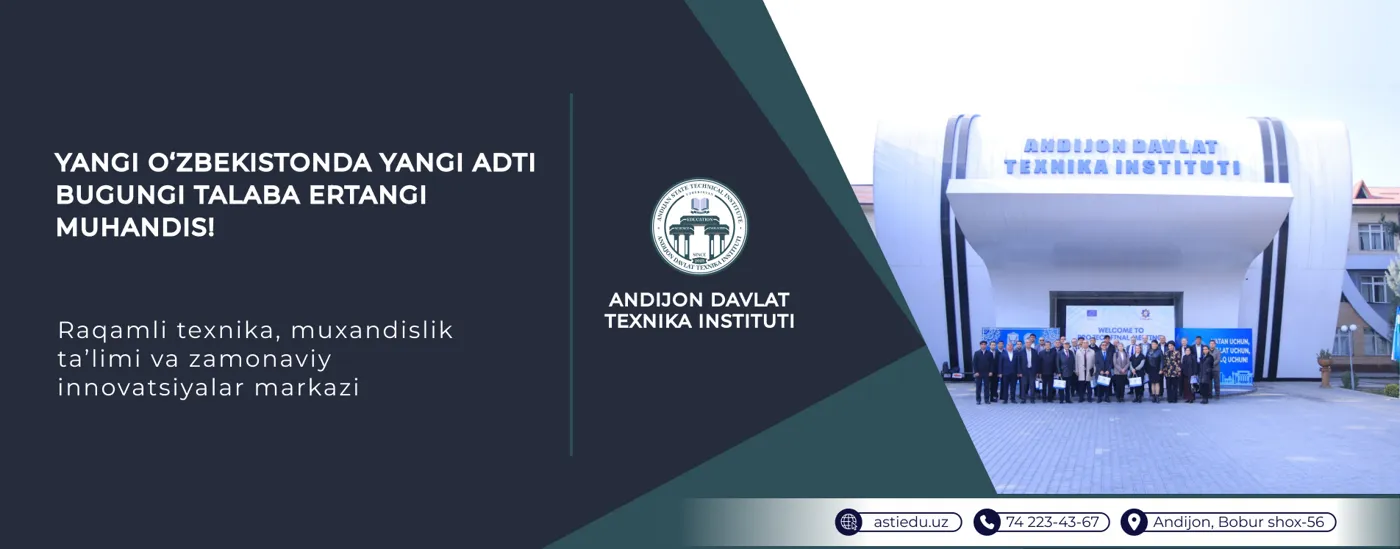
Andijan State Technical Institute is a state higher-education institution in Andijan, Uzbekistan. Its current form was established by the presidential decision of 18 November 2024, bringing together Andijan Machine-Building Institute, Andijan Institute of Economics and Construction, and the Andijan faculty of Tashkent Institute of Textile and Light Industry. The history of one predecessor extends to 1976, when an Andijan branch of Tashkent’s national-economy institute was established. That branch became an independent economics and management institute in 1992, followed by engineering-economics and machine-building stages. The present institute therefore combines a recent institutional reorganization with a longer local teaching tradition. Its mission connects professional preparation with the needs of regional industries, including automotive manufacturing, electrical engineering, energy, textiles, machinery and construction. It gives its official address as 56 Boburshoh Street in Andijan, linking its administrative identity firmly to the city.
Construction and architectural education
The Faculty of Construction Engineering and Architecture carries forward teaching developed within Andijan Institute of Economics and Construction. Its history describes an economics-and-construction faculty established in September 2020 and a division into separate economics and architecture-and-construction faculties in September 2023. The current faculty page identifies departments concerned with architecture and hydraulic engineering, and with construction engineering. Its listed undergraduate fields include architecture, building and structural construction, construction materials and products, hydraulic construction, and materials science. Engineering communications, road engineering and hydraulic and geotechnical engineering also appear in its teaching portfolio. These fields connect the design of buildings with the materials, infrastructure and water-related systems needed to construct and operate them. The faculty’s organization includes responsibilities for teaching methods, student affairs and tutors, reflecting an academic structure that combines subject teaching with the administration of students’ educational experience.
Renewable-energy teaching and research
The Alternative Energy Sources department traces its establishment to 2020 within the predecessor machine-building institute. It developed from an electrical-engineering department to address renewable energy, environmentally cleaner technologies and sustainable energy systems. Its stated educational responsibilities include introducing solar, wind, biogas, geothermal and hydropower topics into curricula and combining theoretical preparation with laboratory work. The department also describes research intended to improve the efficiency of alternative-energy systems and to develop and test new technologies. Its practical objectives include equipment suited to local conditions and projects involving businesses, farms and industrial enterprises. Environmental awareness seminars and discussion of the social and economic advantages of alternative energy form another part of its stated responsibilities. International cooperation, joint research and academic exchanges appear among its aims. These descriptions establish the department’s academic direction without treating every proposed project as an already completed installation.
Information technology and intelligent systems
The Information Technologies department identifies its origins in an institutional academic-council decision of August 2012. Its current teaching description covers information systems and technologies alongside artificial intelligence. The published subjects combine mathematical foundations, including calculus, linear algebra, probability and statistics, with programming, databases, computer networks and algorithms. Web technologies, mobile applications and operating systems extend that foundation into practical computing. Artificial-intelligence topics include machine learning, deep learning, natural-language processing, knowledge bases and image processing. The wider list also includes cloud computing, embedded systems, digital control, modelling and optimization. An individual project appears among the listed learning components. The department describes responsibilities spanning teaching, educational-method development and research, with preparation of bachelor’s and master’s specialists among its objectives. Its public page identifies Saidaxon Atajonova as department head, providing an institutional point of reference for this area of study.
Sources: Information technology and intelligent systems ↗
Materials, manufacturing and scientific methods
Materials science is represented by a department located in the teaching building of the Faculty of Light Industry and Chemical Engineering. Its description connects academic staff with cooperating institutions and engineers from production enterprises. The subjects it publishes range from structural-materials technology and the fundamentals of materials science to heat treatment, surface processing and corrosion protection. Polymer materials, ceramics, special steels, composite materials and non-metallic materials broaden the range beyond conventional metalworking. Other topics address crystallography, morphological changes, the properties of modern lightweight materials and the quality control of materials and components. Nanostructures and nanotechnology also feature in the subject list. Scientific-research methodology and the foundations of scientific inquiry accompany these technical areas. The department describes the preparation of teaching materials and contributions to journals and conferences as part of its academic work, connecting classroom resources with continuing scholarly activity.
Research ideas and intellectual-property learning
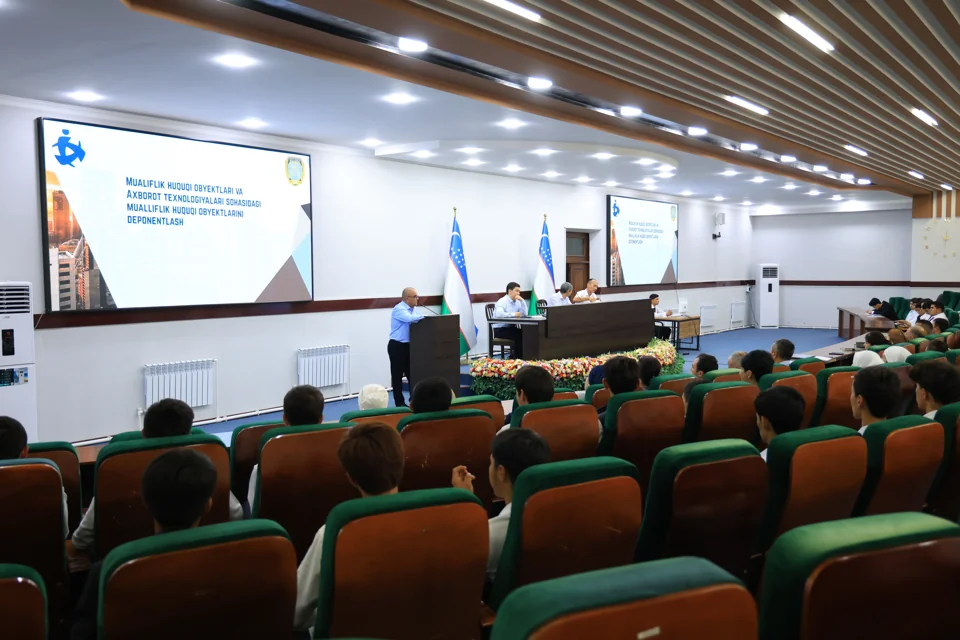
A seminar held at the institute on 21 September 2026 illustrates how research support extends beyond technical experimentation. The event concerned the preparation and legal protection of inventions, utility models and copyright-related work. It was opened by the head of the institute’s department responsible for scientific research and the preparation of research and teaching personnel. Specialists from Uzbekistan’s Intellectual Property Center participated in the discussion. Presentations covered descriptions accompanying invention applications, including devices and methods, and the deposit of copyright objects such as computer programs and databases. Participants received explanations about identifying intellectual-property objects and preparing the relevant documentation. The programme concluded with questions and answers. This dated event provides a concrete example of institutional attention to the administrative and legal stages between developing an academic idea and presenting it for protection and practical use.
Sources: Research ideas and intellectual-property learning ↗