Visa


About Ajou University in Tashkent
A university linking Uzbekistan and Korea
Ajou University in Tashkent, commonly abbreviated AUT, is located in the Yashnabad district of Uzbekistan’s capital. Its campus address is on Asalobod Street. The institution links Korean academic traditions with the development of higher education in Uzbekistan and has its own campus and academic life in Tashkent.
The university’s history identifies Presidential Decree No. 4041 of 2018 as the basis for its establishment. Academic operations began in 2020, and the university held its first graduation in 2024. These milestones distinguish the legal establishment from the beginning of teaching and the completion of the first students’ programmes. Early academic development focused on architecture, construction and electrical engineering. The university subsequently broadened its provision into subjects including software, business, interior design and language-related management study. Its institutional account places international cooperation and the connection between education and research at the centre of that development.
Sources: AUT history ↗
Architecture and the built environment
The architecture programme examines the creation and management of built environments, from individual buildings to communities and cities. Its published framework extends over four years and brings architectural design together with structure, construction and building services. The stated educational purpose combines a broad understanding of buildings with practical problem-solving.
The course list includes architectural design studios, digital design, the history of Western architecture, urban planning, building materials and architectural landscape. Students also encounter reinforced concrete, steel structures, building mechanical and electrical systems, construction documents and cost estimation. Project management and an architectural internship appear within the published programme. This combination connects the visual and conceptual work of design with the technical and organisational requirements of building. Interior architecture and environmental systems further widen the range of questions considered, showing how the programme links the appearance of places with their construction and use.
Sources: Ajou University in Tashkent (AUT) ↗
Civil systems and infrastructure
Civil Systems Engineering addresses infrastructure and the use and management of natural resources. Its published account considers the creation of environments that serve people, while its course list moves from foundational mechanics into the design and management of substantial engineering works.
Applied mechanics, fluid mechanics, solid mechanics, surveying and computer-aided design provide part of that foundation. More specialised subjects include hydrology, soil mechanics, foundation engineering, reinforced concrete, earthquake-resistant engineering and structural analysis. Water and wastewater systems, bridge engineering and tunnel engineering extend the programme into infrastructure serving communities. Geographic information systems, construction management and planning connect technical investigation with the organisation of projects. An engineering internship is also listed. The range of subjects demonstrates how civil systems study brings together the behaviour of materials, the characteristics of sites and the practical coordination of construction rather than focusing only on one type of structure.
Sources: Ajou University in Tashkent (AUT) ↗
Electrical and computer engineering
The Department of Electrical and Computer Engineering combines electronic systems with computing and communications. Its published academic description identifies electronic devices and materials, multimedia networks, radio communication, computers and automatic control as areas for study and research. Semiconductor, mobile and automotive information technology provide further organising themes.
The course list begins with circuit theory, programming, electromagnetics, logic circuits, signals and systems, and basic circuit laboratory work. It continues into data structures and algorithms, communication systems, computer networks, radio-frequency circuits and computer architecture. Image signal processing, motor control, embedded-system design, artificial intelligence, semiconductor engineering and power electronics show the breadth of later technical study. A capstone design project gives an additional project-based component. These subjects connect hardware, software and the transmission and processing of information, reflecting a department whose scope extends across several interacting technologies rather than separating computing from electronics.
Sources: Ajou University in Tashkent (AUT) ↗
Residential life on the Tashkent campus
The university’s accommodation account describes furnished shared rooms with beds, study desks, wardrobes, shelving and computer workstations. Shared kitchens, bathrooms and shower facilities provide everyday infrastructure, while lounge areas offer places to meet other students and prepare for classes. The published arrangement combines private study and rest with communal facilities.
The dormitories are described as being within walking distance of academic buildings, the library and sports facilities. The university also identifies maintenance, access-control arrangements and an on-site medical station among residential services. Its account places the residence within a multicultural student community, with opportunities for language practice and learning about Uzbekistan and other cultures through daily interaction. Residential life therefore forms part of the campus experience alongside formal teaching. Shared kitchens, lounges and nearby study facilities connect routine living arrangements with the relationships students develop during their time at the university.
Sources: Accommodation ↗
Library collections and shared study
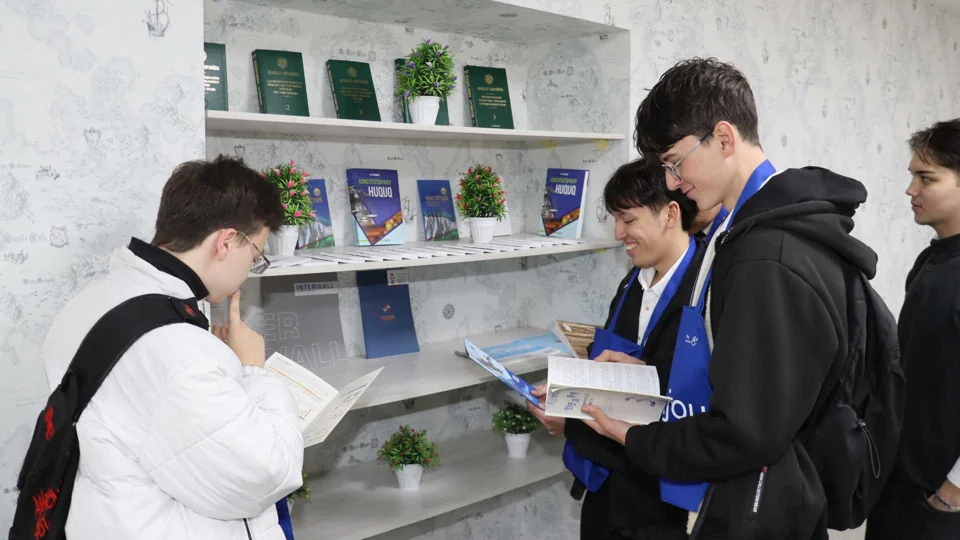
AUT’s library combines academic literature with practical manuals, fiction and books in several languages. Its published description identifies resources across scientific, technical, economic and artistic fields, supporting both coursework and wider reading. Literature, poetry and drama sit alongside more specialised academic publications.
The library also provides computer areas, internet access and electronic databases. Individual and group workspaces allow students to choose settings for focused study or discussion. Printers and scanners support the preparation of projects and research materials. Quiet areas and informal spaces provide different ways of using the collection. These resources make the library both a source of information and a shared setting for study within the Tashkent campus.
Sources: Library ↗