Visa


About American International University-Bangladesh
A private university founded in Dhaka
American International University-Bangladesh, usually known as AIUB, is a private university founded in 1994 by Dr. Anwarul Abedin. It operates as an independent organisation with its own Board of Trustees. Its institutional mission brings together academic study, professional knowledge and ethical values, with teaching spanning business, science, technology, engineering and social sciences. The university identifies continuing academic development, research, community outreach and cooperation with other educational institutions among its organisational goals. It also describes involving students, alumni and professionals in educational projects and institutional development. These aims place teaching within a wider framework of research and social engagement, while the university’s published quality policy identifies students as the central focus of its educational activities.
Sources: Institutional overview and mission ↗
Academic fields and the current campus
AIUB’s current university address is 408/1, formerly KA 66/1, Kuratoli, Khilkhet, Dhaka. Its academic organisation includes arts and social sciences, business administration, engineering, health and life sciences, and science and technology. Undergraduate subjects range from English, economics, law and journalism to accounting and business administration. Engineering provision includes electrical and electronic engineering, computer engineering, mechanical engineering, industrial and production engineering, and architecture. Health and life-science subjects include biochemistry and molecular biology, microbiology and pharmacy. Computing-related programmes cover computer science and engineering, computer networks and cybersecurity, and data science. Graduate study is also listed across several fields, including business, law, development studies, English, engineering, public health and computer science.
Sources: Academic organisation, programmes and current location ↗
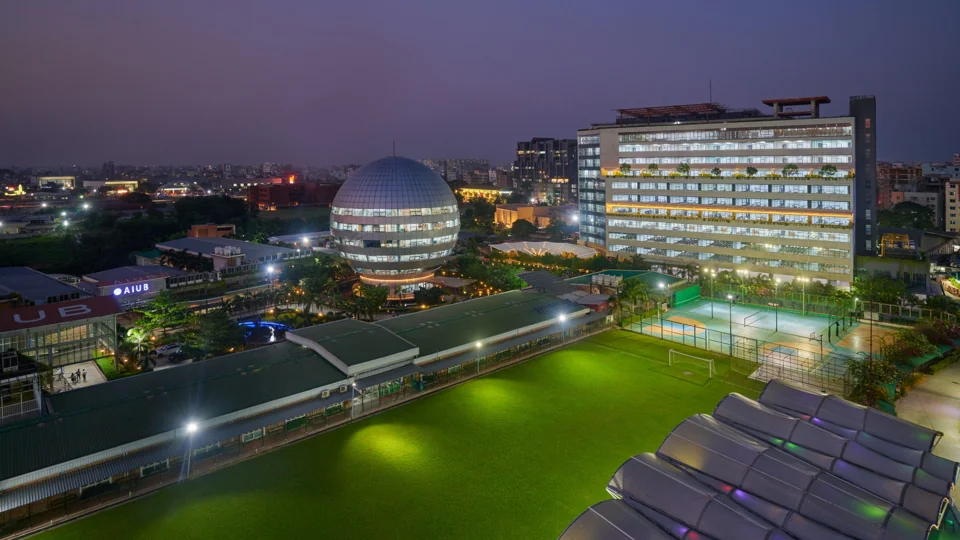
Facilities supporting practical learning
The university’s campus resources connect classroom teaching with specialist practical environments. Engineering facilities include workshops for foundry work, woodwork and machinery-related activities. Computing and animation facilities support digital production, while design studios provide space for creative project work. The media studio includes recording, editing and broadcasting equipment, together with an audio booth and facilities for staged production. Mooting facilities support the practical study of legal procedures and advocacy. Beyond academic rooms, the campus includes an auditorium, multipurpose hall, amphitheatre and indoor and outdoor seating areas. Sports and recreation provision encompasses a football field, cricket practice space, courts, indoor games and a gymnasium. The student zone and cafeteria provide additional places for students to gather between classes.
The university library
AIUB’s library began in 1994 to serve students, faculty, researchers and university staff. Its collections cover business, science, technology, computing and social sciences, with books, journals, newsletters, theses and audiovisual material included among its resources. Books are organised using the Dewey Decimal Classification, and most volumes are available on open shelves. Student identification cards are used for library borrowing. The library also operates an information system developed by the university’s own IT department. Its website provides new-arrival notices, policy information and staff contacts, keeping library services connected to the university’s digital information environment. The library’s published address places it within the Kuratoli campus, bringing collections and borrowing services into the same setting as the university’s teaching facilities.
Sources: University library ↗

Artificial intelligence and research computing
The AI Supercomputing Laboratory provides computing infrastructure for research involving artificial intelligence and large-scale data processing. Its academic description identifies machine learning, natural-language processing, computer vision, data science, robotics and generative AI among the intended research areas. Research objectives include model training, simulations and interdisciplinary applications in fields such as education, finance and urban systems. Cybersecurity and digital forensics are presented alongside these activities. The laboratory’s account also addresses responsible AI, including dataset integrity, model auditing, explainability, bias and fairness. It describes cooperation across academic disciplines and with outside organisations as part of its research approach. This combines access to computational tools with questions about how AI systems are developed, evaluated and used.
Sources: AI Supercomputing Laboratory ↗
Teaching development through CETL
AIUB’s Centre of Excellence in Teaching and Learning, or CETL, is presented as a service and training centre supporting the university’s educational aims. Its institutional account links its development to the University Grants Commission of Bangladesh and the British Council’s work on teaching and learning in higher education. The centre identifies training, educational research, resources, training-module development and the preparation of trainers among its activities and objectives. It operates under the university’s executive and academic authorities. The wider CETL network connects AIUB with other Bangladeshi universities. Within this framework, the centre focuses on developing teaching practice and educational resources, giving academic staff an institutional setting for discussing learning and professional development.
Student affairs and campus participation
The Office of Student Affairs coordinates internal and external student activities and supports orientation, student organisations, events and other aspects of university life. Its published responsibilities include student services, non-academic counselling, feedback and complaints, festival celebrations and student volunteering. Student organisations span debate, drama, performing arts, photography, social welfare, film, computing, engineering and business. The university also identifies a foreign-student association and student participation in sports teams and professional student chapters. This range of organisations provides different routes into campus life, connecting academic interests with cultural and social activities. The office’s event-related work brings together student-led initiatives, university celebrations and activities involving outside organisations.
Sources: Office of Student Affairs ↗
Academic integrity and inclusion
AIUB’s institutional policies set out expectations for academic integrity in teaching and research. They address plagiarism, fabricated information, inaccurate attribution and other forms of academic misconduct, alongside fair assessment and student supervision. The university’s ethical framework also describes academic freedom, respectful discussion, accountability and cooperation with institutional partners. Its non-discrimination policy applies to admissions, employment and participation in university activities. A Diversity and Equality Committee includes representation from academic, administrative and student communities. Its stated functions include reviewing policies, examining student experiences and supporting awareness and capacity-building activities. These published policies establish the university’s intended approach to academic conduct and inclusion across teaching, research and campus participation.
Sources: Institutional academic integrity and inclusion policies ↗