Visa
About Ad-din Momin Medical College
Identity and setting
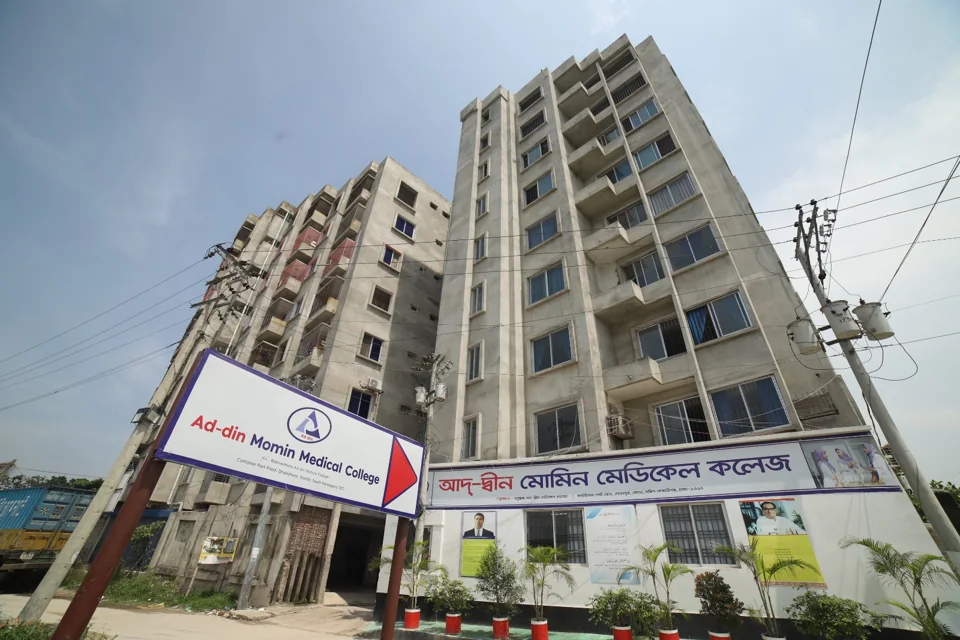
Ad-din Momin Medical College is a medical education institution in South Keraniganj, Dhaka, Bangladesh. The same college was previously known as Bashundhara Ad-din Medical College, a name that remains in some of its institutional material. Its official campus photograph carries both names, explicitly identifying Bashundhara Ad-din as the former name. The University of Dhaka’s constituent-colleges directory lists Ad-din Momin Medical College separately from Ad-din Women’s Medical College in Dhaka. These are distinct institutions within the wider Ad-din medical education setting.
The college gives its address as Container Port Road, Dholeshwar, Konda, South Keraniganj. The principal’s published introduction dates the start of academic activities to 2014. It describes a campus containing academic departments, a library and accommodation for Bangladeshi and international students. The introduction also connects medical education with ethical conduct, discipline and a sense of responsibility towards the community. These themes provide a framework for understanding both the academic programme and the expectations surrounding student life.
Sources: Official college overview ↗ · College contact and location ↗ · University of Dhaka constituent colleges directory ↗
Institutional development and academic structure
The college’s affiliation page records several stages in its institutional development. It cites government permission dated 2 October 2013, affiliation with the University of Dhaka dated 17 December 2014, and recognition documentation from the Bangladesh Medical and Dental Council dated 20 September 2018. These dates distinguish the initial permission to establish the institution from later academic and regulatory milestones.
Its MBBS course page organises the examination structure into four phases. Anatomy, physiology and biochemistry form the first phase. The second covers pharmacology and therapeutics alongside forensic medicine and toxicology. Community medicine and public health, pathology and microbiology appear in the third. Medicine, surgery, and gynaecology and obstetrics constitute the final phase. The published table includes written, oral and practical assessment components, showing that evaluation encompasses several forms of demonstrating knowledge. This sequence moves from foundational sciences through disease-related subjects to major clinical disciplines.
Sources: Affiliation and institutional permissions ↗ · MBBS examination structure ↗
Practical learning facilities
The laboratory description identifies teaching spaces across the subjects encountered in the medical course. It lists anatomy, physiology and biochemistry laboratories, together with an anatomy dissection hall and museum. Community medicine and forensic medicine also have laboratory and museum facilities. These resources connect the early scientific subjects with practical observation and subject-specific materials.
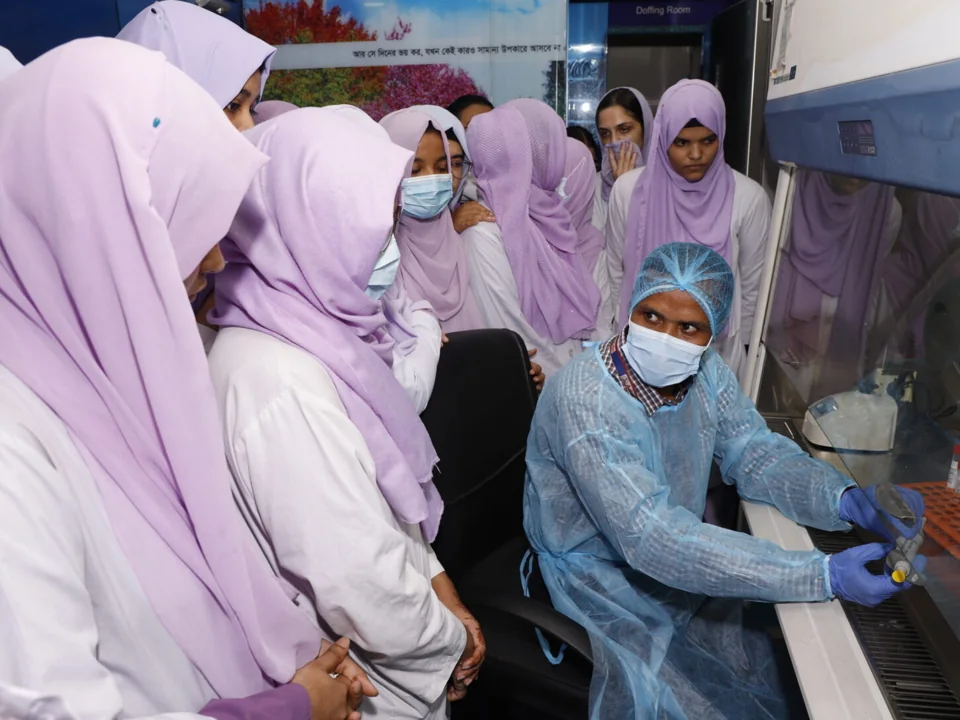
Further facilities cover pharmacology, pathology and microbiology. The college also identifies serology and immunology, histopathology and cytology among its laboratory areas. Its official laboratory page illustrates students observing a demonstration at a laboratory workstation. The range of listed facilities reflects the breadth of practical work associated with the curriculum, rather than presenting medicine solely as classroom instruction. Teaching staff and laboratory resources are described together as part of the college’s approach to learning.
Sources: Teaching laboratories ↗
Library and independent study
The academic library occupies the sixth floor of the college building. Its collection includes textbooks, reference works and monographs relating to medicine and surgery, as well as Bangladeshi and overseas journals covering medical and allied subjects. A reading room gives students a place to work with these materials, while the published facilities include wireless internet and access to computers. The library therefore supports both printed reading and the use of electronic learning resources.
Library rules emphasise quiet study, careful handling of materials and the return of borrowed books within the permitted period. Entry uses a library card signed by the principal. Newspapers, magazines and journals are assigned designated reading areas, and removing materials requires the appropriate permission. The rules also prohibit damaging or marking books. Together these arrangements describe how the shared collection is managed for successive groups of students.
Sources: Library and reading facilities ↗
Accommodation and cultural life
The hostel page describes separate accommodation categories for male and female students, including provision identified for local and international residents. Listed amenities include personal lockers, common lounges, shared kitchen and dining facilities, and security arrangements. Residence is governed by rules concerning permission to leave, visitors, cleanliness and the use of shared spaces. The published framework makes accommodation part of a supervised residential environment.
Activities outside the classroom include picnics, cultural evenings and celebrations associated with Bengali traditions. The college highlights Spring Pitha Utshob, Pohela Falgun and Pohela Boishakh among these occasions. It also commemorates 21 February, Independence Day on 26 March and Victory Day on 16 December. Its account presents cultural participation as one way international students can become familiar with Bangladeshi life. Indoor recreation includes chess, carrom, table tennis and Scrabble, alongside badminton among the activities listed by the college.
Sources: Hostel facilities ↗ · Extracurricular activities ↗
Medical publishing
Ad-din Medical Journal provides a further academic activity associated with the college. Its general-information page describes a peer-reviewed publication issued twice a year by Ad-din Momin Medical College. The journal accepts original research articles, review articles and case reports concerning medical science. Its stated purpose is to provide a forum for new findings and observations, with an emphasis on studies supported by reliable data. This publishing function adds a channel for scholarly communication alongside the institution’s teaching programme and learning facilities. The journal’s information page places responsibility for individual articles’ information, opinions and statements with their authors. It also names the principal as publisher and provides an editorial correspondence route for submissions and publication-related enquiries.