Visa

About Ahsanullah University of Science & Technology
Origins and educational purpose
The name Ahsanullah University of Science & Technology refers to Ahsanullah University of Science and Technology, usually abbreviated AUST, in Dhaka, Bangladesh. Dhaka Ahsania Mission founded the university in 1995. The mission is a nonprofit voluntary organisation established in 1958 by the educationist and social reformer Khan Bahadur Ahsanullah. The university’s history therefore connects a comparatively recent institution of higher education with an older organisation concerned with education and social development.
AUST’s mission emphasises developing human capabilities for changing needs in Bangladesh and beyond, combining professional knowledge and skills with ethical values. It also identifies entrepreneurship, leadership and a sustainable future as educational concerns. Its published aims include programmes in science, engineering, business and social sciences, together with teacher training. Programme review in response to developments in these fields is part of this stated approach. The institution’s vision connects innovation and the creation of knowledge with a wider contribution to society.
Sources: About AUST ↗
A permanent campus in Tejgaon
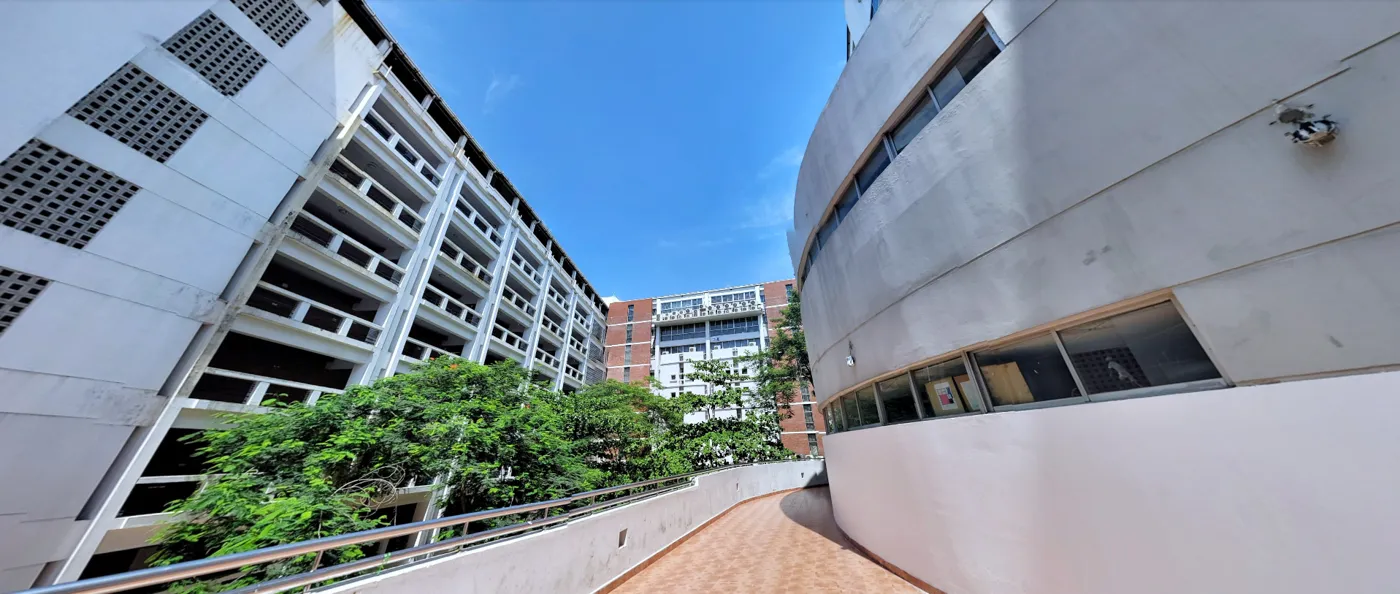
The university’s address is 141 and 142 Love Road in Tejgaon Industrial Area, Dhaka. Its permanent-campus description places classrooms, laboratories, academic offices and student services within a multi-level complex. The campus plan identifies a main plaza and teaching blocks, together with a library, stationery and photocopy services, common rooms and a cafeteria.
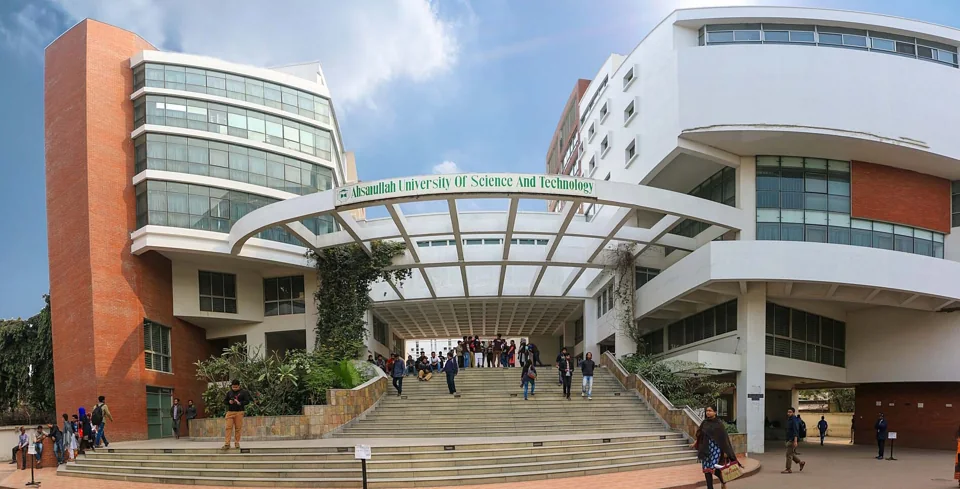
The infrastructure listing also includes an auditorium and seminar space, medical facilities, prayer space and rooms used for visiting delegations. Laboratories are distributed through the academic blocks rather than being described as a separate activity from teaching. These arrangements bring formal instruction, practical work, academic resources and everyday services into the same campus setting. Official photographs show the university’s name over the broad entrance stairway between its teaching buildings.
Sources: Permanent campus and infrastructure ↗
Professional study and practical learning
The Bachelor of Architecture programme brings together culture, history, arts, sciences and engineering. Its stated objectives concern the built environment and the problems of human habitation and work in Bangladesh. The programme places creative ability alongside technical knowledge and emphasises professionalism and social responsibility. This gives architectural education an interdisciplinary character, connecting design decisions with the settings and communities in which buildings are used.
The Computer Science and Engineering Department dates its establishment to 1995 and offers a Bachelor of Science in Computer Science and Engineering. Its mission connects foundational knowledge in computation and information technology with research, ethical commitment and links between industry and academia. Departmental information provides access to syllabuses, laboratory information, research and academic activities.
AUST’s laboratory listing spans civil, electrical and electronic, textile, mechanical and production engineering, as well as architecture and the basic sciences. Textile facilities address processes such as yarn and fabric manufacturing, wet processing, apparel manufacture and testing. Mechanical and production facilities cover thermodynamics, fluid mechanics, materials, ergonomics and manufacturing. Architecture laboratories include computer-aided design, photography, building materials and environmental work. These facilities indicate the range of practical environments supporting different disciplines.
Sources: Bachelor of Architecture ↗ · Laboratory facilities ↗ · Computer Science and Engineering ↗
Library resources and spaces for study
The Kazi Fazlur Rahman Library was established in 1995 and describes its development as aligned with the university’s educational and research mission. It provides printed collections and access to electronic resources, together with individual study carrels, reading areas and spaces intended for faculty members and researchers. Its website presents a catalogue, institutional repository, thesis-help information and account services.
The library also identifies information-literacy classes, borrowing guidance, course-reserve information and remote-access arrangements. Its current website records a research and innovation webinar concerning IEEE publications in October 2026. New-arrival listings range across engineering, architecture, textiles, environmental topics and design, reflecting the university’s subject mix. The combination of collections, electronic access and guidance supports students in finding academic information and using the library as a place for sustained study.
Sources: Kazi Fazlur Rahman Library ↗
Research administration and industry connections
The Research and Publication Office is the university’s central unit for research administration, operating within the Office of the Vice-Chancellor. It formulates policies and procedures for basic and applied research and coordinates internal and external research activities. Its responsibilities include reviewing internal research-grant opportunities and administering ethics-clearance processes.
The office promotes research through talks and seminars involving academics and industry specialists. It also helps faculty prepare proposals for external funding, including opportunities to learn from funding-agency officials and professional experts. Its services identify both the AUST Internal Research Grant and the AUST Student Research Grant. Another part of its work is bringing curriculum-based student projects to the attention of industry personnel, allowing discussion of their potential development into pilot projects or commercially relevant applications.
Sources: Research and Publication Office ↗
Student welfare and extracurricular participation
The Office of the Advisor of Students’ Welfare coordinates co-curricular and extracurricular activities through university clubs. These cover debating, photography, innovation and design, culture, sports, career development, programming, robotics, research and publication, and environmental and social welfare. Activities include competitions, workshops, cultural events, educational visits and community service.
The office also organises orientation and farewell programmes, supports blood-donation activities and operates a welfare fund for students in distress. Career counselling helps students develop realistic career plans, while the campus medical centre provides first-aid support. Job fairs, seminars and other campus events form part of its published responsibilities. This provision connects organised student participation with practical assistance during university life, extending the educational experience beyond individual degree courses.