Visa
About Amar Telidji University of Laghouat
From technical teacher training to a university
Amar Telidji University of Laghouat is an Algerian university based in Laghouat. Its official history traces its beginnings to a higher school for technical-education teachers established in 1986. That school trained teachers in mechanical, civil and electrical engineering. In 1997 it became a university centre, broadening its remit to engineering qualifications, licence degrees and applied university studies. The fields described for this period included computing, industrial chemistry, biology, economics, management, Arabic literature, psychology and law. University status followed in 2001. The transition brought a wider academic structure and additional subjects, including architecture, agricultural sciences, water resources and English. The institution subsequently introduced licence programmes within the Licence–Master–Doctorat framework in the 2006–2007 academic year, followed by complementary master’s programmes in 2009–2010.
Sources: University history ↗
Engineering and an evolving academic structure
The Process Engineering Department illustrates how the university’s academic organisation developed over time. Its origins lie in an Industrial Chemistry department operating in 1996–1997 within the former science and engineering faculty. Its earlier courses included engineering studies in chemical, organic-process and pharmaceutical-process fields, alongside shorter applied university training in analysis. The department adopted the Process Engineering designation in 2010. Following the division of the former faculty into science and technology faculties in 2011, it became part of the Faculty of Technology. Its departmental history also records the introduction of the Licence–Master–Doctorat framework in 2007–2008, initially alongside older courses. The sequence shows a department moving from an industrial-chemistry foundation into a broader process-engineering identity.
Historical studies and the humanities
History teaching has its own documented institutional development. Historical and archaeological studies were established within the Humanities Department under a 2010 decision concerning departments in the Faculty of Humanities and Social Sciences. A further decision in September 2013 reorganised this provision around general history, with subject-specific study beginning in the second year. The creation of the Faculty of Humanities, Islamic Sciences and Civilisation in 2016 provided a subsequent academic home for the History Department. Its presentation identifies both licence and master’s students. This account places historical studies within a changing faculty structure and documents a humanities strand alongside the university’s earlier technical and scientific disciplines.
Sources: History department presentation ↗
Planning, information and campus development
The Vice-Rectorate for Development, Planning and Guidance is responsible for several practical aspects of institutional development. Its official presentation dates the creation of this office to a ministerial decision in August 2004. Three services bring together statistics and planning, guidance and information, and monitoring of university construction and equipment programmes. These responsibilities connect the collection of institutional information with decisions about the university’s physical and educational development. The published organisation distinguishes the service concerned with prospective statistics from the service providing guidance and information, while a separate team follows building and equipment work. The office therefore forms part of the administrative structure supporting the university’s academic activities.
Sources: Development, planning and guidance vice-rectorate ↗
Language learning at CEIL
The Intensive Language Teaching Centre, known as CEIL, offers courses in English, French, Spanish, German and Arabic. Its programmes cover levels from beginner to advanced, with additional provision concerning business and technical language. The centre also describes preparation for language-proficiency examinations, including TOEFL, IELTS, DELF and DELE. Its teaching approach emphasises communication, active participation and practical activities supported by multimedia resources. Small classes are part of the centre’s stated approach to individual attention. Students can use a language-resource library and multimedia laboratory. CEIL presents intercultural understanding as an educational aim alongside language proficiency. Its courses add a dedicated language-learning service to the university’s disciplinary teaching, with registration and contact information provided through the official university website.
Sources: Intensive Language Teaching Centre ↗
Scientific computing through CUMULUS
CUMULUS is the university’s high-performance computing infrastructure, brought into service in 2024. It supports research requiring substantial computing resources, including numerical modelling, physical and chemical simulation, large-scale data analysis and artificial intelligence. The centre describes a collaborative project involving Amar Telidji University and Algeria’s Directorate-General for Scientific Research and Technological Development. Access is organised around authorised research projects involving university researchers, doctoral students, research master’s students and collaborators. A user guide covers connecting to the system, software modules, submitting computing jobs and managing files. The centre also publishes a usage charter covering responsible resource allocation, account security, software and research acknowledgement. Its projects page describes computational materials research combining machine learning with density-functional-theory methods, including investigations of materials intended for solar-energy applications.
Scientific, cultural and sporting life
A dedicated sub-directorate supports scientific, cultural and sporting activities. Its remit includes developing student scientific and cultural activities, supporting university sport and organising recreational programmes. It also carries out social activities for university personnel. The published structure divides this work between a scientific and cultural activities service and a sports and recreation service. This administrative provision gives extracurricular interests an identifiable place within university organisation, covering both students and staff. Its university address is listed on the Ghardaïa Road in Laghouat.
Entrepreneurship within student project discussions
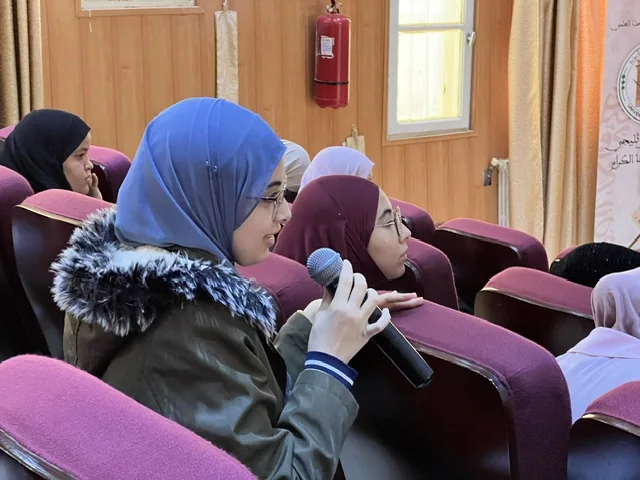
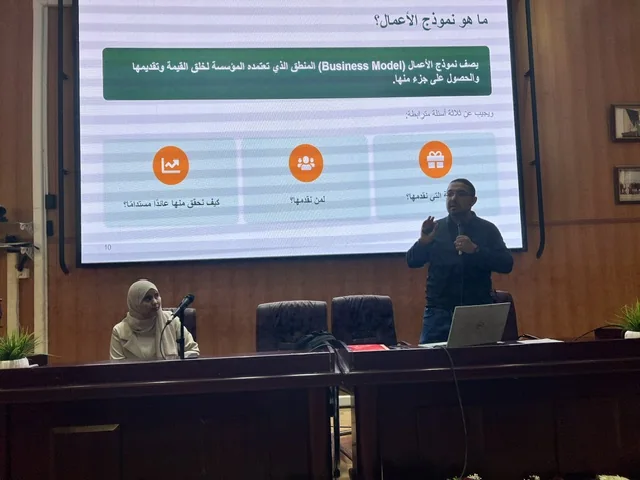
An official report published on 30 October 2026 records an awareness event for dentistry students concerning graduation projects developed within a start-up or patent framework. The accompanying institutional photograph collection shows a presentation on business models and participation from the audience. The report places entrepreneurship-related discussion within a specific academic setting in the Faculty of Medicine. It provides a recent example of students encountering project-development ideas alongside their disciplinary studies.
Sources: Dentistry student entrepreneurship awareness event, published 30 October 2026 ↗