Visa
About Abbès Laghrour University of Khenchela
A multidisciplinary university in the Aurès region
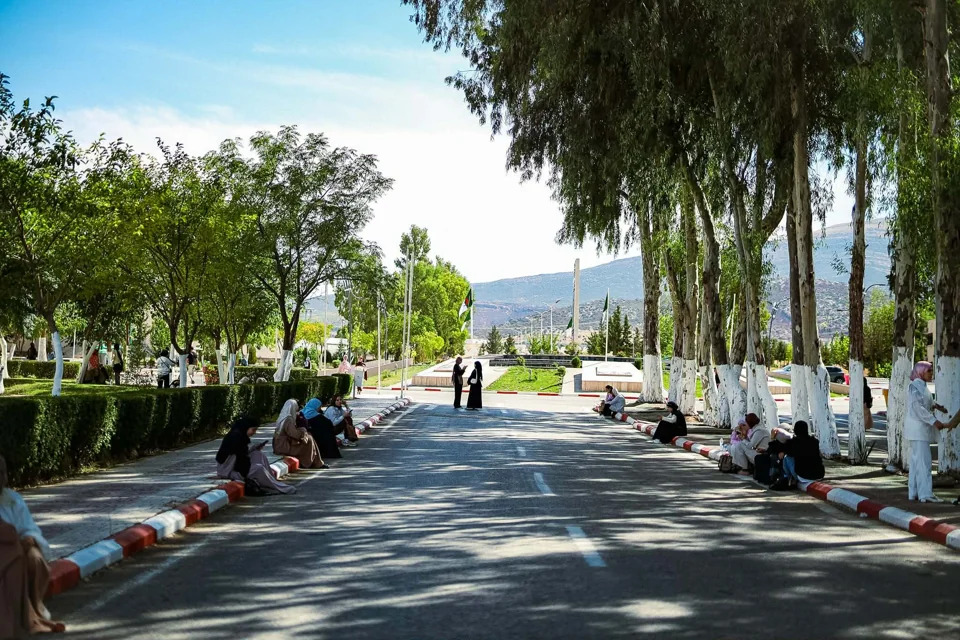
Abbès Laghrour University of Khenchela is an Algerian university located in the Aurès region. Its official history traces its beginnings to a university annex associated with the University of Batna in 1999. It subsequently operated as a university centre from 2001 until its promotion to university status in 2012. The institution takes its name from Abbès Laghrour, a figure associated with Algeria's independence struggle. The university's introduction presents a broad academic role involving the preparation of teachers, researchers and qualified personnel for public administration and enterprises. Its subject areas extend across science and technology, natural and life sciences, humanities and social sciences, economics and management, languages and literature, and law and political science. This range places the institution within a regional setting while connecting its work to several kinds of professional and scholarly activity. Its historical development shows how a smaller higher education presence grew into a more comprehensive university.
Sources: University introduction and history ↗
Understanding the degree structure
The university's study-system page explains the licence, master and doctorate framework, commonly abbreviated as LMD. It describes a first degree following three years of study after the baccalaureate, followed by a master's stage and then doctoral research. The guidance distinguishes academic and professionally oriented pathways and presents progression as a process of building knowledge before developing greater specialisation. It also emphasises independent work, student support, mobility and the recognition of acquired learning. Teaching is organised into units, bringing together fundamental subjects with methodological, discovery and transversal learning. This description helps prospective students understand the framework behind individual programme titles. It is an overview of the educational structure rather than a guarantee of entry to a particular degree or progression route. The relevant programme and current university guidance determine the conditions applying to a student's own course of study.
Sources: Study system ↗
The central library and digital resources
The Central Library's institutional account connects its establishment with the creation of the Khenchela university centre in 2001. It describes a building at the El Hamma university complex on the Oum El Bouaghi road, with collective and individual reading spaces, bibliographic research facilities, internet access, lending services and storage areas. The library presents itself as an important source of support for teaching and study, with collections developed in relation to students' academic needs. Its public portal connects readers with the library catalogue, doctoral theses, a digital repository and the national electronic documentation system, SNDL. Links also point towards shared Algerian cataloguing and other digital educational resources. These services provide several routes into academic literature, from locating a printed reference to exploring research outputs. The library's rules and reader guidance remain the appropriate sources for borrowing conditions and access to particular resources.
Sources: Central Library ↗
Language learning for the university community
The Intensive Language Teaching Centre is described as a shared university service supporting foreign-language learning. Its stated audience includes students, academic staff, administrators and other employees, reflecting the role languages can play throughout university life. The centre explains that its training follows the Common European Framework of Reference for Languages. Its public page also identifies a centre library, internal regulations and information about the certificates it offers. This places language learning alongside disciplinary study and research as a supporting academic activity. For students, the centre provides an institutional contact for exploring additional language training rather than assuming such preparation forms part of every degree. The relevant course information should be checked for the languages, levels, registration arrangements and certification available at the time of application. The centre's stated purpose is to support communication and access to wider cultures and knowledge.
Sources: Intensive Language Teaching Centre ↗

Supporting ideas, entrepreneurship and innovation
The university's business incubator presents its purpose as helping people with innovative projects develop their ideas into startups. Its institutional information records establishment in February 2022 and an incubator label in April 2023. The emphasis is on accompaniment through an incubation process, connecting a proposed idea with the work needed to develop a viable enterprise. A related support structure is the Technology and Innovation Support Centre, known as CATI. The university describes CATI as a partnership with Algeria's National Institute of Industrial Property, INAPI, and dates its creation to June 2022. Its public resources include guidance on preparing and submitting a patent application and materials for student entrepreneurs. Together, these structures show how the university supports activity beyond conventional coursework and publication. They provide routes for exploring innovation and intellectual property, while the success or protection of an individual project depends on its development and the applicable assessment processes.
Sources: Business incubator ↗ · Technology and Innovation Support Centre ↗
Building connections with organisations
The university–enterprise liaison office, or BLUE, describes a role in strengthening communication between the university and its economic and social environment. Its institutional introduction connects this work with the use of knowledge in local and national development. It also identifies the relationship between educational preparation and the needs of the surrounding labour market as an important concern. The office is presented as one of the structures intended to maintain dialogue with economic and social organisations and support more useful partnerships. This offers a further perspective on the university's regional mission: teaching and research are linked with organisations that may apply knowledge or employ graduates. Such a liaison function provides a framework for cooperation rather than an employment guarantee. Students and external organisations can use the office's official information to identify its objectives, contacts and appropriate routes for discussing potential collaboration.