Visa
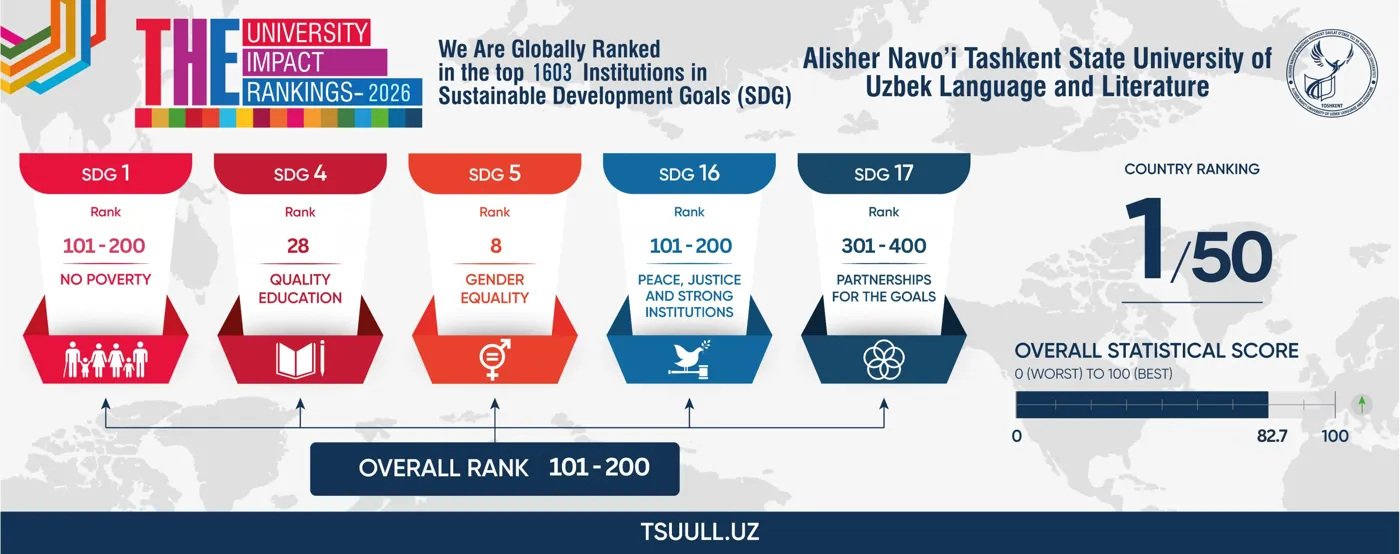

About Alisher Navo'i Tashkent State University of Uzbek Language and Literature
A university centred on Uzbek language and literature
Alisher Navo’i Tashkent State University of Uzbek Language and Literature is a specialist university in Tashkent, Uzbekistan. Its modern institutional history begins in 2016, when it was established with programmes in Uzbek philology, Uzbek language and literature, and Uzbek–English translation theory and practice. That foundation is distinct from the much older academic traditions described in its institutional history. The university traces relevant faculty roots through literature and philosophy teaching in 1918 and Uzbek language and literature faculties established in 1935 at predecessor institutions. Its subsequent development broadened the original concentration: teaching Uzbek as a foreign language appeared in 2018, followed by publishing studies in 2019. The history also records the addition of Russian translation in 2020 and German and French translation in 2021. These milestones describe an institution whose subject remains Uzbek language and literature while its teaching has expanded into translation, publishing and applied language work.
Sources: University history ↗
Purpose and cultural responsibilities
The university’s mission places language within a wider cultural and intellectual setting. It identifies Uzbek as a medium of national identity, literature, education and historical understanding, and calls for research into both its formation and its modern development. Training researchers and teachers is central to this purpose. The mission also addresses the preparation of translators able to work between Uzbek and English or other languages, including the translation of scientific and literary material. Another stated responsibility is preparing Uzbek language teachers for institutions outside Uzbekistan. Its strategic ambitions include strengthening Turkic studies and increasing international engagement with Uzbek culture. These are institutional objectives rather than a list of completed projects. Together they explain why language teaching, literary scholarship and translation occupy prominent places in the university’s academic provision.
Sources: University mission ↗
Undergraduate academic range
The university’s published undergraduate programme table separates several related approaches to language study. Uzbek language and literature sits alongside philology and language teaching, while a separate route addresses Uzbek in other language groups. Translation theory and practice is listed for English, Russian, German and French. The table also includes textual studies and literary source studies, publishing studies, applied philology, computer linguistics, and folklore and dialectology. Responsibility is distributed across departments concerned with teaching methods, linguodidactics, literary history, criticism, linguistics, language theory and world literature. This organisation gives a clearer picture than a single broad label such as philology: some fields emphasise teaching, others investigate texts and literary traditions, and others connect language with translation or digital technologies. The programme listing therefore shows both the university’s specialist focus and the variety of academic questions pursued within it.
Sources: Undergraduate programmes ↗
Postgraduate specialisation
At master’s level, the published specialties develop more narrowly defined areas of study. The table includes Uzbek language and literature and Uzbek language in foreign language groups, together with folklore and dialectology. Translation-related specialties distinguish comparative linguistics and linguistic translation studies from simultaneous translation, literary translation, and scientific and technical translation in English. Textual studies and literary source studies provide another route, while literary studies is divided into Uzbek literature, world literature and literary theory. Computer linguistics also appears in the master’s list. The accompanying departmental assignments connect these specialties with language teaching, intercultural communication, translation, literary history and digital technologies. Read alongside the undergraduate table, the postgraduate provision shows how the same broad subject can lead toward different research and professional areas, from interpreting to the analysis of literary sources and language data.
Sources: Master’s specialties ↗
Textual criticism and literary research
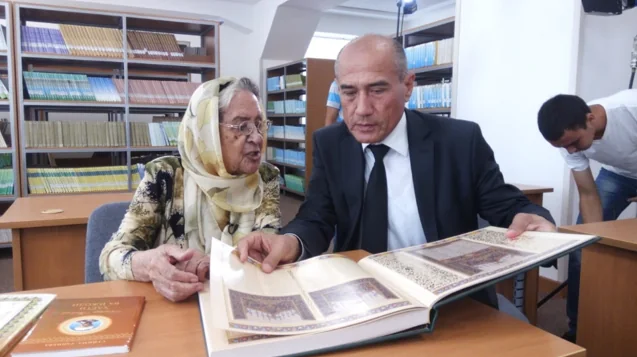
The official account of Shuhrat Sirojiddinov’s scientific school describes research grounded in textual criticism and the study of literary sources. It presents the interpretation of literature as a task involving artistic, philosophical, historical and religious perspectives. The school’s work includes Uzbek classical literature, comparison with Persian and English literature, and questions of equivalence in translated sources. Alisher Navo’i’s life and writing are a particular research interest, together with religious, philosophical and mystical ideas in Uzbek literature. The account locates this work in the Department of Textual Criticism and Literary Sources and describes a scientific centre associated with the department. Its emphasis is on reading works closely while considering their broader intellectual contexts. A photograph published with the account shows a consultation over an illustrated volume, giving a concrete view of the source-based scholarship described on the page.
Sources: Scientific school of Shuhrat Sirojiddinov ↗
Applied linguistics and language technology
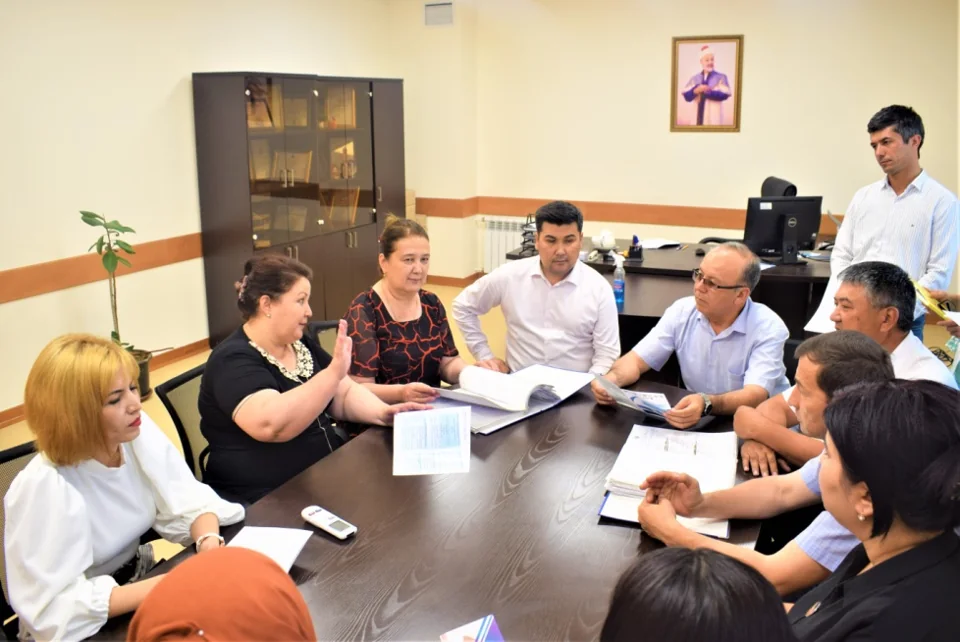
A different research direction appears in the account of Bakhtiyor Mengliyev’s scientific school. Its substantive-pragmatic approach concerns how Uzbek functions in communication and how linguistic research can support practical language use. The account identifies work on educational and morphological dictionaries, morphological analysis, syntactic analysis and semantic analysis. It also describes an educational corpus forming part of the National Corpus of the Uzbek language. Research areas include lexicography and terminology, educational vocabulary, corpus linguistics, linguoculturology, language teaching and linguistic expertise. These examples connect the study of language with organised linguistic resources and tools rather than treating scholarship solely as literary interpretation. The accompanying photograph depicts a group discussion around documents in an office setting. Alongside the textual criticism school, this research account illustrates the university’s engagement with both inherited written culture and contemporary language applications.
Sources: Scientific school of Baxtiyor Mengliyev ↗
Library resources
The university’s library page describes a collection spanning scientific literature, fiction, course books, textbooks and foreign-language material. It also identifies an electronic document collection and an independent reading room with internet-connected computers. Links from the page direct readers toward library news and the electronic document service. These resources support the institution’s combination of teaching, literary study and language research, with printed works and digital documents represented in the library’s description.
Sources: University library ↗