Visa


About Albstadt-Sigmaringen University
A university across two towns
Albstadt-Sigmaringen University is a public university of applied sciences in Baden-Württemberg, in southwestern Germany. Its German name is Hochschule Albstadt-Sigmaringen. The university operates in two towns, with distinct academic strengths at each location: Engineering and Computing are based in Albstadt, while Business and Life Sciences are based in Sigmaringen. This arrangement brings technological, commercial and scientific subjects into one institution without concentrating all its teaching in a single city. Its official English overview identifies 1971 as the year of foundation. The university's applied sciences identity connects its academic work with practical questions arising in industry and other professional settings.
Sources: University overview ↗
From specialist education to higher education
The Sigmaringen site's educational history predates the university. Until 1968 it accommodated a Landfrauenschule, a school associated with rural women's education. Subsequent institutional changes introduced higher specialist education for women's professions and social pedagogy, followed by an engineering school. In 1971, reforms to German higher education provided the setting for the establishment of Fachhochschule Sigmaringen. Its initial subjects included clothing technology and household and nutrition technology. These were the programmes of the founding period, rather than a description of the present degree catalogue. The university's historical account therefore traces a development from specialist vocational education toward an institution combining scientific study with professional application.
Sources: Origins and early development ↗
Albstadt and Sigmaringen
The two locations offer different surroundings for university life. In Albstadt, the central campus lies beside the pedestrian area, close to shops and cafés and connected to public transport. The university presents the town as a place where study, everyday services and nearby housing can be combined. Sigmaringen's campus has views toward the town's castle, with the Danube and surrounding landscape contributing to its setting. Both locations sit within a region containing industrial employers and opportunities for institutional cooperation. Their physical separation is an important feature of the university: a student's academic subject determines which town provides the main setting for teaching.
Sources: Two university locations ↗
Engineering and applied learning
Engineering education in Albstadt combines technical foundations with questions of organisation and business. The faculty describes a progression from basic knowledge toward specialisation, supported by lectures, projects and electronic learning. Practical semesters, project work and supervised final theses provide different settings in which students apply what they have studied. Its subject areas include mechanical construction and lightweight design, digital production, mechatronics and autonomous systems, and materials and processes. Industrial engineering adds connections between technology and economic decisions, including production, energy and mobility. At master's level, the faculty's programme range includes Industrial AI and Digital Production Management, reflecting the place of data and automation alongside established engineering disciplines.
Sources: Faculty of Engineering ↗
Life Sciences in Sigmaringen
The Faculty of Life Sciences brings together biological, food-related, pharmaceutical and engineering subjects. Its bachelor's programme directory includes Applied Biology–Food and Pharma, Applied Nutrition and Food Science, Bioanalytics, Pharmaceutical Engineering, and Smart Building Engineering and Management. This range spans the study of living systems, analytical methods, production processes and the operation of buildings. Graduate provision includes Biomedical Sciences and Life Science Engineering. The latter links natural science with engineering and production management, including the planning of plants and facilities. The faculty's scope consequently extends beyond a single laboratory discipline, bringing scientific investigation into contact with the design and management of practical processes.
Sources: Faculty of Life Sciences ↗
Research and knowledge transfer
Research is organised around three broad priorities. DITI covers digitalisation, IT security and Industry 4.0, including digital forensics, cloud services, autonomous robotics and networked production. GEB brings together health, nutrition and biomedicine, with subjects such as biomarkers, DNA repair and in-vitro testing systems. NESP focuses on sustainable development and smart materials and products, including intelligent textiles, additive manufacturing and energy efficiency. The Institute for Applied Research helps coordinate research and relationships with business. The university describes knowledge and technology transfer as a way of bringing results from research, teaching and continuing education into use beyond the institution. Its structure encourages collaboration across subject boundaries rather than treating each faculty as an isolated research setting.
Sources: Research profile ↗ · University portrait ↗
A library serving both campuses
The university library supports teaching, research and study while also serving people in the surrounding region. Its print collections reflect the subjects taught at the university, and university members can reach electronic journals and databases remotely through the institutional network. Library instruction develops skills in finding and using information. Interlibrary loans extend access beyond local holdings, while a courier service connects the collections in Albstadt and Sigmaringen. Both library locations offer step-free access. The OPUS-HSAS publication repository provides another route to the university's academic output. Together, these services make the library a shared resource across the two towns rather than simply a separate reading room on each campus.
Sources: University library ↗
Robotics and discussion of teaching
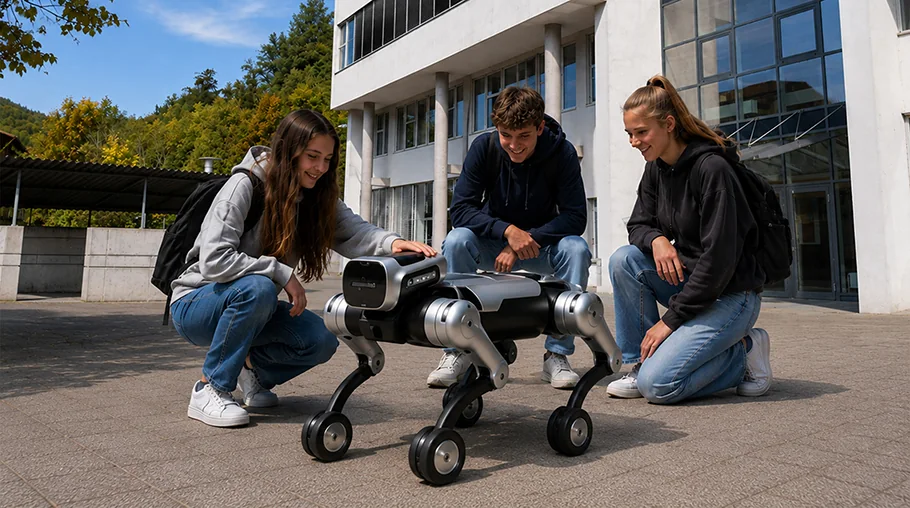
An October 2026 university report illustrates applied learning through a project involving Industrial AI master's students and the company Vantive. Students investigated transport applications for an autonomous robotic dog, developed and tested approaches over several weeks, and discussed their results with company specialists. The work considered practical and economic questions alongside technical possibilities.
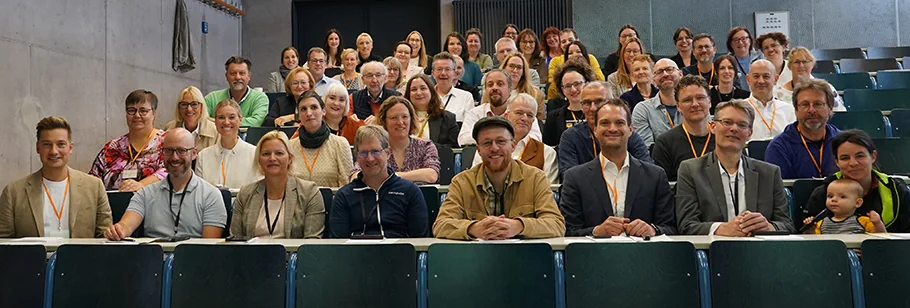
A separate report published that month describes an exchange about artificial intelligence in university teaching. Conference sessions, a teaching day and a doctoral colloquium brought together discussions of curricula, examinations, learning assistants and responsible AI use. A visit to the Forschungsfabrik Sigmaringen connected those conversations with industrial applications. These documented activities show how practical projects and reflection on teaching contribute different elements to the university's academic work.
Sources: Students learn to work with modern robots ↗ · Artificial intelligence in university teaching ↗