Visa
About Alan J Flisher Centre for Public Mental Health
A partnership for public mental health
The Alan J Flisher Centre for Public Mental Health is a South African academic research and teaching centre formed through collaboration between the University of Cape Town’s Department of Psychiatry and Mental Health and Stellenbosch University’s Department of Psychology. A memorandum of understanding between the universities established the partnership in May 2009. The centre launched on 16 August 2010 and was renamed in Alan Flisher’s memory in 2011. Flisher died before the launch. The same event inaugurated an annual memorial lecture, with global mental-health researcher Vikram Patel delivering its first presentation. Its origins included the Mental Health and Poverty Project and parallel work on postgraduate public-mental-health training. In 2014, UCT recognised it as a University Research Committee centre. Its Cape Town contact address is in Rondebosch. These university connections provide the institutional setting for its research, teaching and policy-oriented work.
Sources: Background and university partnership ↗

Research, teaching and policy objectives
The centre’s focus is public mental health in Africa, connecting research with teaching, consultation and advocacy. Its objectives encompass mental-health policy, services, legislation and human rights. Capacity development is intended to strengthen the skills available within African institutions responsible for planning and delivering mental-health systems. The centre also identifies advisory work with governments and international health and development organisations as part of its role. Its vision is interdisciplinary and collaborative, linking the generation of evidence with its use in policy and practice. Rather than concentrating only on individual clinical encounters, its stated direction considers the organisation of services and the needs of communities and populations.
Sources: Vision and objectives ↗
Methods shaped by social context
The centre’s principles draw on public health and a broad range of disciplines. These include community psychology, psychiatry, sociology, social work, epidemiology, biostatistics, nursing, anthropology and disability studies. Quantitative methods are used alongside qualitative social-science approaches to understand mental health within social and economic settings. The centre emphasises theories and research that are appropriate to the African contexts in which participants work. Its principles also include community participation and the involvement of people with mental-health disabilities. Disseminating policy-relevant findings is another priority, helping connect research with decision-making at national, district and community levels. Collaboration between academics, practitioners, policymakers and service users forms part of this approach. Leadership training addresses planning, financial management, information systems, quality improvement and collaboration across sectors, connecting research knowledge with the practical organisation of services.
Sources: Values and research principles ↗
Professional learning with a population focus
The centre’s teaching approach responds to the need for training concerned with population mental health and the systems supporting it. It aims to build practitioners’ ability to plan and evaluate services, interpret evidence and contribute to policy discussions. Its teaching description brings together perspectives from public health, psychiatry, psychology and social sciences. Participants are encouraged to connect assignments and research with their work in their own countries. The centre’s historical teaching page records students and facilitators from its first MPhil class at Stellenbosch University in 2012. This emphasis on practitioners’ experience gives the educational work a connection to service settings while supporting scholarly knowledge about public mental health in lower-resource contexts.
Sources: Teaching and historical first cohort ↗
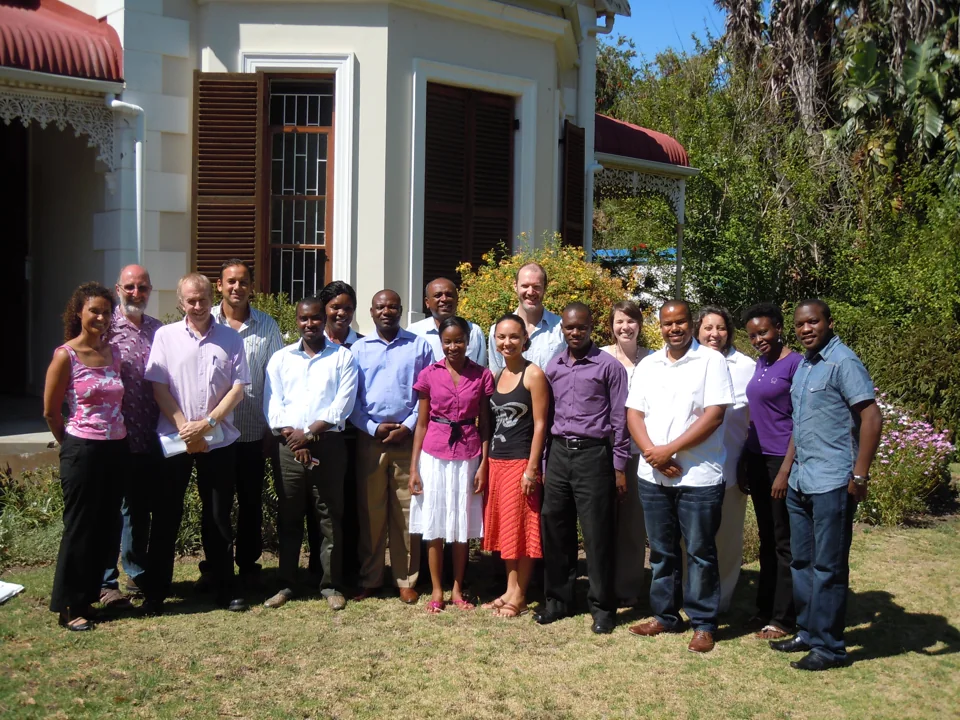
Research training in the MPhil programme
The published 2027 MPhil in Public Mental Health outline describes a part-time research degree intended for practitioners from varied professional backgrounds. Its training includes public-mental-health concepts, quantitative and qualitative methods, statistics, epidemiology and responsible research conduct. A residential teaching module is followed by an online writing course, ongoing supervision and monthly webinars. The dissertation gives students an opportunity to investigate a specific public-mental-health question, from developing a proposal and obtaining ethical approval to collecting, analysing and presenting data. The centre encourages projects connected with participants’ professional settings, such as evaluating a programme within a service organisation. The programme is an academic research pathway without clinical components, within the centre’s university-based teaching arrangements.
Doctoral research through the University of Cape Town
The centre’s doctoral route concerns research questions relevant to public mental health in Africa. Its programme description specifies registration through the Department of Psychiatry and Mental Health at the University of Cape Town. Students work within UCT’s postgraduate policies and establish an agreement with their supervisors. Suitable supervision is an important part of the research setting, with proposals assessed alongside the applicant’s academic and research background. The programme draws on foundational disciplines including public health, psychology, nursing, medicine, social work, occupational therapy and health economics. This provides a route for advanced investigation across professional boundaries, with the centre’s public-mental-health focus shaping the questions and supervisory relationships around which doctoral study develops.
Sources: Doctoral study through UCT ↗
Building research capacity through AMARI
The African Mental Health Research Initiative, or AMARI, is an example in the centre’s published research portfolio. Its programme description brings together African universities with support from UK institutions to develop research leadership in Ethiopia, Malawi, South Africa and Zimbabwe. The initiative focuses on mental, neurological and substance-use research, including connections with established health programmes. Its capacity-building design includes doctoral and postdoctoral preparation, statistics and epidemiology, alongside an Academic Career Enhancement Series. This wider training addresses mentoring, presentation, grant writing, teamwork, teaching and career planning. The initiative illustrates an approach in which methodological preparation and the practical skills of sustaining a research career are developed together.