Visa
About Al-Rowad University
A university community in Taiz
Al-Rowad University is based in Taiz, Yemen, with its public information identifying the Habail Salman area. Its academic structure includes medical sciences, science and engineering, and finance and business. The university's mission connects education with scientific research, professional conduct and sustainable development. Its objectives include reviewing academic programmes, supporting research and innovation, strengthening community partnerships and improving coordination across university units. Published values include ethical commitment, creativity, transparency, accountability, teamwork and sustainability. These statements give a sense of the institution's intended educational direction: developing knowledge and practical capabilities while connecting university work with the surrounding community. Academic and administrative development are presented as continuing responsibilities.
Accounting within finance and business
Accounting is one of the programmes presented within the Faculty of Finance and Business. Its published mission emphasises education informed by professional standards, research and community partnerships. The programme's objectives cover scientific and professional preparation in accounting and auditing, development of teaching and research in those fields, and closer relationships between learning outcomes and professional practice. It also seeks to build links with different sectors and attract academic expertise into a supportive teaching and research environment. The programme brings accounting knowledge, auditing and applied enquiry into a shared educational framework. Its quality and partnership objectives are stated as areas for continuing development.
Sources: Accounting programme ↗
Academic development and quality assurance
The Academic Development and Quality Assurance Centre describes itself as the university unit responsible for improving academic and institutional performance. Its remit includes developing staff capabilities, evaluating performance and supporting continuous improvement throughout programmes and university units. The centre identifies the development of evaluation policies and the promotion of a shared quality culture as important parts of its work. It also seeks cooperation with evaluation and quality-assurance bodies and draws on practice beyond the institution. Institutional and programme accreditation appear as goals that the centre supports the university in pursuing. Its stated role is thus one of development, review and capacity building across both academic and administrative activity.
Sources: Academic Development and Quality Assurance Centre ↗
Designing courses around learning outcomes
A workshop held on 25 January 2026 addressed course descriptions based on intended learning outcomes. Organised by the quality-assurance centre with Human Resources, it involved deans and department heads and was presented as the second phase of the university's internal quality system. Expert Abdulraqeeb Al-Samawi discussed how educational objectives could be translated into identifiable knowledge and practical skills. The workshop also covered teaching strategies and assessment methods, linking what students are expected to learn with how that learning is developed and evaluated. The university's report connected this work with completing programme descriptions for 2025–2026 and improving the substance of curricula, rather than simply preparing documentation.
Sources: Course learning-outcomes workshop, 25 January 2026 ↗
Introducing new students to university study
On 19 August 2026, the university reported an introductory meeting for new students joining the third semester of the 2025–2026 academic year. Academic staff, department coordinators and faculty representatives took part. University leaders offered guidance on making use of university life, following academic regulations and developing scientific and personal abilities. The Admissions and Registration director explained course registration and the operation of the credit-hour system. The meeting was intended to help students understand academic procedures and available university services before beginning their studies. Its practical emphasis on registration and regulations sat alongside a welcome from the university's different academic areas.
Sources: New-student orientation, 19 August 2026 ↗
Students meeting across specialisations
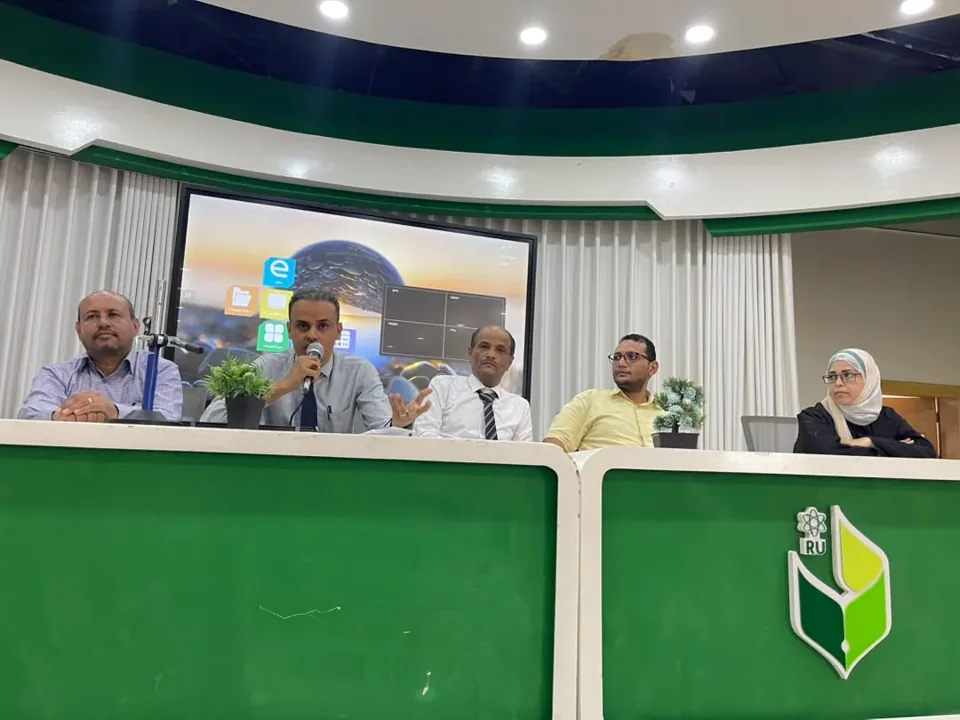
A meeting reported on 29 August 2026 brought together students who had received competitive scholarships in different specialisations. Student Affairs and Student Activities supported the occasion, recognising the students' academic effort and encouraging their involvement in university programmes beyond their individual courses. The report describes opportunities for students to meet one another, exchange experiences and develop a stronger sense of belonging. Participation in activities was linked with building skills, confidence and leadership. This particular event illustrates how the university uses student gatherings to connect learners across academic areas, while recognising achievement and encouraging further contributions to campus life.
Sources: Competitive-scholarship students meeting, 29 August 2026 ↗
Recognising work behind graduation
The university also reported recognition of staff and students who served on committees organising the graduation ceremony for its second graduating cohort in 2025–2026. University president Ali Sallam, the Student Affairs dean and the secretary general took part in the recognition. The account highlights preparation, organisation and follow-up as shared responsibilities among staff and student volunteers. Certificates of appreciation were presented to those who contributed. The occasion records a form of student participation that extends beyond attending classes or the graduation ceremony itself: helping plan and deliver a major university event through cooperation with academic and administrative colleagues.
Sources: Graduation organising committees recognised, 29 August 2026 ↗
Putting institutional plans into practice
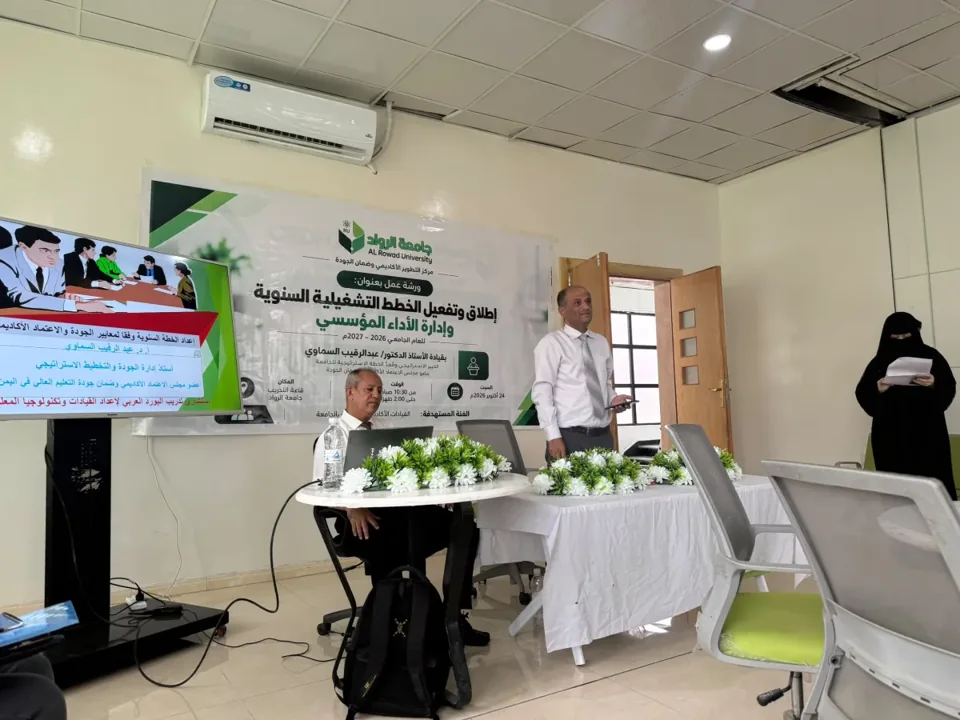
On 24 October 2026, Al-Rowad held a workshop on annual operational plans and institutional performance for the 2026–2027 academic year. The report, published on 26 October, describes participation by academic and administrative leaders under the supervision of planning specialist Abdulraqeeb Al-Samawi. Work centred on connecting the university's 2025–2029 strategic plan with implementable projects and activities. Participants practised preparing annual plans, assigning responsibilities, setting performance indicators and identifying evidence through which progress could be checked. University representatives stressed moving from writing plans to carrying them out. This dated activity provides a concrete example of how institutional objectives are discussed and translated into tasks for colleges and administrative units.
Sources: Annual operational planning workshop, 24 October 2026 ↗