Visa

About Al-Ahgaff University
Establishment and development
Al-Ahgaff University is based in Hadhramaut, Yemen, with its principal contact address in Fuwah, Al-Masakin, Mukalla. Its establishment dates to Ministerial Decree No. 5 of 1994, issued on 8 February 1994. Teaching began in 1995 in Sharia and in Commercial Sciences and Business Administration. The founding decision and the beginning of classes are therefore separate milestones in the university’s history.
The university subsequently expanded its academic range. Computer Sciences and Education and Islamic Sciences for Girls were added in the 1997–1998 academic year. Its first graduating cohort followed in 1998–1999. An Arts and Humanities faculty, initially represented by an English Language Department, opened in 2006–2007. These developments show the institution growing from its early religious and commercial subjects into computing, education and the humanities.
Mukalla and Tarim
The university’s educational setting includes both coastal Mukalla and Tarim in the Hadhramaut Valley. Its arrangements for the 2026–2027 academic year covered colleges in both cities, reflecting an institution distributed across more than one location. Mukalla is the address used for the university’s central contact information and for recent computing-faculty activities.
The Faculty of Sharia and Law has a longstanding presence in Tarim, where its background account dates its establishment to 1995–1996. The faculty’s dedicated library is also located in its Tarim building. This geographic distinction is important to the university’s character: its academic life includes both the coastal city and a valley town with a long tradition of Islamic scholarship.
Sources: 2026–2027 arrangements in Mukalla and Tarim ↗ · Faculty of Sharia and Law background ↗ · Sharia and Law library in Tarim ↗
Sharia, law and scholarly resources
The Sharia and Law faculty combines the study of classical Islamic texts with a university-based academic structure. Its description emphasises Islamic jurisprudence, the principles of jurisprudence and law, together with related study of Qur’anic sciences and Hadith terminology. Islamic economics, banking and computing also appear in its account of a broad scholarly preparation.
The faculty identifies research into contemporary questions as part of its educational approach. It also describes the value of moderation and respect for scholarly traditions. Its Tarim library supports these interests with books covering Sharia, jurisprudence, law and related fields, as well as specialist journals and periodicals. The library is consequently a defined resource for the faculty’s particular academic subjects, rather than simply a general campus amenity.
Sources: Faculty of Sharia and Law background ↗ · Sharia and Law library in Tarim ↗
Computing and information technology
The Faculty of Computer Science and Engineering lists Computer Information Systems, Computer Science, Information Technology and E-Commerce among its specialisations. Its stated objectives emphasise knowledge and technical skills in computing, the development of educational programmes and support for research. Student projects and opportunities for creative work feature in its description of the learning environment.
The faculty also identifies the development of teachers and teaching assistants, academic collaboration and community engagement as areas of institutional work. Its programme presentation brings computer systems and information technology together with commercial applications of digital tools. These subjects form a different strand of the university’s academic activity from Sharia and law, while remaining part of the same university structure. Recent faculty reports also describe orientation, research-skills training and the discussion of student graduation projects.
Management and economics
Management and Economics continues one of the university’s early subject areas, with the faculty dating its establishment to 1995. Accounting and Business Administration are the specialisations listed on its current faculty page. Its objectives concern administrative, financial and accounting knowledge, programme development and the preparation of teaching staff.
Research and consultancy are also included in the faculty’s stated remit. It describes studies and advisory work for public and private institutions, alongside partnerships with other academic and community organisations. The faculty’s educational presentation places professional and ethical values beside its academic subjects. Its news listings include accounting activities, graduation research and training in accounting software, illustrating several ways in which its teaching and practical interests are expressed.
Research connected to Hadhramaut
The Hadhramaut Research Center is associated with the university and describes its own financial and administrative autonomy. Its work concerns the region’s past, present and future through research, studies, conferences, seminars, training and consultancy. The centre identifies cultural and historical inquiry as part of its contribution to understanding Hadhramaut and its heritage.
Its departmental structure includes scientific research, vocational and professional training, translation and language editing, arbitration and legal studies, technical consultancy, and financial, economic, social and legal studies. Its published activities also include the Al-Ahgaff Journal of Social Sciences and training offerings in digital and technical subjects. The centre therefore provides a setting where research, professional learning and regional questions meet, alongside the work of the university’s faculties.
Sources: Hadhramaut Research Center ↗
Support for international students
The university’s International Students Affairs office identifies support for arrival, admission and official procedures among its responsibilities. It aims to coordinate with university departments and relevant external organisations, while responding to difficulties that international students encounter during their studies. Academic and residential matters both appear within its stated support remit.
The office also identifies communication and continued monitoring of students’ needs as part of its work. Its published description includes an International Students Affairs Office in Tarim. This gives the university’s international dimension a practical organisational basis, with a named area of responsibility for helping students navigate institutional procedures and connecting them with the appropriate departments during their academic experience.
Sources: International Students Affairs ↗
A new electronic library in Mukalla
On 28 October 2026, the Faculty of Engineering and Computer Sciences inaugurated an electronic library in Mukalla. The university described a collection bringing books, academic references, educational courses, software and technological tools into one accessible resource. Access through the local network was part of the facility’s design.
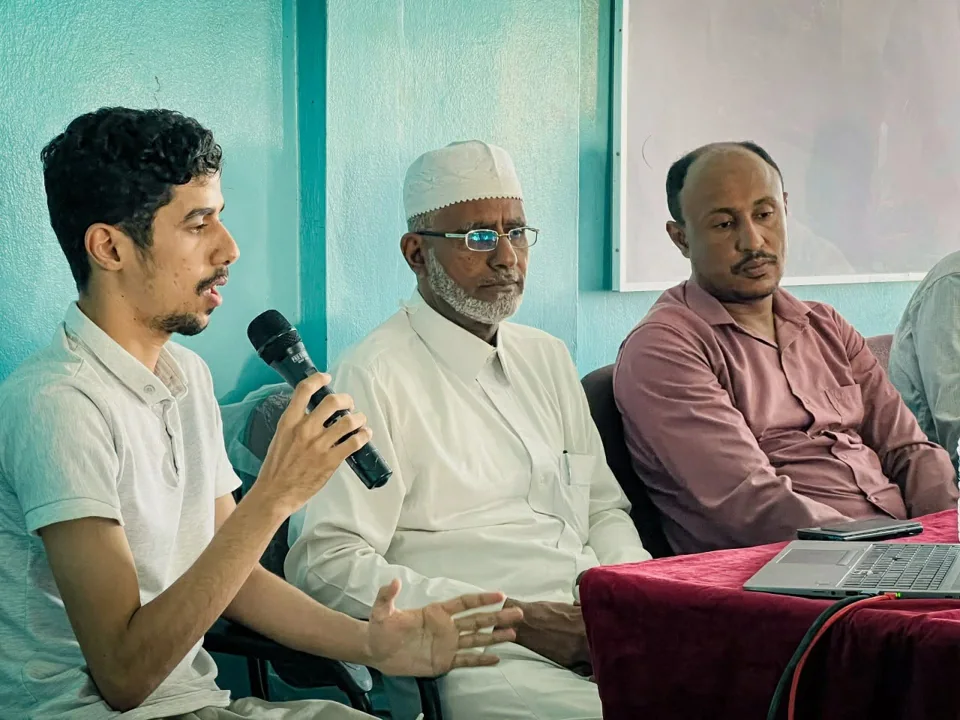
During the opening, a student demonstrated how users could reach the library and make use of its resources. Faculty members, technical staff, students and university representatives were involved in bringing the project into use. The event connected the faculty’s computing interests with the practical provision of learning materials. It also supplied a recent example of a specific academic resource being introduced for students’ study and project work.
Sources: October 2026 e-library inauguration in Mukalla ↗