Visa

About Al-Awael Modern University
A university in Hadramout
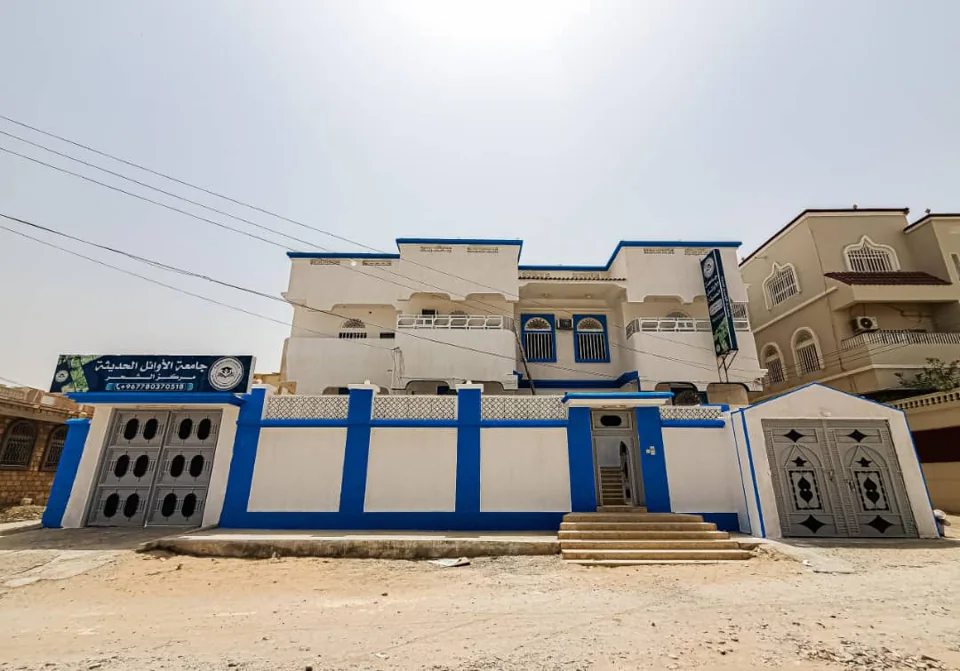
Al-Awael Modern University is a private Yemeni university whose main centre is in Mukalla, Hadramout. Its Arabic name is جامعة الأوائل الحديثة. The university states that it opened its doors in the 2021–2022 academic year. Its educational presence includes centres and buildings within the governorate, with university services identified separately for Fuwah in Mukalla and for Al-Shihr.
The institution’s academic organization includes engineering and economics, administrative sciences and humanities. Its published service contacts distinguish admissions and registration, student affairs, student financial administration, archiving and graduate affairs. The Fuwah centre is in Al-Insha’at, opposite the presidency of Hadhramout University. The Al-Shihr centre is identified in Al-Mansourah, beside Imam Al-Nawawi Mosque.
Sources: University introduction and student services ↗
Academic development and facilities
A February 2024 university report records a visit by a delegation from Yemen’s Ministry of Higher Education, Scientific Research, Technical Education and Vocational Training. The delegation met the university’s leadership and reviewed the programmes and curricula taught across its colleges. The visit was led by the ministry’s educational affairs undersecretary and included officials concerned with private education and legal affairs, alongside an information technology academic from the University of Aden.
The report describes the delegation touring classrooms and laboratories to observe teaching arrangements and the university’s different academic specializations. This account provides a dated view of institutional development during the university’s early years, including attention to academic organization, teaching spaces and the practical facilities used in its educational work.
Learning through student projects
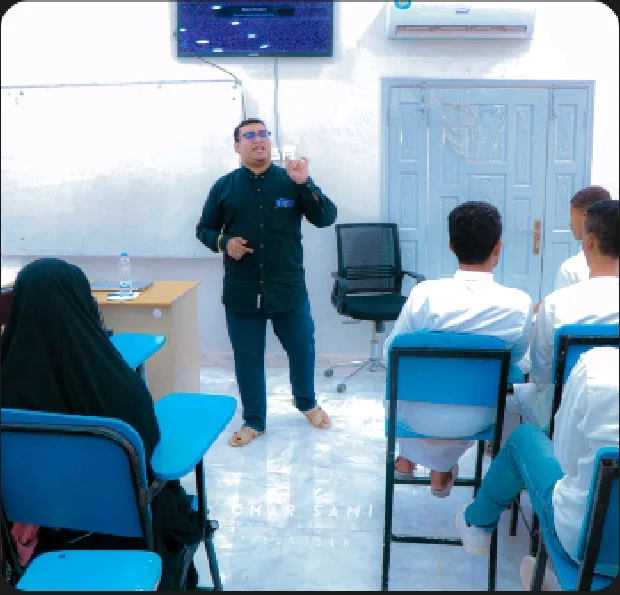
An applied teaching report describes first-year students in the College of Economics and Administrative Sciences presenting projects within a marketing course. Students developed products and considered packaging, pricing, production and marketing strategies. Examples included food products, perfumes, candles and handmade goods, giving a practical setting to concepts introduced in a theoretical course.
Second-year students also presented work for a business process modelling course. Their projects involved systems analysis and website interface design, including travel reservation, judicial affairs management and other administrative systems. University leaders and representatives of Bin Doul Bank attended the presentations. The event brought student explanations, project demonstrations and discussion into the same learning activity, connecting classroom material with products and working system designs.
Sources: Applied student projects ↗
Exhibitions and the Al-Shihr centre
On 8 August 2024, the university inaugurated its first student exhibition and opened a new building in Al-Shihr. The report identifies participation by university leaders, the district’s director general and local cultural and community representatives. The exhibition combined student work with stalls from shops and productive households, bringing academic activities into contact with a wider local audience.
First-year student contributions represented architecture, networking, information systems, accounting and international business administration. Student committees helped coordinate the exhibition, which also included cultural and welcoming performances. Visitors toured the displays with university and district representatives. The combination of student presentations and community participation made the exhibition both an academic showcase and a public event associated with the new centre.
Sources: First student exhibition and Al-Shihr building opening ↗
Training and community service
Al-Awael’s Training and Community Service Centre describes a role beyond the university’s degree teaching. Its March 2024 introduction presents training programmes for different members of the community and identifies knowledge sharing and community development as central purposes. It also emphasizes an educational environment built around learning and interaction.
The centre’s main address is within the university building in Al-Insha’at, opposite the presidency of Hadhramout University. Its published channels include direct contact and social platforms through which programmes and activities are announced. This places continuing training and community engagement alongside the university’s college-based academic work.
Graduation and university life
In October 2026, the university reported celebrating its second graduating class, named Ruwwad Al-Awael, and recognizing high-achieving students from the 2025–2026 academic year. The ceremony brought together university leadership, academic staff, administrators and invited guests. Recognition extended to graduates, students achieving leading results at different levels, and individuals who had contributed to the institution’s development. The report names Professor Ahmed bin Alawi Al-Attas as chair of the board of trustees and Professor Mubarak Awad Al-Sebaee as university president attending the occasion.
The celebration included artistic and cultural performances, as well as recognition of parents’ support for students. Its account connects graduation with the university’s wider community of families, staff and supporters. It also describes ongoing attention to educational facilities, infrastructure and academic and digital services as part of the university’s development.
Sources: Second graduating class celebration, October 2026 ↗
Research publication and archiving
The Al-Awael Journal of Engineering and Management Research is described by the university as an annual, open-access digital journal and institutional repository. Its scope includes graduation projects, applied engineering studies and management research, with related fields in information technology and business systems. The publication provides a channel for documenting academic work produced within the university.
Its stated policy includes initial academic screening and editorial review for originality, integrity and preparation. Accepted materials are archived through the university’s Zenodo community, with digital object identifiers used for records. The publication page identifies an editorial and administrative team and presents annual issue collections for 2025 and 2026. This research channel complements teaching by preserving student and academic outputs in a publicly accessible digital setting.
Sources: Al-Awael Journal of Engineering and Management Research ↗