Visa
About Al Hikma University
Origins and educational development
Al Hikma University is a private Yemeni university with an educational history that began before it adopted its university name. Its foundation started educational activity in 2004 through the University Institute for Medical Specialties. In 2007, Al-Hikma College added technical and administrative specialisms. The institution became a university in 2008, with Dhamar central to this development and branches also established in Sanaa and Taiz. This sequence explains the combination of medical, technological and administrative education within its later academic structure. The university describes a regular academic year divided into two semesters, each lasting sixteen weeks including examinations. Its academic framework also provides for an eight-week summer term. These arrangements give its different fields of study a shared academic calendar.
Sources: About the University ↗
Science, engineering and applied learning
The College of Science and Engineering dates from the university's establishment in 2008. Its listed fields include civil engineering, architecture, information technology, telecommunications and network engineering, and cybersecurity and digital forensics. The college's mission connects applied education with professional ethics, rather than treating technical knowledge as an isolated subject. Its stated development priorities include updating programmes and curricula, supporting the continuing professional development of academic staff, and encouraging students to undertake applied research. Creativity and innovation also appear among its educational objectives. Beyond ordinary classes, the college identifies seminars, conferences and cooperation with technical and industrial organisations as ways to connect academic work with wider professional questions. It also includes studies and consultation for the surrounding community among its intended contributions.
Sources: College of Science and Engineering ↗
Humanities and administrative subjects
The College of Humanities and Administrative Sciences was also established in 2008. Its programme listings bring together accounting, business management, management information systems, marketing and international business management. English language and translation, together with Sharia and law, extend its scope beyond business alone. This combination places organisational, linguistic and legal subjects within the same college while retaining their separate disciplinary identities. The college describes education, training, research and advisory services as parts of its mission. Its objectives include revising curricula, strengthening academic staff research, and developing partnerships and conferences. Training and consultation directed towards community needs are further elements of this agenda. The resulting academic scope encompasses both the internal operation of organisations and the languages and legal frameworks through which they work.
Sources: College of Humanities and Administrative Sciences ↗
A university with several branches
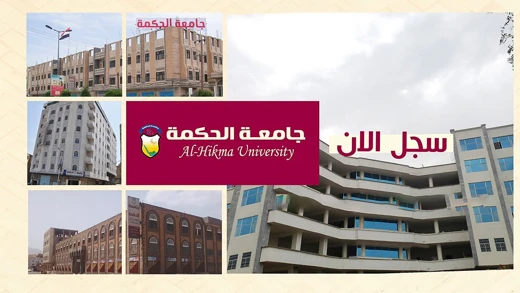
The university's branch pages distinguish Sanaa, Taiz, Dhamar and Hawban, with different selections of programmes at each location. The Sanaa branch is on Al-Hurriya Street and lists medical, engineering and administrative subjects. Taiz, in Al-Shamasi, lists dentistry, pharmacy, laboratory sciences and nursing alongside architecture, information technology and business subjects. Dhamar's listings include community health and health administration as well as computing, accounting, business and Sharia and law. Hawban's page lists architecture and information technology, business-related subjects and several medical fields. These branch-specific descriptions are useful for understanding the institution's geographical organisation: the university has a broad collective academic range, while each branch presents its own particular combination of subjects rather than an identical programme list.
Sources: Sanaa Branch ↗ · Taiz Branch ↗ · Dhamar Branch ↗ · Hawban Branch ↗
A searchable academic catalogue
The university's online library catalogue organises material across a wide range of subject categories. These include natural sciences and mathematics, computer science, economics and finance, engineering, languages, philosophy and psychology, religion, medical sciences and scientific journals. Individual records identify such details as an author, language or subject section, and some provide a download link. The displayed material includes research on business process reengineering, contemporary Arab women's life writing, connected-device security and water contamination in Dhamar. These examples illustrate the catalogue's disciplinary breadth without reducing it to a single professional field. University journal material is also represented. The catalogue therefore provides a route into research texts alongside the programme information available elsewhere on the university website.
Sources: University Library Catalogue ↗
Student projects on public display
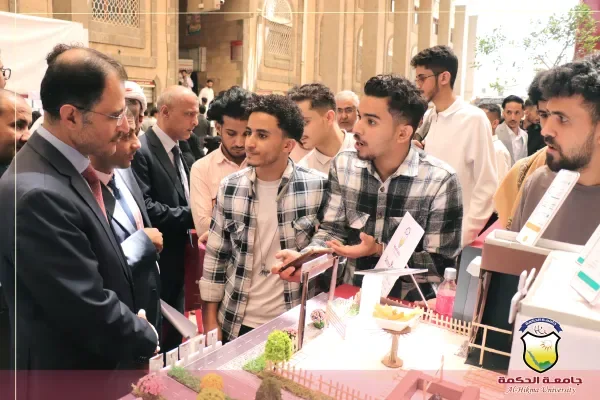
A university report dated 8 September 2026 describes the seventh technical innovation exhibition at the Sanaa branch. Students presented projects through models and prototypes, explaining their ideas, how the projects worked and the stages involved in developing them. The event brought students into direct discussion with visitors and university representatives around the displayed work. Its emphasis was on giving practical form to classroom learning and making the development process visible. The report describes the exhibition as an annual activity, placing this edition within a continuing sequence of student presentations. Such an event offers a concrete example of the engineering college's broader interest in applied work, creativity and opportunities for students to explain technical ideas to an audience.
Sources: Seventh Technical Innovation Exhibition — 8 September 2026 ↗
Software collaboration across branches
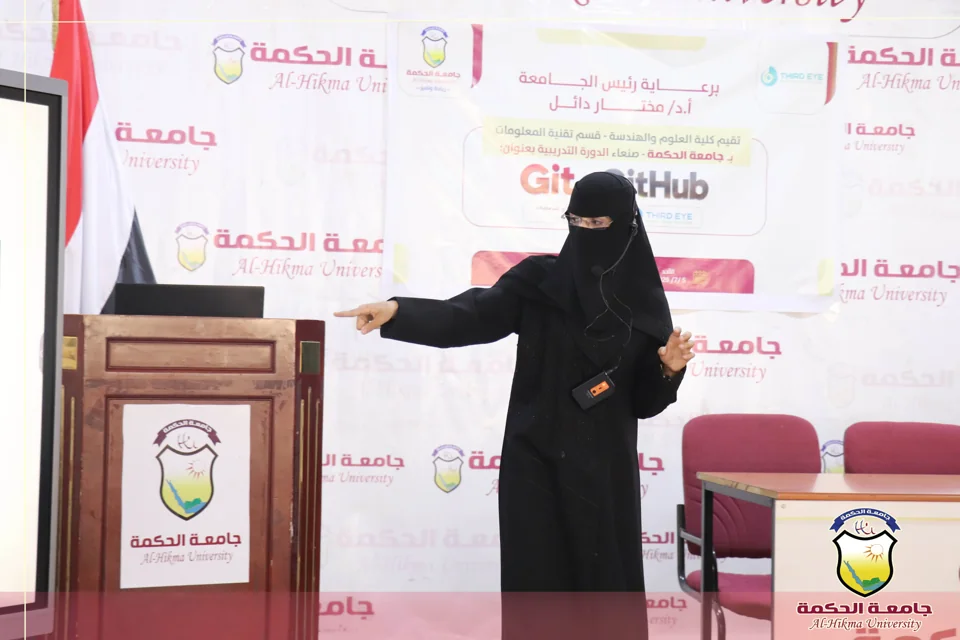
Another report, dated 9 July 2026, records the opening day of a Git and GitHub training course organised with Third Eye Software. Participants from the university's branches joined through Google Meet, making the session a shared activity across locations. The initial teaching covered the principles of version control, basic Git commands, tracking code changes and managing software projects. The announced course extended over three training days, with later sessions planned to address GitHub repositories and collaboration. The report documents the first day's activity specifically. Its subject connects individual programming work with the practical organisation of shared code, showing how a short training event can address tools used in collaborative software development alongside the university's formal computing programmes.
Sources: Git and GitHub Training — 9 July 2026 ↗