Visa
About Al Hayat Medical University
Medical education in Mogadishu
Al Hayat Medical University, abbreviated AMU, is a higher education institution in Mogadishu, Somalia. Its institutional account dates its establishment to January 2016 and describes its founders as a team of medical professionals. The university's contact address is Wadnaha Road in Tarabuunka, Mogadishu.
Medical and health sciences education remains central to its identity. The university presents programmes in medicine, dentistry, nursing, pharmacy, public health, medical laboratory sciences and midwifery. Its wider faculty listing also includes veterinary medicine, healthcare management and economics, and education. The institutional introduction connects teaching with research and community engagement, describing a curriculum intended to respond to the learning needs of Somali students. This combination gives the university a health-professions focus within a broader set of educational subjects.
Sources: Al Hayat Medical University: Institutional introduction ↗
Mission and institutional values
The university's vision links health-professions education with research, healthcare and social accountability. Sustainable community development is presented as the purpose connecting those activities. Its mission similarly brings together teaching, translational research, innovation and engagement with the community.
National and international partnerships are identified as ways to support that mission. The published core values include integrity, professionalism, community engagement, innovation and entrepreneurship. These statements establish the university's declared educational direction: disciplinary knowledge is considered alongside responsibility to the society in which that knowledge is used. Research and collaboration are therefore presented as parts of the institution's academic purpose, together with the professional education provided through its programmes.
Medicine and surgery
AMU's Bachelor of Medicine and Bachelor of Surgery is organised over seven years and fourteen semesters. The published structure begins with a foundation year, continues through five further academic years and finishes with a core clinical internship. The programme page lists 84 courses and 5,600 contact hours.
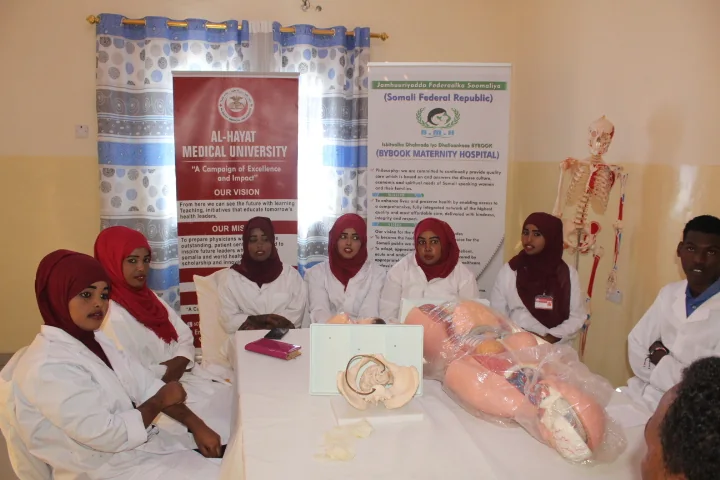
The opening stage develops basic sciences and academic skills. Preclinical subjects include anatomy, physiology, biochemistry, pathology, pharmacology and microbiology. Clinical study subsequently covers internal medicine, surgery, obstetrics and gynaecology, paediatrics, psychiatry, community medicine, radiology and anaesthesia. The university describes lectures, small-group learning, problem-based sessions and skills-laboratory simulation as teaching approaches. Supervised clinical practice is also included in the published curriculum, with the final internship providing a structured period of supervised learning and increasing responsibility within the educational programme.
Sources: Al Hayat Medical University: Medicine and surgery programme ↗
Nursing education
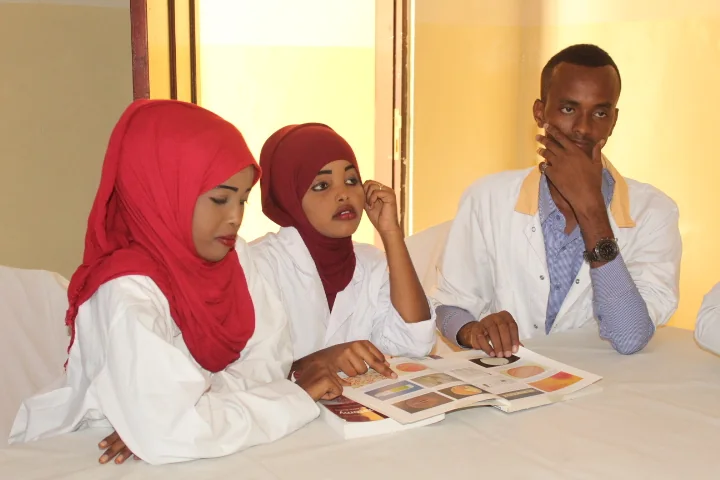
The Bachelor of Science in Nursing follows a five-year, ten-semester structure. Its published curriculum comprises 224 credit units, 67 courses and 4,020 contact hours. Anatomy, physiology, biochemistry and microbiology provide scientific foundations alongside the fundamentals of nursing.
Later areas of study include medical and surgical nursing, maternal and child health, paediatric nursing, community health and mental health. Critical and emergency care, nursing management and research are also incorporated. The programme description connects skills-laboratory work with supervised placements in hospital, health-centre and community settings. It concludes with a research project and supervised clinical internship. This structure combines several fields of nursing study with practical educational experience, while research and management introduce students to responsibilities beyond individual clinical tasks.
Medical laboratory sciences
The medical laboratory sciences degree is published as a five-year programme spanning ten semesters. Its stated curriculum contains 241 credit units, 67 courses and 4,000 contact hours. The programme focuses on the scientific and technical study underlying laboratory investigation.
Subjects include clinical chemistry, haematology, blood transfusion science, medical microbiology, parasitology, immunology, histopathology, cytology and molecular diagnostics. Laboratory quality management, biosafety and biosecurity are included alongside instrumentation and laboratory information systems. The university describes practical work in its laboratories followed by supervised placements in hospital and reference laboratories. A research thesis forms the concluding academic component. The combination of subject study, practical laboratory work and a thesis gives the programme an educational framework covering both technical processes and the organisation of laboratory practice.
Sources: Al Hayat Medical University: Medical laboratory sciences programme ↗
Learning resources
The AMU Library describes its role as supporting academic programmes, research, health services and continuing education. It serves students, faculty members and university staff through resources focused on biomedicine and healthcare. Books and journals are included among the learning materials it identifies.
The published facilities list includes internet and intranet access, individual study carrels and group study rooms. The library's development aims emphasise skilled staff, cooperation, networking and resource sharing. These priorities connect the collection with the people and systems needed to use it. Within the university's educational structure, the library provides a setting for independent reading and collaborative study alongside the taught and practical components of the programmes.
Research and academic exchange
The university's research page introduces the Annual Conference on Medicine and Health Science, known as ACMHS. It presents the conference as a forum for scholars, students and administrators to discuss theoretical and practical questions in medicine and general health sciences. The page links to records for its first, second and third conferences.
The university identifies greater research productivity, international cooperation and stronger grant applications as development priorities. Its explanation places academic exchange within a wider research strategy, rather than treating conferences as isolated events. By bringing different participants together, ACMHS is intended to support discussion and collaboration. The published account therefore connects research development with opportunities to share ideas across professional and academic fields.
University governance
The published Board of Trustees description assigns the board overall policy direction and oversight of the university. Its listed functions include appointing the president, approving senior appointments through the stated governance process, reviewing annual reports and approving budgets. It also has responsibilities connected to the university's constitution and amendments.
The board is described as a link between the institution, the community, government and other organisations. Supporting the acquisition of resources and assisting university management are additional functions. The governance account identifies trustees' work as voluntary community service and provides for regular and extraordinary meetings. These responsibilities place institutional oversight, financial review and external relationships within a defined governing structure.
Sources: Al Hayat Medical University: Board of Trustees governance ↗