Visa
About Al-Azhar University of Gaza
Foundation and academic development
Al-Azhar University of Gaza was established in 1991 as an independent Palestinian institution of higher education. Its official historical narrative identifies Gaza City as its founding location and attributes the establishing decree to Yasser Arafat. Law and Education formed its initial academic base. The early expansion brought agriculture, pharmacy, science and humanities into the university's provision.
The institutional history then records the opening of Medicine in 1999 and Engineering and Information Technology in 2001. Dentistry and the reopening of Sharia studies further extended its range. These developments created an institution combining professional education with scientific, cultural and social fields. That academic history needs to be read alongside the university's own 2026 accounts of severe destruction and educational disruption. Historical descriptions of campus buildings and services cannot establish their present condition or availability; current activities depend on the particular arrangements documented for students and academic units.
A history of teacher education
The Faculty of Education began with the university in 1991. Its early classes were held at a secondary religious institute, and its initial teaching drew on programmes associated with Al-Azhar University in Egypt. The faculty's older account traces successive reforms in how students studied and how programmes were organised, making educational development a continuing institutional concern.
It records a move from annual teaching to two semesters in 1994–1995 and the introduction of credit hours in 1997–1998. Reviews of the curriculum added and developed psychology and basic education. Later work revised guidance-related study and primary-education planning. Teacher preparation covered elementary, preparatory and secondary stages. The faculty's stated aims linked subject knowledge with professional ethics and responsibility towards Palestinian society. Updating courses, diversifying assessment and strengthening the practical aspects of teaching were central elements of its published educational approach.
Sources: Faculty of Education history (historical English site) ↗
Postgraduate study and research
Postgraduate education acquired a dedicated organisational base when the university established its deanship in 1994. The older English description presents graduate study across applied and natural sciences as well as humanities and social sciences. Its account includes pharmacy, water and environment, education, economics and administration, arts, law and Sharia.
The deanship coordinated research-related responsibilities with academic departments. These involved approval of research titles and supervisors, programme requirements and students' academic plans. It also supported research projects, reviewed instructions governing research, and encouraged publication and participation in scientific conferences. Developing critical thinking and proposing applicable responses to local and regional problems were among its stated objectives. The description demonstrates an institutional structure for connecting advanced education with investigation. Its historical programme counts and facilities statements are not evidence of the scale or physical availability of graduate provision after the wartime destruction.
Humanities and social sciences
The university's humanities tradition encompasses languages and the study of communities, politics and the environment people inhabit. The Arts and Human Sciences faculty traces its beginnings to Languages and Translation, followed by Arabic studies and departments concerned with geography, history and social sciences. Its historical description records Arabic-language master's admissions from 1996 and postgraduate study in Middle Eastern Studies.
It also illustrates interdisciplinary combinations within undergraduate education. Examples joined geography and planning, sociology and social service, sociology and psychology, and language study and journalism. The faculty's stated purpose included preparing researchers in human sciences while sustaining citizenship and national and Arab cultural values. Its academic message emphasised critical and creative thought and cultural, political and social understanding. These longstanding areas of study sit alongside the university's scientific and professional disciplines within its broader educational history.
Sources: Arts and Human Sciences (historical English site) ↗
Education amid destruction: October 2026
The university's recent reporting shows how international cooperation has helped particular students continue education. On 30 October 2026, it reported that medical students hosted by Istanbul Medeniyet University had completed their compulsory clinical training. A ceremony at the Turkish institution marked that completion, with representatives of both universities and participation by the Palestinian health minister.
In describing the event, the Gaza university's president acknowledged extensive destruction and losses affecting his institution and other universities in the territory. The medical faculty highlighted the host academics' work in arranging admission and following up clinical placements. The report therefore documents a specific route through which education continued outside Gaza during exceptional disruption. Its account concerns those trainees and their completion ceremony; it provides no basis for treating all historical campuses as intact or assuming that every programme has resumed ordinary in-person teaching.
Sources: Medical students complete training in Istanbul, 30 October 2026 ↗
Research concerned with recovery
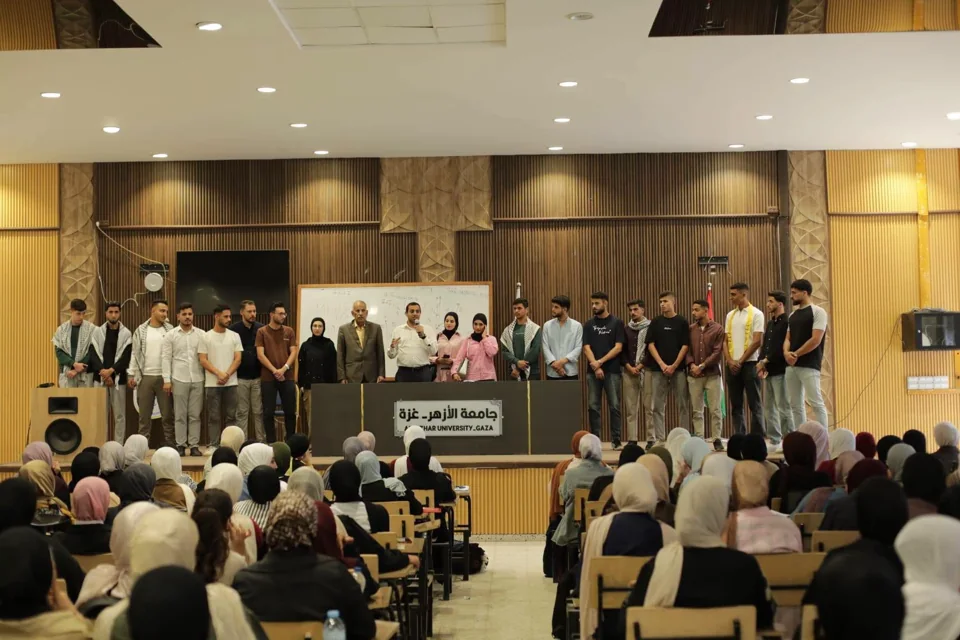
Agricultural recovery is the subject of a forthcoming university research event. The official announcement for CRAFS1, the First International Scientific Conference on Rehabilitation of Agriculture and Food Systems, gives 5–6 December 2026 as its scheduled dates. The event is still prospective at the time of this November 2026 profile. Its theme concerns Gaza's food system, linking the experience of destruction with recovery, resilience and sovereignty.
The conference's institutional introduction connects education and investigation with community engagement and sustainable development. This planned academic meeting illustrates the university's effort to make recovery a subject of organised scientific exchange. Together with the dated evidence of students completing training through a partner abroad, it shows distinct forms of academic activity continuing amid disruption, without implying that reconstruction or a full restoration of campus life has already been achieved.
Sources: CRAFS1 planned conference, 5–6 December 2026 ↗