Visa
About Al-Azhar University
Cairo origins and the tradition of learning
Al-Azhar University in Egypt developed from the teaching tradition associated with Al-Azhar Mosque in Cairo. The official mosque history dates the start of construction to 970 and its opening for prayer to 972. Teaching subsequently became a central part of the institution's work. Early study was organized around scholars and their circles of students, with learning assessed through discussion and a teacher's authorization after study. The disciplines described in the historical account include Quranic interpretation, hadith, jurisprudence, Arabic grammar, rhetoric, logic, arithmetic and astronomy. Residential arrangements known as riwaqs provided spaces associated with students from different regions of Egypt and the wider Islamic world. This history explains the university's longstanding international connections and its relationship with the mosque. The present university's faculties and formal degree structures emerged through later educational reforms, building on a teaching institution whose organization changed over many centuries.
Sources: Official history of Al-Azhar Mosque and its teaching tradition ↗
The emergence of modern university faculties
Modern reforms progressively organized Al-Azhar's teaching into defined stages, examinations and qualifications. An official institutional account identifies the 1872 reforms as an early step toward a more formal examination system. The 1930 legislation established a university stage with faculties of Islamic law, theology and Arabic language. Four-year faculty study was followed by specialized preparation in fields such as religious judiciary, preaching and teaching. The later reorganization under Law 103 of 1961 widened the university's scope to include scientific and professional disciplines alongside the religious faculties. The account describes the university as the part of the wider Al-Azhar institution responsible for higher education, while pre-university institutes formed another part of that educational structure. These changes matter because they distinguish the historical mosque-based teaching tradition from the modern organization of faculties, academic specializations and postgraduate study. They also place the university within a larger institution with several educational and scholarly bodies.
Religious scholarship and wider academic disciplines
Al-Azhar's official English university profile describes an educational approach combining the study of transmitted religious texts, logical disciplines and applied sciences. Islamic studies remain part of the framework alongside specialized academic subjects. The profile explains that the 1961 reorganization expanded the scientific section through fields including commerce, medicine, engineering and agriculture. It also records the establishment of a women's college with branches in medicine, commerce, science, Arabic and Islamic studies, and humanities. The university therefore has a broader academic identity than religious instruction alone. Its account of postgraduate work includes research on contemporary questions within religious jurisprudence. This combination connects inherited scholarly disciplines with subjects that developed within the university's modern structure. The profile also presents international educational and cultural engagement as part of the institution's mission, reflecting Al-Azhar's historical relationship with students and scholars from outside Egypt.
Language teaching and professional development
A July 2025 announcement from Al-Azhar documents an English-language training programme based at the university's Foreign Languages Teaching Center in al-Dirasa, Cairo. It was planned to run from August 2025 to May 2026 for employees of Al-Azhar's principal sectors who needed English in their work. The stated aims were to develop basic language skills, improve communication in the workplace and support continuing professional development. The announcement provided a registration process followed by a placement test, connecting participation with an assessment of applicants' starting level. This dated example shows the university campus serving language education beyond full degree programmes, with the centre used for structured training within the wider Al-Azhar institution. The programme's focus was practical communication in a working environment, while its organization brought together registration, assessment and a defined period of language study.
Student engineering projects and technical activity
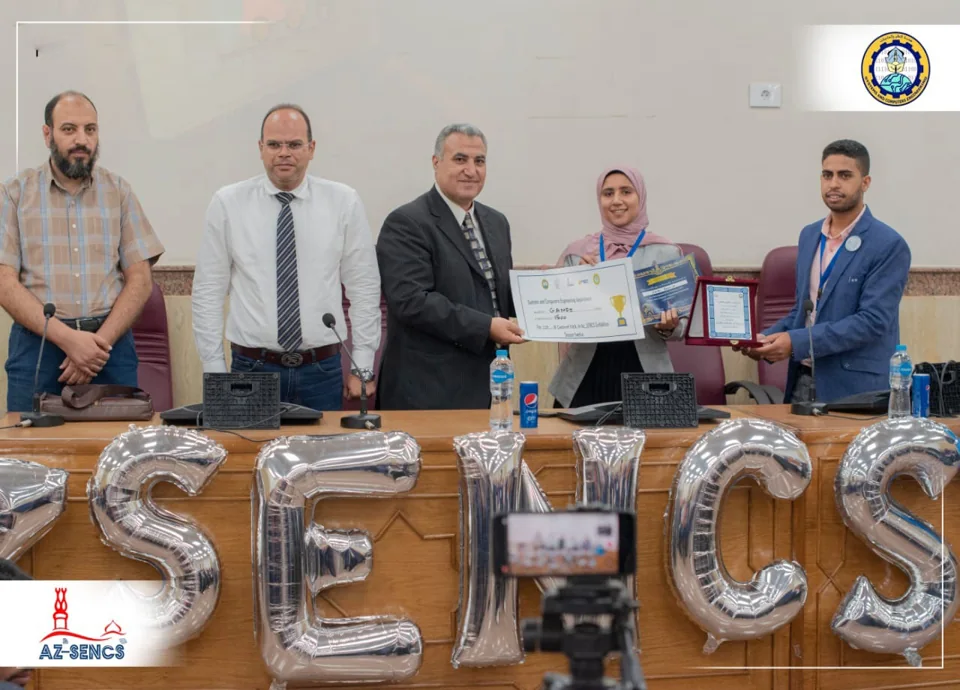
The Systems and Computer Engineering Department's Az-SENCS exhibition provides a documented example of practical student work. An official June 2022 report describes its tenth edition, held on 29 and 30 May, with projects from Al-Azhar and other universities reviewed by academic and engineering panels. Subjects included embedded systems, artificial intelligence, mobile applications, websites, networks and automatic control. The report explains that Az-SENCS began as a software competition in 2010 and later expanded into an exhibition covering the department's wider technical fields. Its activities included training, workshops, summer learning and scientific events. The 2022 programme combined project presentations with technical feedback and sessions concerning digital transformation, entrepreneurship and embedded systems. Examples described in the report included a guided-vehicle project, a recycling application and a website for handmade products. The event thus connected students' technical ideas with presentation, review and discussion outside ordinary classroom lessons.
Sources: Systems and computer engineering student exhibition, 2022 ↗
Cultural activity across Cairo faculties
An October 2026 report from Al-Azhar's Islamic Research Academy records recognition of university faculties that hosted the preceding academic year's cultural-season activities. The programme, organized through the academy's committee concerned with introducing Islam, included lectures and seminars intended to connect directly with students. Participating Cairo faculties included Islamic Dawah, Islamic and Arabic Studies for men, Languages and Translation, Islamic and Arabic Studies for women, Education for women, and Humanities for women. The recognition brought together their deans and the organizing body to acknowledge the support provided for the events. This is a dated example of cooperation between the university's teaching units and another scholarly body within the wider Al-Azhar institution. It also illustrates how activity extended across several academic communities and both men's and women's faculties, bringing religious and intellectual discussion into organized events alongside the university's formal teaching.
Sources: University faculties and the 2025–2026 cultural season ↗