Visa


About Akademia Wychowania Fizycznego im. Eugeniusza Piaseckiego w Poznaniu
A century of physical-education scholarship
Akademia Wychowania Fizycznego im. Eugeniusza Piaseckiego w Poznaniu, commonly known as AWF Poznań, is a specialist higher-education institution in Poznań, Poland. Its identity combines education, research and sport, with historical roots in the preparation of physical-education teachers.
The academy traces that tradition to a department established in 1919 at the institution later known as Poznań University. Eugeniusz Piasecki, the academy’s namesake, was its first head. A physical-education study unit followed in 1924. After the Second World War, teaching resumed in April 1945. An independent higher school of physical education was established in 1950, and it became an academy in 1973. The institution subsequently expanded its academic scope, including a tourism and recreation faculty established in 1974. A branch founded in Gorzów Wielkopolski in 1971 also forms part of its institutional development.
Sources: About the academy and its history ↗
Fields of study
The academy’s current programme directory extends across physical education, sport, physiotherapy, dietetics, psychology, tourism and recreation, dance in physical culture and neurobiology. These subjects show how its teaching moves between physical activity, education, scientific understanding of the body and cultural or organisational aspects of movement.
Tourism and recreation, for example, draws on humanities, natural sciences, economics and law. The directory identifies first- and second-cycle study in that field. Dance also has first- and second-cycle provision. Neurobiology is described as an interfaculty master’s programme involving four Poznań institutions: AWF, Adam Mickiewicz University, the medical university and the university of life sciences. This cooperative arrangement connects the academy’s interests with complementary academic expertise elsewhere in the city.
Sources: Current fields of study ↗
A campus built around teaching and movement
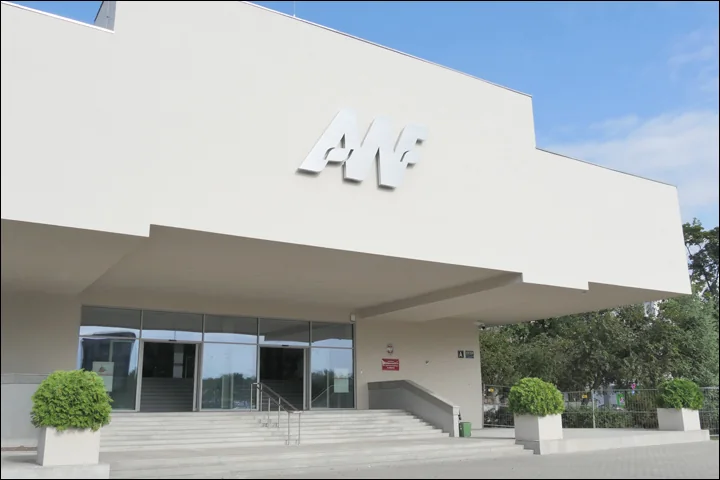
The Poznań campus includes a main building designed by architect Marek Leykam, containing lecture rooms, specialist rooms and the academy’s auditorium. A separate teaching building accommodates classrooms, laboratories and recruitment services. The main library occupies its own building.
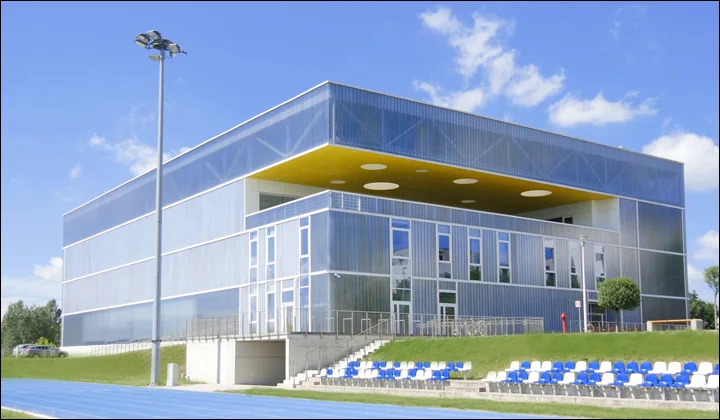
Sport facilities are closely integrated with this teaching environment. The Professor Andrzej Wieczorek teaching and sports hall combines team-sport spaces with classrooms, laboratories and a gym. Another sports hall supports activities including combat sports and contemporary movement disciplines. Outdoor provision includes athletics facilities and tennis courts. The swimming centre contains a 25-metre pool, a gym and indoor spaces for cycling and aerobics. These buildings give the academy facilities for both classroom-based education and practical work involving physical activity.
Sources: Campus buildings and facilities ↗
Library collections and academic memory
The Main Library developed alongside physical-education scholarship in Poznań. Its early collection was assembled through Piasecki’s efforts, and surviving holdings were supplemented after the war with his private books. The library became part of the independent higher school in 1950 and moved to its building on Droga Dębińska in 2004.
Its subject coverage includes physical culture, sport, rehabilitation, physiotherapy, tourism, recreation, hotel management, dietetics and the sciences related to these fields. An online catalogue describes the collection, while electronic holdings complement printed materials. Historical collections include Piasecki’s books, Henryk Jordan’s collection, selected works of Pierre de Coubertin donated by Wojciech Lipoński, and books from former rector Zbigniew Drozdowski. A particularly early volume is the 1601 edition of Hieronymus Mercurialis’s work on gymnastics. Such holdings connect contemporary study with the history of physical education.
Sources: Library history and collections ↗
Doctoral research in physical culture
The Doctoral School took its present form in 2019, building on organised doctoral education introduced at the academy in 1997. It specialises in physical culture sciences, also described as sports sciences or kinesiology. Its central research subject is human physical activity and the conditions and effects associated with it.
The school presents this as an interdisciplinary field combining biological, natural, engineering, technical, social and humanistic approaches. Research contexts include sporting performance, development, nutrition, genetics, technology, environmental influences and quality of life. Doctoral work can concern physical education, sport, movement rehabilitation, dietetics, recreation or tourism. The school describes supervision, research-methodology training and laboratory access as parts of its educational environment, alongside opportunities to seek research funding, undertake placements and cooperate with other scientific centres.
Sources: About the Doctoral School ↗
Sport as a degree subject
The first-cycle Sport programme is a three-year, full-time course. Its published description places practical coaching knowledge alongside staff management, marketing and sports psychology. This combination makes the programme broader than participation in a chosen sporting discipline: it also addresses organisational and interpersonal aspects of sporting activity.
The course page links students to the programme of study and individual subject syllabuses. It presents coaching in a selected sport as a central professional orientation. Within the academy’s wider offering, Sport therefore represents a focused route that connects practical work with knowledge about managing people and understanding the psychological setting of sport.
Sources: First-cycle Sport programme ↗
Dance, choreography and movement study
Dance in Physical Culture has a practical profile and welcomes applicants with differing levels of dance experience. Its first-cycle description includes contemporary, competitive and classical dance, modern techniques, physical dance, improvisation, contact improvisation, character dances, acrobatics and gymnastics.
The published specialisations are Dance Education and Choreography, and Therapeutic Dance. The curriculum connects artistic practice with anatomy, physiology, biomechanics and dance kinesiology. Dance history, theory, choreography and composition provide further dimensions. The education and choreography route emphasises creating original choreography and leading dance activities or artistic groups. The therapeutic-dance route concerns adapting dance activities to the purposes and capacities of different participants. These are educational orientations within the programme, illustrating the academy’s combination of artistic expression and the study of human movement.