Visa
About Academy of Economics in Poznan
From an academy to a university
The institution historically known as the Academy of Economics in Poznan is today Poznań University of Economics and Business, commonly abbreviated PUEB. It is based in Poznań, Poland, and traces its origins to a commerce-oriented higher school whose first academic year was inaugurated on 12 October 1926. The original school operated privately with a three-year curriculum and began teaching in a building on Marcinkowskiego Avenue.
The institution adopted the Polish name Akademia Ekonomiczna in 1974. On 27 December 2008 it received its present university status and name, making the directory’s academy title a historical designation for the same institution. Its current mission links education and research with social responsibility, sustainability and innovation. It describes businesses, public administration and nongovernmental organisations as partners and emphasises openness, ethical conduct and responsibility for educational and research quality.
Sources: University history ↗ · Current institutional mission ↗
Business administration and finance education
The university’s English-language bachelor information presents Business Administration and Finance as distinct study options. Business Administration places economic and business decisions within an international context, connecting business knowledge with politics, society and cultural differences. Students begin with introductory work spanning both of its tracks before choosing between International Business and Management and Global Economics.
The common curriculum includes areas such as mathematics, microeconomics, macroeconomics, financial accounting, management, marketing and business statistics. The programme information also identifies sustainability, international economic relations and qualitative methods among shared themes. The Finance programme combines economics and management with financial theory and practical analysis. Its subject areas include accounting, corporate and public finance, insurance, wealth management and portfolio management. Together, the two programmes illustrate different routes into understanding organisations and economies, with one emphasising international business choices and the other financial systems and decisions.
Sources: Bachelor programmes ↗
A library with a long institutional history
The Main Library was established in 1926 alongside the original school. It moved into a new teaching building in 1932, resumed operation after the Second World War in 1945, and became part of the nationalised institution in 1950. Most of the library relocated to Collegium Altum in 1995, while its online catalogue began in 1999. These milestones connect the library’s development with changes in the university itself.
Today its stated mission centres on acquiring, organising and making collections accessible in ways suited to an academic community. Those collections include printed books and journals, electronic books and journals, databases, theses and typescripts. Library staff assist users with both online and physical resources. The library also helped establish the consortium developing the BazEkon database, connecting its local information services with a wider economics information resource.
Sources: Library history and mission ↗
Information resources for research and study
The library’s database guide brings together scholarly literature, economic information and material documenting the university’s own history. It offers access to platforms including EBSCO, Oxford journals, Taylor and Francis resources and Web of Science, with access arrangements identified for users on and off the university network. These services provide routes into published research across business, management, economics and other disciplines.
Other resources serve more specialised purposes. The History Centre collection database describes documents relating to university life and its employees. A separate press database records reporting about university activity. LSEG Workspace is available on a designated reading-room computer and provides financial and macroeconomic information. This combination supports literature searching, historical investigation and work with economic data. The guide makes the type of resource and its access conditions visible rather than presenting all information as a single undifferentiated collection.
Sources: Library databases ↗
Student organisations and shared investigation
Student organisations provide opportunities for international exchange, public discussion, consulting activity and community projects. The university lists AIESEC, the Erasmus Student Network, the Independent Students’ Association, PBDA Consulting and Cognitis among its organisations. The local Erasmus Student Network has operated since 2007 and supports exchange students before, during and after their periods abroad. Challenger gives junior economists a venue for early research writing through a student magazine.
Student research groups add a more specialised form of collaborative learning. The university defines them as organisations that develop knowledge, research skills and practical applications through shared study. Qualitas focuses on management with attention to quality, environmental questions, occupational safety and sustainable development. Its activities include research, training and charitable work. Registered student organisations can apply for university financial support, use institutional infrastructure and participate in research, social and cultural events. Their published operating framework also requires plans and reports on activities. These groups connect disciplinary interests with teamwork and provide a setting in which students can investigate subjects beyond their regular classes.
Sources: Student organisations ↗ · Student research groups ↗
Buildings within the city
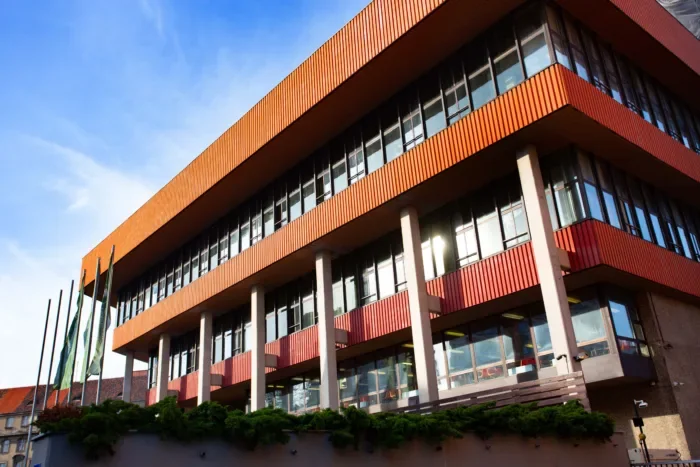
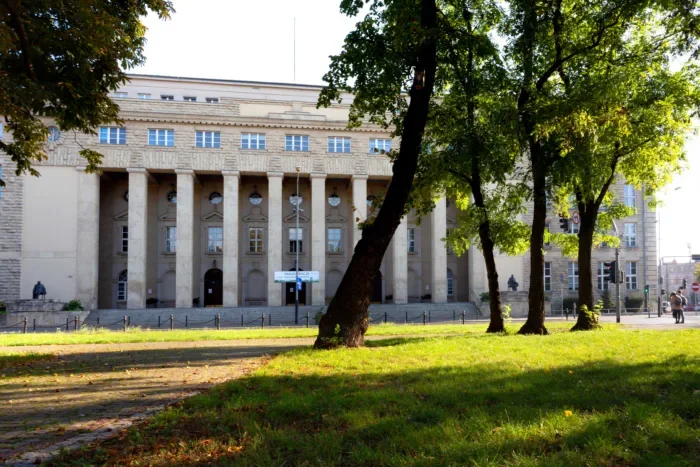
The university’s infrastructure page identifies several buildings across central Poznań. Building A stands at Aleja Niepodległości 10, which is also the university’s main contact address, while Building B occupies number 12. Buildings C and D are on Towarowa Street, and Building E is on Taczaka Street. Collegium Altum is located on Powstańców Wielkopolskich Street.
The infrastructure guide provides photographs and links to virtual views so that students can familiarise themselves with the locations. The different buildings form an urban campus with recognisable architectural settings rather than a single enclosed site. They provide a physical framework for the teaching, library services, research activity and student organisations that together constitute the contemporary university.
Sources: Campus infrastructure ↗