Visa
About Academy of Business and Health Sciences in Lodz
WSBiNoZ in Łódź
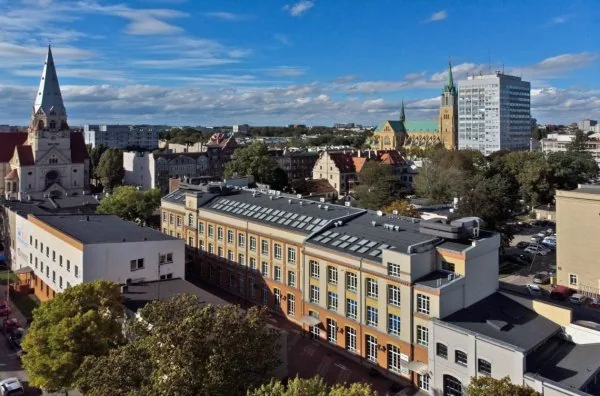
The Academy of Business and Health Sciences in Lodz is the institution known in Polish as Wyższa Szkoła Biznesu i Nauk o Zdrowiu w Łodzi, abbreviated WSBiNoZ. Its main address is 278 Piotrkowska Street in Łódź. The institution began activity following a ministerial decision of 21 September 2006. Its history records entry into the register of non-public higher education institutions in February 2007, followed by an opening ceremony in March and its first formal academic-year inauguration that October.
The college’s development began with cosmetology and broadened into health, education, social and legal subjects. Its current educational offer includes dietetics, cosmetology, pedagogy, criminology, internal security, psychology and law, alongside postgraduate professional study. Practical learning is a central feature of its institutional presentation, supported by specialist teaching rooms and cooperation with practitioners. The college also operates branches in Rybnik and Szczawno-Zdrój, extending its activity beyond its Łódź base.
The institution also supports student scientific groups, publishes periodicals and organises professional conferences. Its About page identifies physiotherapy and massage, health and psychology among the subjects of these meetings. Such activities provide further settings for discussion and exchange alongside its taught programmes.
Sources: About WSBiNoZ ↗ · Institutional history ↗
Growth in programmes and locations
The published institutional timeline records the introduction of first-cycle pedagogy and dietetics in 2010, together with postgraduate study. Second-cycle provision followed in pedagogy in 2014, cosmetology in 2015 and dietetics in 2016. Internal security was added in 2017, while the institution’s development of psychology and law is recorded in 2018 and 2019 respectively. These stages explain the wider disciplinary range found in its present offer.
Rybnik’s branch was created in 2017 and formally opened in February 2018. The Szczawno-Zdrój branch was established in April 2023. The timeline also records the expansion of criminology at both first- and second-cycle levels. This growth connects the institution’s original health and cosmetic-science interests with educational, behavioural and legal fields, while retaining a professional orientation across its different study locations.
Sources: Institutional history ↗
Dietetics and food-related learning
The first-cycle Dietetics programme lasts three years and leads to the Polish licencjat degree. It is offered in full-time and part-time formats with a practical profile. Study includes human nutrition, anatomy, biological foundations of the body, nutritional planning, nutrition in the context of disease, paediatric and gerontological dietetics, food technology and the psychology of eating. Prevention and dietary counselling are prominent parts of the programme description.
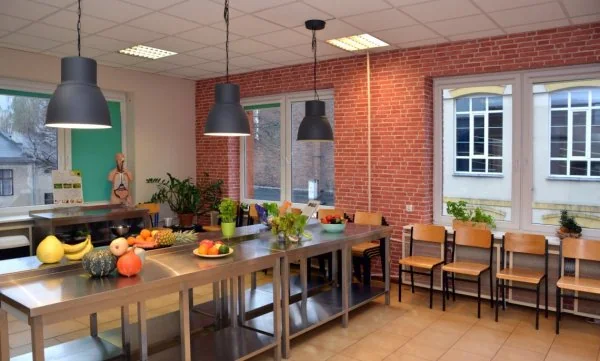
Practical classes use specialist rooms for dietetics, anthropometric measurements, food technology and chemistry. Teaching involves academic staff and practitioners from areas including dietetics, biology, chemistry, pharmacy and psychology. Students work with nutrition software such as Kcalmar and Dietico to prepare dietary plans. The programme’s described pathways allow focused study in medical dietetics, sports nutrition and psychodietetics, connecting nutritional science with different populations and forms of professional practice.
Sources: First-cycle Dietetics ↗
Cosmetology and specialist facilities
First-cycle Cosmetology is another three-year, practical-profile programme leading to the licencjat degree, available full time or part time. Its course examples include cosmetic-treatment practice, histology, cosmetic chemistry, dermatology, massage and physiotherapy foundations, aesthetics, sensory study and fragrances, makeup and styling, aromatherapy and aesthetic cosmetology. Students learn to assess skin, plan treatments and select appropriate care procedures within the programme’s scope.
The teaching-facilities directory identifies cosmetology rooms associated with KLAPP and PEEL MISSION, a PODOPHARM podology room, a HAIRMAX trichology room and a HABYS spa and massage room. Further spaces support makeup and styling, chemistry, food technology, anthropometric assessment, and qualitative analysis and research. Lecture halls and a media library accompany these specialist facilities. Their variety reflects the different forms of practical instruction required across the college’s health-related courses.
Sources: First-cycle Cosmetology ↗ · Teaching facilities ↗
Psychology and flexible study
Psychology is presented as a five-year integrated master’s programme, leading to the magister qualification. Its teaching includes development across the lifespan, personality, emotions and motivation, psychopathology, psychological assessment, crisis intervention and methods of psychological assistance. Other listed subjects address child assessment, adult mental disorders, addiction, psychosexual development and psychotherapy. The programme description combines foundational psychological knowledge with practical skills and elective opportunities.
The college offers full-time, part-time and hybrid forms for this programme. In the hybrid format, practical classes remain at the institution while theoretical teaching also uses an e-learning platform. Workshops and projects are among its stated teaching methods. This arrangement gives the programme a combination of direct practical participation and distance-supported academic work, rather than treating online delivery as a replacement for every aspect of professional preparation.
Sources: Integrated master’s Psychology ↗
Virtual reality for legal and criminological education
The specialist Virtual Reality Laboratory, opened in February 2023, is used by law and criminology students. Developed in cooperation with Asseco Data Systems, it contains two simulators: Criminalistic Procedures and a Virtual Courtroom. These allow the college to reproduce situations that would be costly, unsafe or difficult to arrange as conventional teaching exercises.
In the simulated crime setting, students can examine traces and evidence left at a scene. Courtroom work allows participants to take roles such as judge, prosecutor or defence lawyer. The laboratory therefore adds scenario-based exercises to the institution’s wider collection of practical teaching spaces. It connects procedural learning with participation and observation, complementing the theoretical study undertaken in its legal and criminological programmes.
Sources: Virtual Reality Laboratory ↗ · About WSBiNoZ ↗